Introducing RiskState — risk governance for autonomous crypto agents.
Your agent decides WHAT to trade.
RiskState tells it HOW MUCH it can risk.
→ 30+ real-time data sources
→ 5-level policy engine (BLOCK → EXPANSION)
→ Deterministic & auditable (SHA-256)
→ BTC + ETH + DeFi lending aware
→ Any LLM, any framework, any execution layer
Free beta API live → https://t.co/K2J74nXlCB
I backtested @riskstate_ai product — and published everything.
"Backtesting the Policy, Not the Signal": an exposure-matched audit of RiskState's sizing output, on 275 live policy decisions + an 8-year multi-regime reconstruction (2018–2026).
▸ 16.6% vs 40.4% max drawdown vs unmanaged exposure
▸ 3.4% vs 23.8% weekly deep-tail frequency
▸ Stored historical decisions — zero look-ahead, seeded, reproducible, CIs on everything
And the part nobody else publishes: at the 7-day horizon our dynamic sizing doesn't yet beat a constant cap — so we pre-registered the fix (realized-vol-first sizing) for score_v4, with shadow telemetry already running in production.
Risk engines that only publish wins aren't publishing research.
https://t.co/2cMKroPoZr
New in the RiskState API:
POST /v2/risk-distribution — loss quantiles, expected shortfall and P(loss > X), regime-conditioned and byte-reproducible.
Public docs synced → https://t.co/GUiSCQw5Pq
Every week you see a new "AI trading agent" repo with 500+ stars.
Signal detection, execution, backtesting — all covered.
- Position sizing when your signals conflict?
- Risk limits when volatility spikes?
- What happens to your agent when the market drops 15% in a week?
That's the layer nobody builds. And it's the one that matters most when the market turns.
https://t.co/pg1dd8G8T6
best piece i've read on agentic trading architecture this year. "if the model can see the rule, it can optimize around it" is the insight most builders miss — they put risk limits in the prompt and call it governance.
the separation between planning and constraint layer is exactly right. the model proposes, a deterministic system adjudicates. that's the only way hard constraints stay hard.
one thing i'd push further: the constraint layer itself should be dynamic. exposure caps that adapt to live volatility, macro regime, funding extremes — not just static user-set thresholds. the boundary needs to move with the market, not just hold a fixed line.
been building exactly this separation. great to see the architecture formalized.
Genuine question for anyone building AI trading agents or bots:
What determines your max position size? Is it fixed? % of portfolio? Some function of volatility?
And when the regime shifts — do you adjust automatically or manually?
Curious how people handle this in production, not in backtests.
https://t.co/pg1dd8G8T6
Great product. "set risk limits" is the right idea — but static limits set once at deploy don't adapt. what happens when volatility spikes or macro turns risk-off while your agent is running? a dynamic policy layer that adjusts limits in real-time based on live market conditions would make the arena a lot safer. Check us out!
How a risk engine reacts when its own signals disagree: it doesn't pick a winner, it cuts size.
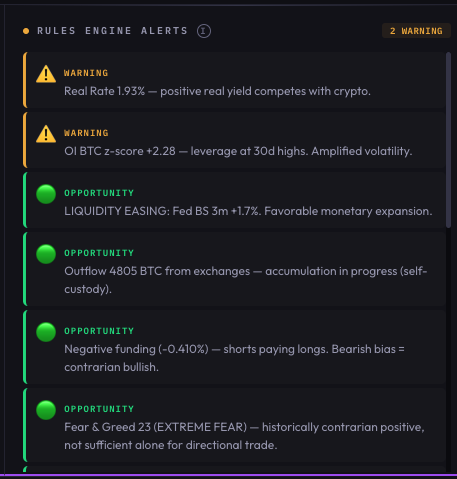
BTC and ETH both flagged DIVERGENT today — trend active, RSI overbought. Same formula, smaller exposure.
Determinism over opinion.
Most trading agents blow up the same way: they get the direction right and the size wrong.
POST-PEAK, low volatility, longs crowded. Everything looks quiet. That's exactly when over-sizing kills you — the move comes from compression, not from signal.
The model that picks trades should never set its own limits.
That's why we built a separate policy engine — deterministic, 5 levels, live market conditions.
API docs: https://t.co/pg1dd8G8T6