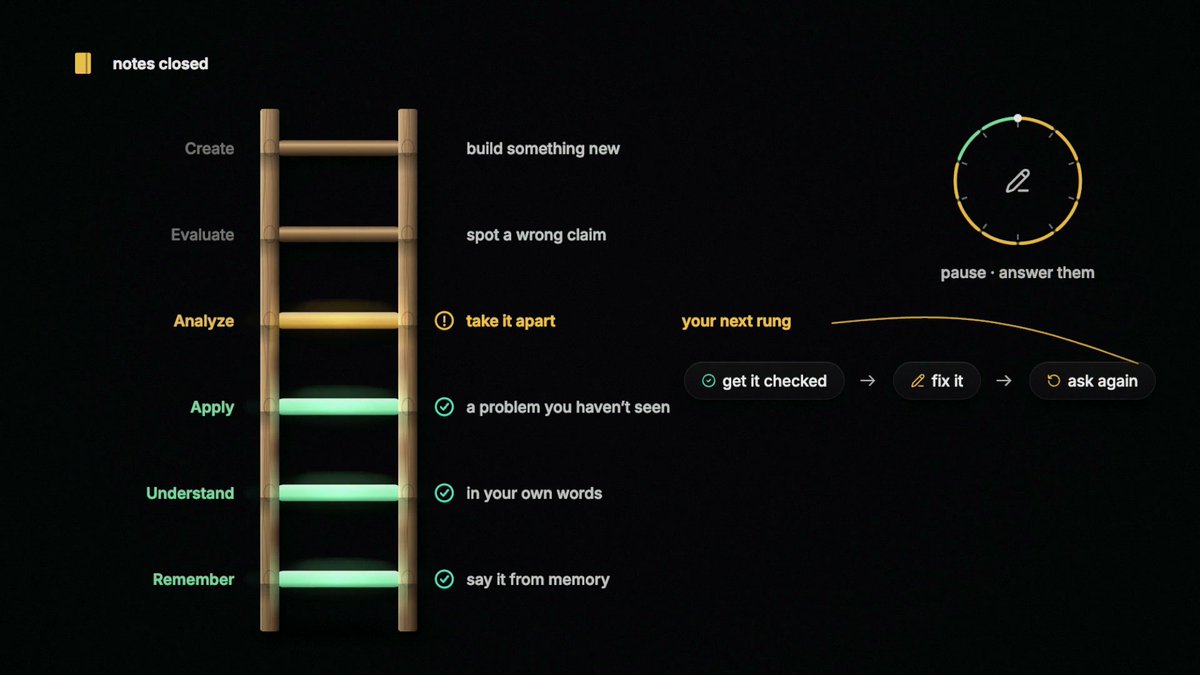
AI made getting answers instant. It didn't make learning any faster and deeper.
Introducing Ritsu: the AI tutor that trains you to deeply understand, practice, retain and apply whatever you're learning.
Watch the two-minute intro, then start learning free: https://t.co/NjyK8ZrFgH
Most study sessions can start on the defaults. When you need more, it's one window.
Getting Started with Ritsu, Ep 3: every setting in plain words, then one real Exam prep lesson. Visual made with AI.
The order on screen: write one sentence about what you want, add one source (a file, a YouTube video, a website, slides or a topic), then open Preferences only if you need something specific.
Presets are ready-made mixes. Balanced is the standard plan; Exam prep leans on what is likely to be tested, with quick checks and common mistakes.
In the demo, Exam prep + Beginner turned a biology chapter into a plan whose first lesson flags a common pitfall and ends with a self-check, answers included.
Set up your next session: https://t.co/9ojYam0HeY
If you only had 20 minutes a day to study, what would you cut first: rereading, taking notes, or watching lectures? And what would you refuse to sacrifice, even during your busiest week?
You have 20 minutes on the train, 15 at lunch, and 10 before bed. But you keep waiting for three uninterrupted hours to study. Learning science suggests a better approach. Here’s the 10–20–45 Method for busy learners ↓
Made with AI. https://t.co/tWd8IhIbbf
Have 10 minutes? Upload your own study material to Ritsu, answer questions before seeing explanations, and revisit what you learned through spaced retrieval. Spend your study window learning, not preparing to learn. https://t.co/wDBUWX8ZZA
If you read 50 books this year but can only explain the ideas from five, how many did you actually learn from? Should we measure reading by books finished or ideas we can use?
A book you never retrieve is a book you rented. If you remember the cover, a few quotes, and almost nothing else, try the Closed-Book Method: a science-backed system for making what you read part of how you think ↓
Made with AI. https://t.co/PLU36t0coJ
Try the Closed-Book Method with your own reading. Ritsu turns your PDFs, chapters, and articles into questions you answer before seeing explanations, then brings key ideas back through question-based spaced review: https://t.co/b67ZmK9Vdr
Fifteen episodes of Getting Started with Ritsu, in six habits.
Ep 15, the finale: start right, answer first, practice your weakest idea, review on time. Next, a new series on Ritsu's learning tools. Visual made with AI.
Start with one source and one sentence about what you want, in the language you think in. Then read your plan: every page chip opens the page it came from.
Answer first. Every answer is evidence, and that's what moves your Knowledge Map, not the time you spend. Then practice your weakest idea.
Add the session to Review once and come back when it's due. Keep each course in one Learning Project, and watch your XP, rank and certificate grow.
Start one active learning session today: https://t.co/PPT7eEmi9B
If someone has a 400-day language streak but can't hold a basic conversation, has the app failed them—or have they confused completing lessons with learning a language? Where should we draw the line?
You have a 400-day language streak. A native speaker asks you one simple question. You freeze. What went wrong? Here's a 5-stage plan for turning the words you recognize into a language you can actually speak ↓
Made with AI. https://t.co/GufDqUHsd7
Try this with your next language lesson: close the material, answer questions from memory, then correct your mistakes. Ritsu helps you practice this loop using your own vocabulary lists, grammar notes, and transcripts. https://t.co/2fsLWf2ikb
If someone can explain a concept perfectly but can’t apply it to an unfamiliar problem, do they really understand it?
Where would you draw the line between knowing something and understanding it?
You understand every word. You’ve read the paragraph five times. So why does the concept still make no sense?
There are 3 reasons you get stuck — and a 4-layer method to fix them. Here’s how to understand difficult ideas ↓
Made with AI. https://t.co/bkPXZg9Rdb
Parts → Picture → Explain → Prove.
Put the method into practice with Ritsu: turn your own notes, PDFs, and slides into questions, attempt answers, and use targeted feedback to repair gaps in your understanding.
https://t.co/czMcogMYPE
The five questions, from the film: what must I be able to do at the end, which words keep coming back, what has to come before what, how do I know I have it, which branch is next. Germain kept checking, and her third entry won in 1816. Ritsu's Feynman Mindmap draws the tree from your own syllabus, with a check under every branch.
https://t.co/jdm2Vqxwap
Sophie Germain taught herself university math from the notes of a school that barred women.
In 1811 she alone entered the Academy's prize. She lost: nobody had checked her work.
Teach yourself any subject without that hole, in five questions: link in the first comment ↓
The catch: you can't ask the question you can't see. Give the Bloom Test in Ritsu your chapter. It asks about it at every level, then shows where your understanding breaks and what to study next. It's built on a tutor's moves, not a tutor's results.
https://t.co/WMhzFJ9k9N
The average tutored kid beat 98% of a normal class. Benjamin Bloom published it in 1984 and called it a problem: too costly at scale.
With no tutor, just a quiz per unit and help fixing mistakes, the average kid beat 84%.
Then ask one level higher. The catch and the link below.
Ritsu has about forty learning commands. The ones that grade your answers are the ones that count.
Getting Started with Ritsu, Ep 14: the four groups, what moves your Knowledge Map, and where to start. Visual made with AI.
Four groups: Learning (explain, compare, why, how), Assessment (quizzes, flashcards, questions), Visualize (mind maps, diagrams) and Controls (next, back, progress, help).
On their own, Learning commands stop at Familiar. Turn on a check question and your answer counts too.
Not sure what a command does? Highlight it and press the right arrow to read its documentation.
Open the slash menu and try /quiz or /askme: https://t.co/rRd74BQsbs
If you can follow every step of a math solution but can't solve a similar problem alone, did you really understand it?
Where should we draw the line between recognizing mathematical reasoning and actually understanding it?
You understood every step of your professor's solution. Then you went home and couldn't write the first line.
That doesn't mean you're bad at math. It means you may have been practicing the wrong skill.
Here's how to teach yourself math ↓
Made with AI. https://t.co/CFQV2e16Re