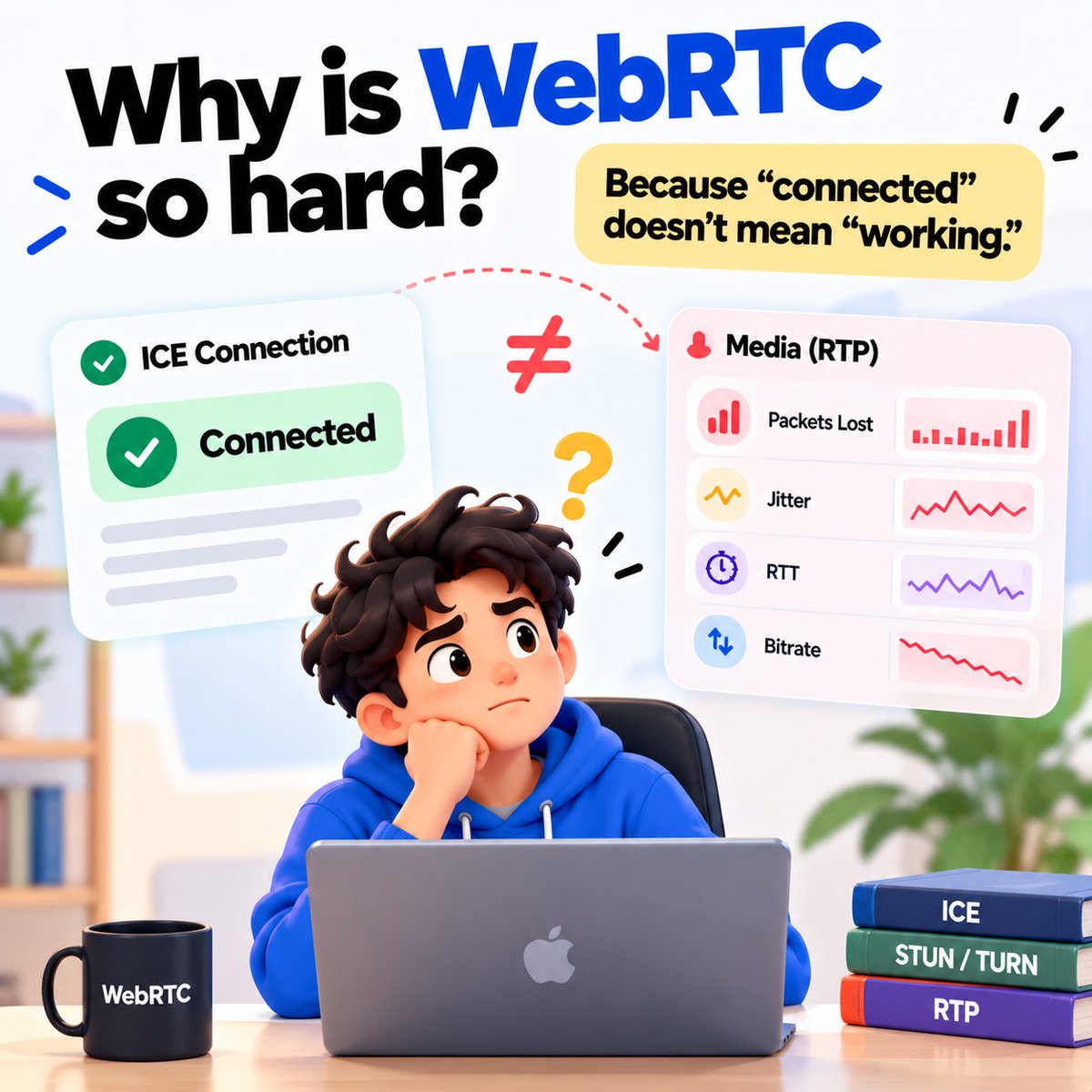
Can WebRTC predict congestion before packet loss happens?
RTT variance + jitter trend + TWCC timing + bitrate slope might reveal degradation early.
Reactive adaptation is common. What if WebRTC became predictive?
#WebRTC#RTP#Networking
One camera. Three video streams.
WebRTC simulcast lets an SFU send different quality layers to each viewer based on bandwidth.
Same source. Different quality.
Read the full breakdown:
https://t.co/3Jrk1QTPa3
Why does WebRTC feel unpredictable?
Because the network is part of your application.
Latency changes.
Packets disappear.
Bandwidth moves.
Routes switch.
Your code must adapt in real time.
What’s the hardest WebRTC issue you’ve debugged?
#WebRTC
WebRTC simulcast sends multiple quality layers of the same video.
Low → Medium → High bitrate.
An SFU selects which layer each viewer receives based on bandwidth and device constraints.
One publisher. Different network conditions.
#WebRTC#SFU#RealTimeCommunication
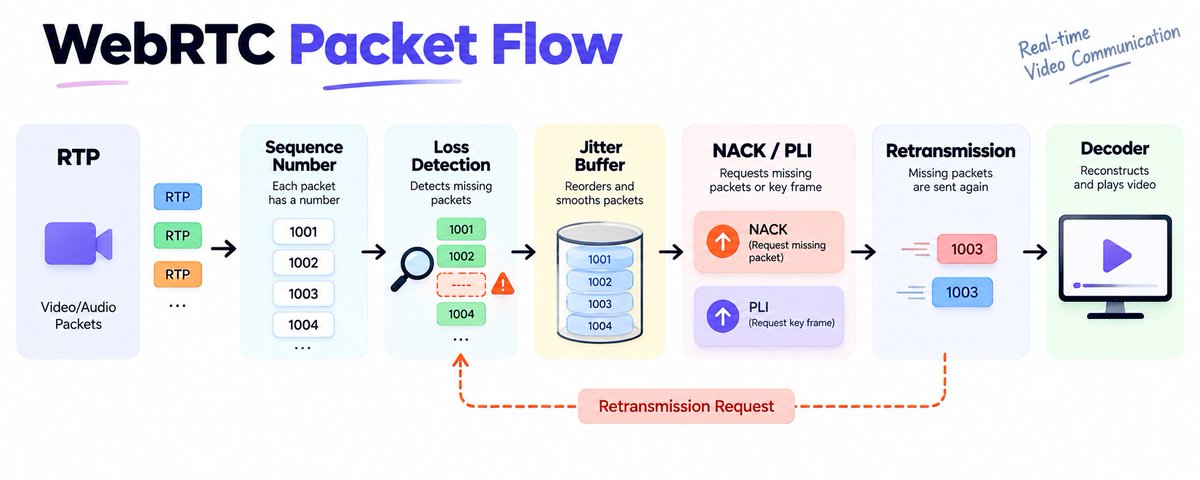
WebRTC packet flow:
RTP → sequence number → loss detection → jitter buffer → NACK/PLI → retransmission → decoder.
The hard part isn’t sending video. It’s recovering gracefully when the network fails.
#WebRTC#RTP#SoftwareEngineering
Your WebRTC DataChannel shows as open but data still won’t send.
What do you check first: readyState, bufferedAmount, or the ICE connection?
Reply with your debugging order.
AI course generation is a pipeline:
Input → chunking → embeddings → vector search → LLM → structured lessons → quizzes → validation → publishing.
The model generates the content.
The architecture determines whether learners can trust it.
#AI#EdTech#LLM
Your camera doesn’t send a video.
It sends frames → encoding → packetization → RTP packets.
Then the network carries packets, not “video.”
Want to understand what happens next?
https://t.co/GKSH6bf79i
Your production video streaming service took months to build.
One leaked session and the whole content is gone.
What actually stops users from downloading or resharing protected streams right now?
A login can protect access.
It cannot protect the video.
For paid education, authentication ≠ content protection.
Rittly uses DRM + watermarking to protect the media itself.
Build. Sell. Protect.
#EdTech#DRM#OnlineCourses
Login protects access. DRM protects the media itself. For paid video, that distinction matters: authenticated users can still attempt to copy or redistribute content. #DRM#EdTech
A course platform isn’t just a video player.
Behind one lesson: video delivery, access control, payments, analytics, progress tracking and content protection.
The interesting engineering problem is making all of it feel simple to the learner. What layer would you optimize first?
A message queue creates that buffer: producers send tasks to the queue, and consumers process them when capacity is available. This separates task creation from task processing and gives workers room to scale independently
10,000 tasks hit your app at once. Do you let one server handle everything?
Queues absorb traffic spikes, protect backend workers, and process jobs at a controlled rate. That’s a core pattern in scalable cloud systems. How would you handle it? #CloudComputing#Backend
https://t.co/DHHq9VBF0F
Your app can produce data faster than the network can deliver it. What happens next? It gets buffered. bufferedAmount lets you see how much data is waiting inside the browser. #WebRTC#Networking
https://t.co/DHHq9VBF0F
A WebRTC connection can exist and still not be ready to send data. That tiny distinction matters. The DataChannel moves from connecting to open before your application can safely use it. #WebRTC
https://t.co/DHHq9VBF0F
Finding a WebRTC path doesn’t mean you’re done. You’ve only built the road. The next question is: what can actually travel across it? That’s where RTCDataChannel enters the story. #WebRTC#Networking