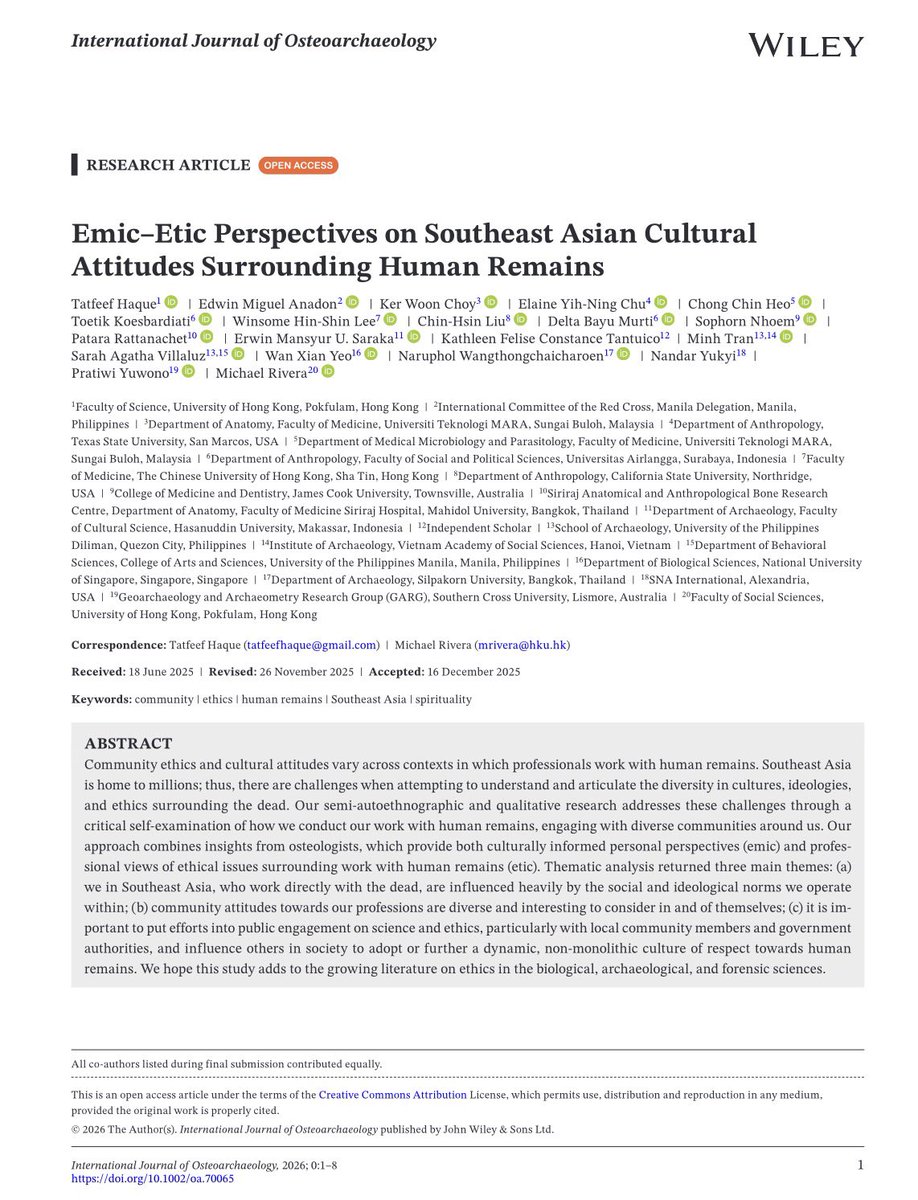
New paper by our all-Asian team on community attitudes towards human remains - now in Early View and Open Access! 📑
Our semi-autoethnographic, qualitative research highlights diversity in cultures, ideologies and practices across Southeast Asia. 🌏
https://t.co/oryKR69DNT
💬 “We do not have yet much discussion just among ourselves as Southeast Asians for fine-tuning our practice in ways that benefit us all scientifically and morally. We instead face foreigners taking over the ethical discussion, writing papers on ethics on our behalf, and…”
New paper by our all-Asian team on community attitudes towards human remains - now in Early View and Open Access! 📑
Our semi-autoethnographic, qualitative research highlights diversity in cultures, ideologies and practices across Southeast Asia. 🌏
https://t.co/oryKR69DNT
💬 “… effectively ignoring local communities' and biologists' views. This produces a paucity of understanding about what local communities are concerned about when we work with human remains.”
When am I going to see more East and Southeast Asians receiving grants and PhD offers to study the prehistories and histories of their own regions? 🌏
Or #archaeology and biological #anthropology papers sole-authored / first-authored / last-authored by people like us? 🤷🏻♂️
New paper by our all-Asian team on community attitudes towards human remains - now in Early View and Open Access! 📑
Our semi-autoethnographic, qualitative research highlights diversity in cultures, ideologies and practices across Southeast Asia. 🌏
https://t.co/oryKR69DNT
Never imagined one day, there would be a chance to publish on Asian perspectives in the Int. J. of Osteoarch. 🙇🏻♂️
I thought for almost 15 years we would never be taken seriously if we had ethical opinions… 💀 #iykyk
Take a look at some of the articles in our special issue @ArchaeometryJnl that aim to explore how stone tools can directly address some of the grand challenges in anthropological archaeology:
https://t.co/4Ja5LRbnkP
https://t.co/iXEN1PwTeO
https://t.co/QbTcPqyyX3
The objective of this #Special_Issue is to highlight the efforts made by #anthropologists and other social scientists to integrate the theoretical framework and methods of #systems_thinking into their research. Check out all the papers here:
https://t.co/EqAggpJytg
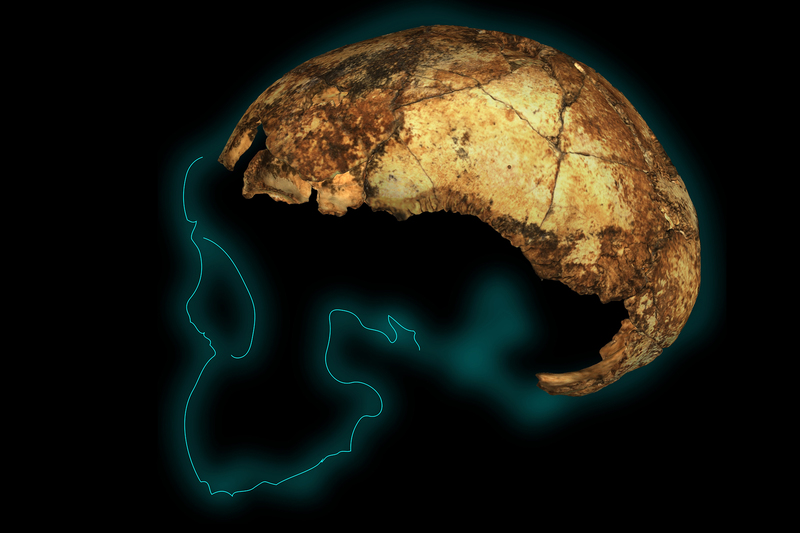
Imagine rebuilding history - one fossil fragment at a time.
This is the earliest known #HomoErectus skull, reconstructed from over 150 pieces at the Cradle of Humankind in #SouthAfrica.
Read more: https://t.co/nuAFOSTMhk
Finding someone willing to share their course design in such meticulous detail—from intended learning outcomes to teaching and learning activities that foster student engagement—isn't an easy task. Thank you, Dr. Michael Rivera, for doing exactly that in the workshop you led.🙌
So glad this is finally out. Have a read of the revised text (take your time, it is long!) and the reviews. This is a massive work by a large team of amazing scholars. Hominin evolution is a complex tangle offering a special window into what it means to be human (and hominin).
This research underscores the power of food preferences and social systems of distinction in making and breaking #economies. In the case of British Honduras, #food_racialization was the linchpin connecting agency, meaning, and food insecurity.
📖 https://t.co/39x8zd5Rlp
1/6 Our new paper “Threatened synanthropes depend on intact forests: a critical evaluation of Moore et al. (2023)” in Biological Reviews makes the case that accurate interpretations/representations of data are critical for species in anthropogenic landscapes. A 🧵
Unfortunately, the association is facing serious financial challenges. Membership fees alone are no longer sufficient to cover basic operational costs. Please follow/share the following link for donating: https://t.co/EPwpu3jRLf (5/5)