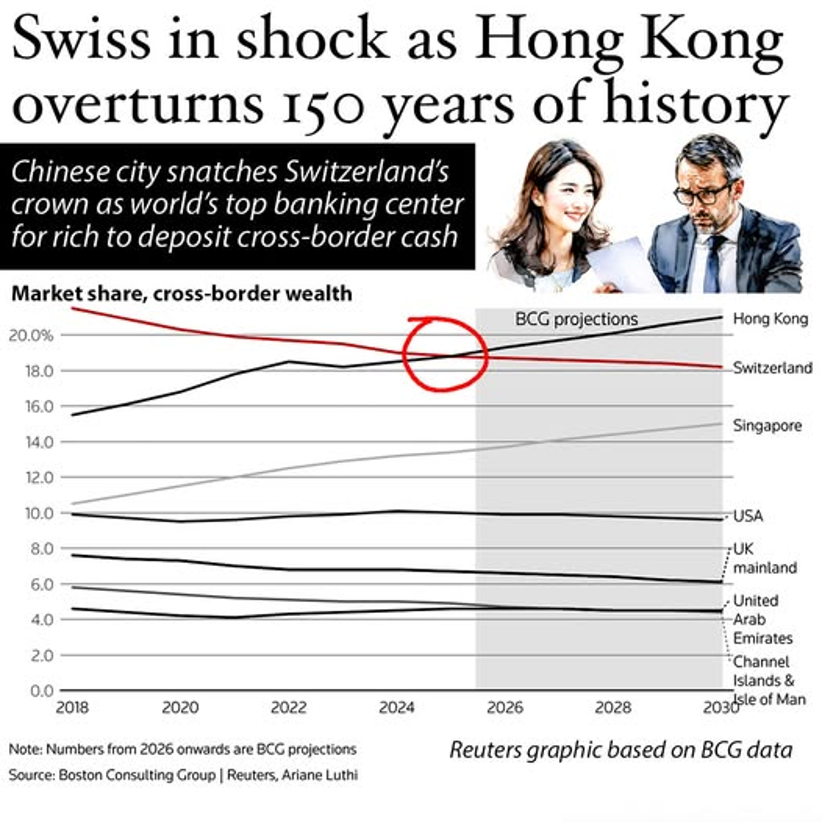
BREAKING NEWS: Hong Kong has overtaken Switzerland to become the world's favorite banking hub for the rich, it was revealed last night.
The Swiss have been the world's top cash deposit center for 150 years--but no more.
The Chinese city took US$2.95 trillion of international assets in 2025, slightly ahead of Switzerland's US$2.94 trillion—but the signs show that Hong Kong's lead is set to widen.
The data comes from a study of cross-border cash, released yesterday by the Boston Consulting Group.
Hong Kong's new role as number one global wealth hub will widen to place it almost US$600 billion ahead of Switzerland in less than four years.
EAST ASIA IS GETTING RICHER
" This is a completely new phenomenon. I haven't seen anything like it, " Swiss money-manager Michael Pellman Rowland told the Financial Times.
About 60 per cent of the cash entering Hong Kong comes from China's role as a successful factory of the world, and from Chinese companies raising funding offshore.
HEDGING THEIR BETS
Another stream comes from around the planet, " with clients seeking to spread their assets across multiple jurisdictions to hedge against geopolitical tensions, sanctions risks and political instability", the Financial Times said.
Rich people everywhere are spreading their cash to hedge their bets. US-led western expansionism means there are conflicts in West Asia (Iran, Lebanon, Israel, the Gulf states), in Europe (Ukraine), and in Central/ South America (Venezuela, Cuba).
SMALLER RIVALS
Hong Kong's smaller rival as a destination for safe-haven cash is Singapore.
But the city-state has " seen growth moderate after high-profile money laundering cases triggered a regulatory crackdown and tougher scrutiny of wealthy foreign clients ", the Financial Times said.
Dubai has also been growing as a wealth deposit center, but lags far behind – it was US$721 billion last year, a quarter of Hong Kong's total.
And that was before its role in the disastrous US-Israel attack on Iran.
BAD NEWS FOR THE WORLD
This is good news for China, but there's also bad news in the report.
It says that an increasing proportion of the world's cash is going to the ten main "booking centers" across the world for international deposits.
In other words, the rich are getting richer. The era of unbridled capitalism is not making the world a fairer place.
Source: Friday news project
🇺🇸🇨🇳 Senator Rick Scott says a hes ok with destroying the global energy market as long as it cripples China’s economy:
“I think blocking the Strait of Hormuz is fine from my standpoint If no oil ever goes to China again, and their economy is destroyed, that would be a really wonderful day for me.”
🚨GOOGLE JUST SILENTLY DOWNLOADED A 4GB AI MODEL TO YOUR COMPUTER WITHOUT ASKING.. WITHOUT TELLING YOU.. AND WITHOUT ANY WAY TO STOP IT..
If you use Chrome.. There's a good chance a 4 gigabyte file is sitting on your hard drive right now that you never agreed to download..
It's called Gemini Nano.. Google's on-device AI model.. A security researcher just proved it installs itself with zero clicks.. Zero prompts.. Zero notifications..
Alexander Hanff set up a completely fresh Chrome profile.. Didn't click anything.. Didn't scroll.. Didn't type a single keystroke.. Just opened the browser and watched..
14 minutes and 28 seconds later.. Chrome had silently scanned his hardware.. Read his GPU, RAM, and storage.. Then wrote a 4GB file to his hard drive.. No permission dialog.. Nothing..
Chrome's own logs show the download begins BEFORE the settings page where you could opt out is even loaded.. The file starts installing before the refusal button exists..
As of Chrome 148.. Any website you visit can trigger this download.. One line of JavaScript.. You click a link to read a blog post.. That click counts as "user activation".. And Chrome silently pulls 4GB in the background..
No install prompt.. No consent dialog.. Google's own docs admit this..
Your laptop overheats.. Storage disappears.. Battery drains.. And you have no idea why..
The model doesn't even work well.. Cloud requests take 1.3 seconds.. The local model at worst case takes over 9 minutes for a single response..
Google is using your storage, electricity, and bandwidth to run an AI that's 40 times slower than their own servers..
And the "AI Mode" button in Chrome's address bar.. Doesn't even use the local model.. It sends everything to Google's cloud anyway..
You pay the storage penalty.. The heat penalty.. The bandwidth penalty.. And the visible AI feature ignores the local file entirely..
Because Chrome fails to clean up old versions.. Users are finding 12GB or more of duplicate AI files stacked on their drives..
Palo Alto Networks found a vulnerability where a browser extension could hijack the local AI model's permissions.. Accessing your webcam.. Microphone.. Local files.. Through an AI you never installed..
Here's how to check if it's on your machine..
Windows.. C:\Users\[YourName]\AppData\Local\Google\Chrome\User Data\Default\OptGuideOnDeviceModel\
Mac.. ~/Library/Application Support/Google/Chrome/Default/OptGuideOnDeviceModel/
If there's a file called weights.bin.. Google downloaded their AI to your computer without asking..
To stop it.. Type chrome://flags.. Search "optimization-guide-on-device-model" and disable it.. Search "prompt-api-for-gemini-nano" and disable that too.. Restart Chrome.. Then manually delete the folder..
If you don't disable the flags first.. Chrome redownloads the 4GB file on next launch..
Firefox requires explicit opt-in for AI.. Apple Intelligence requires explicit consent.. Chrome just takes your hard drive..
Google didn't ask to use your storage.. Your electricity.. Your bandwidth..
They just took it.
We’re saying goodbye to the Sora app. To everyone who created with Sora, shared it, and built community around it: thank you. What you made with Sora mattered, and we know this news is disappointing.
We’ll share more soon, including timelines for the app and API and details on preserving your work. – The Sora Team
PYTHON is difficult to learn, but not anymore!
Introducing "The Ultimate Python ebook "PDF.
You will get:
• 74+ pages cheatsheet
• Save 100+ hours on research
And for 24 hrs, it's 100% FREE!
To get it, just:
• Like & RT
• Reply "Cheatsheet"
• Follow @RodmanAi (so that I can DM)
Do you understand how significant this is?
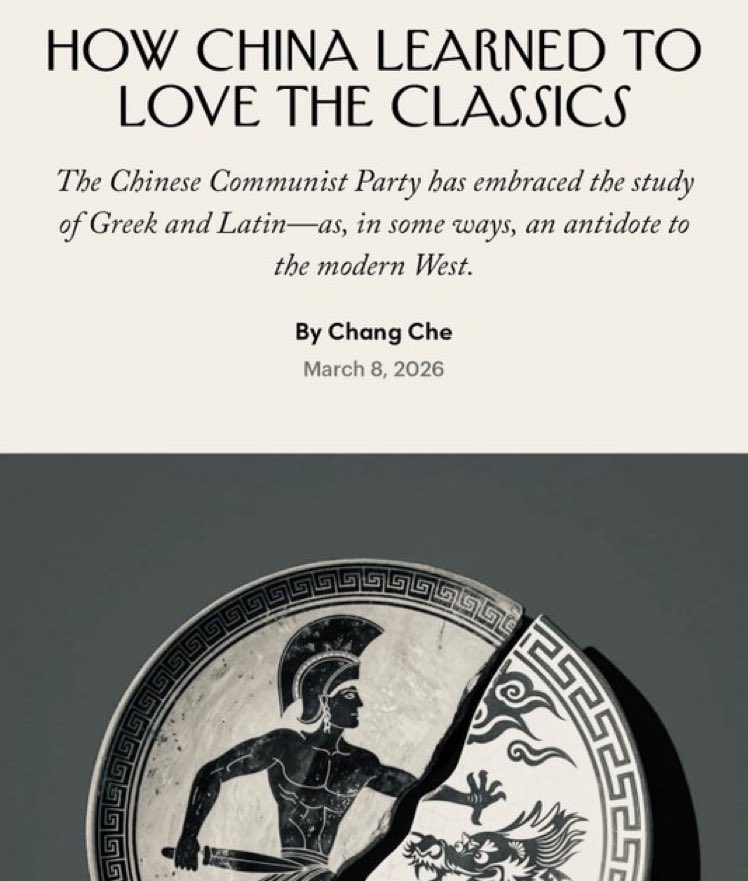
The Chinese government realized the stories that made the West has given the West a massive civilizational advantage.
But since the postmodern West largely abandoned those stories, the Chinese see an opportunity.
If they could build upon the wisdom of those stories while we deconstruct them, they believe they can gain a civilizational advantage.
The West keeps asking whether China is capitalist or communist—
state-controlled or market-driven.
These questions are reductive. They misunderstand the system.
China runs on state-structured competition. It’s a hybrid.
Local governments compete for growth.
Companies compete for scale and efficiency.
Industrial ecosystems move at lightning speed.
That dynamic helped drive 40 years of industrial acceleration.
The mistake many analysts make is trying to force China into a binary Western framework—more like linear chess.
But China’s system is hybrid and competitive by design.
Closer to organic Go (围棋, wéiqí).
China isn’t best understood through an ideological lens.
If you’re not familiar with Jin Keyu or her new book The New China Playbook, it’s well worth reading. She’s one of the rare commentators who approaches China with balance and data rather than ideology.
Original post by Calvin Wee on LinkedIn:
“I just finished Jin Keyu's The New China Playbook and it might be the most important book on China's economy I've read.
Not because it tells you China is great or terrible — but because it finally explains how the system actually works, with data instead of ideology.
A few things that stuck with me:
→ China's economy is neither capitalist nor communist. It's a unique hybrid where local mayors compete like startup founders — and it's been the engine behind 40 years of growth.
→ The one-child generation — shaped by 4 grandparents and 2 parents pouring everything into 1 child — is the most intensely resourced cohort in history. And despite unprecedented Western exposure, they feel more Chinese, not less.
→ The "China just copies" narrative is dead. It's now Malaysian, Indian, and Philippine firms copying Chinese business models.
For those of us building across the ASEAN-China corridor, this isn't academic. It's operational.
The next generation of leaders in Southeast Asia will negotiate, invest, and compete alongside Chinese counterparts as a matter of course.
And most of our education systems are still preparing them for a world that no longer exists. The Young SEAkers changes that”
#China #ASEAN #Leadership #Geopolitics #NextGeneration #ASEANChina
https://t.co/Oz3oyRJI8u
This is a remarkable own goal from the Western propaganda apparatus.
Some mass media outlets thought they held another great anti-China story, and it turns out it revealed the scope of the mass surveillance system in the West, which media usually accuse #China of implementing on its own population.
The story is about a so-called "Chinese law enforcement official" who got busted by OpenAI's ChatGPT for using the app for "planning and record-keeping space" in a "vast influence operation targeting foreign adversaries and dissidents worldwide".
"The individual used ChatGPT to edit and update reports on “cyber special operations,” accidentally revealing the sweeping cyber campaign against foreign enemies and domestic threats."
The problem is that this story also reveals something else, far more ominous, not about the "Chinese law enforcement individual" himself, but about ChatGPT, which admits that it was closely monitoring this person's "personal diary", and decided to conduct itself law enforcement by "banning the account after identifying suspicious activity".
This reveals the mass surveillance system of ChatGPT on all its users, its power to decide what is unlawful activity, to conduct itself "open-source research to identify online activities that lined up with the user’s descriptions", and finally to decide to ban the account. All of this outside of the judiciary system.
The articles even says "you should never trust an AI chatbot with your deepest, darkest secrets", admitting that they are monitored and can be used against you.
As I first said in my book "Comprendre la relation Chine-Occident" (2022), the West is rolling out on its own unsuspecting brainwashed population the very tools that it accuses China of using on the Chinese people.
So far, DeepSeek, Kimi, Qwen, Doubao and all the other vastly superior AI solutions used in China have not been accused of conducting mass surveillance on Chinese citizens like Western media and OpenAI themselves have admitted that OpenAI does and on mass scale, and on a daily basis.
This story has not gained much traction outside of CNN, which seems to indicate that some people have realised it says more about the state of freedom in the West than it does about China's.
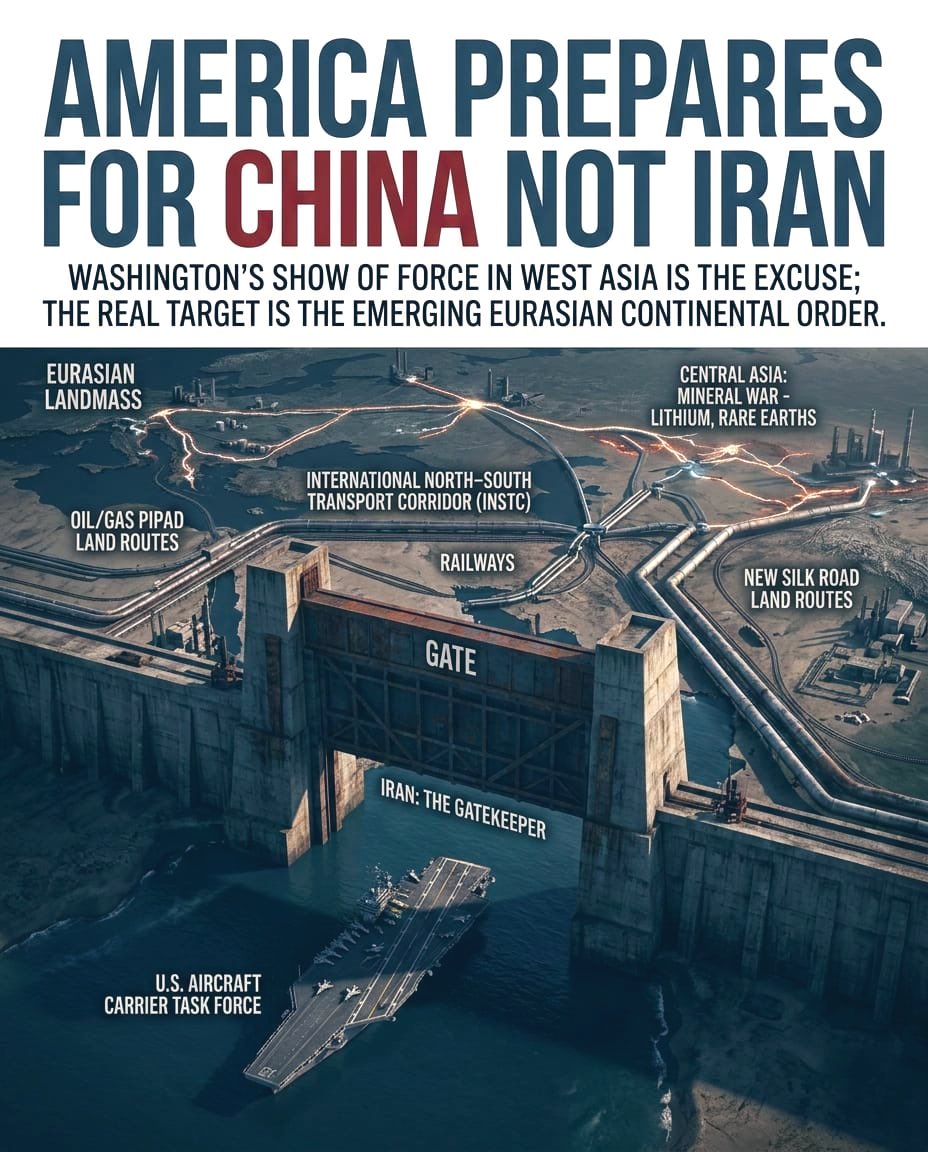
𝗔𝗠𝗘𝗥𝗜𝗖𝗔 𝗜𝗦 𝗣𝗥𝗘𝗣𝗔𝗥𝗜𝗡𝗚 𝗙𝗢𝗥 𝗖𝗛𝗜𝗡𝗔, 𝗡𝗢𝗧 𝗜𝗥𝗔𝗡
It is becoming increasingly clear that the United States is restructuring its global military posture not primarily for Iran, but for a long-term strategic confrontation with China.
Iran is the justification.
China is the calculation.
Washington has done this before. After 9/11, the “War on Terror” enabled a vast redeployment that entrenched U.S. power deep inside West Asia, not just to fight terrorism, but to sit astride the world’s energy arteries, mineral basins, and continental crossroads.
Today, a similar repositioning is underway under the banner of deterrence against Tehran.
But great powers do not reorganize global force posture for secondary threats.
You cannot contain a peer competitor from thousands of miles away.
You cannot shape the balance of Eurasia while anchored in Europe alone. Strategic gravity lies further east, where trade routes, pipelines, resource basins, and land corridors determine the flow of power.
For more than a century, American primacy has rested on command of the seas: controlling chokepoints, shipping lanes, and maritime trade.
China’s grand strategy aims to neutralize that advantage by activating the continental mass of Eurasia.
Railways, pipelines, and overland corridors cannot be blockaded by aircraft carriers.
If Beijing succeeds in building fast, secure, and inexpensive continental routes, modern Silk Roads, the strategic value of U.S. naval dominance declines sharply.
Sea power matters less when the world’s commerce, energy, and supply chains move by land.
This is why Central Asia and its surrounding zones are pivotal.
The region is not only a transit hub, it is a vast reservoir of critical minerals essential for advanced technologies: rare earths, strategic metals, and energy inputs required for semiconductors, batteries, aerospace systems, and next-generation weapons.
Control over these resources means control over the industrial foundations of future power.
Denying them to rivals is as important as securing them.
Equally decisive is the emerging north–south axis centered on Iran.
Overland routes running through Iran allow Russia to access the Persian Gulf directly, faster, cheaper, and beyond vulnerable maritime chokepoints.
This corridor compresses distance between northern Eurasia and warm-water ports, reshaping trade geography.
If China integrates into this network by land, a continuous Eurasian system emerges linking East Asia, Central Asia, Russia, and the Gulf.
In that scenario, American sea control becomes strategically insufficient.
The United States would face a continental bloc able to trade, transport energy, and move goods across Eurasia without reliance on maritime routes dominated by the U.S. Navy.
Control of West Asia therefore achieves multiple objectives simultaneously:
- Secures critical mineral basins and energy reserves
- Dominates key transit chokepoints• Blocks east–west continental integration
- Disrupts north–south connectivity linking Russia to the Gulf
- Positions forces at the intersection of three continents
- Prevents the formation of a self-sufficient Eurasian economic sphere
In this framework, Iran is not the endgame, it is the gate.
What appears as regional crisis management is in reality great-power positioning.
The struggle is not about one country, one conflict, or one nuclear program.
It is about whether the 21st century will be shaped by maritime empires or continental powers.
If China succeeds in activating the land while Russia gains southern access through Iran, a vast integrated Eurasian system could emerge, one largely insulated from maritime pressure.
America would still command the oceans, but no longer the world system.
The battles in West Asia are not the main war.
They are the deployment phase for the one that matters.
My article for Foreign Affairs, entitled, "The Dream Palace of the West", addresses the West's continued inability to accommodate a rising Asia (and the Global South). Aptly, it was published just as the Lunar New Year of the Horse began. Do read: https://t.co/pu0T5tJY1T
I've been wanting to write this for a while: an article on the key characteristics of the Chinese health system, as a patient.
It's something that I - perhaps unfortunately - have come to have a lot of experience with in my eight years in China.
I've been to the doctor as a patient dozens of times. My wife delivered our first daughter in a Chinese hospital, and had cancer surgery in Shanghai. My younger daughter - who once completely severed her thumb in an unfortunate accident in rural Gansu - had emergency surgery in a small clinic there (her thumb is fine now!). We spent the entire covid episode in China. And, to this day, I still go back to China every year to do my routine health tests or the occasional procedure (like a thyroid biopsy in Harbin last year).
In other words, when it comes to the Chinese health system, I've seen a lot.
What's fascinating about the Chinese health system, and that's true in general about many things in China, is that it never inherited Western dogma about how things were supposed to work, it's completely unconstrained by what everyone else has decided is "normal".
And, as a result, you end up with things that would simply sound impossible to any Western patient: a consultation with the head cardiologist of one of Shanghai's best hospitals for less than $10, blood test results in under 30 minutes, and a system where you can walk in, see three specialists and walk out with a diagnosis and your medicine - all before noon.
As I argue in the article that's all enabled by 3 characteristics that sound super unorthodox:
1) extremely short consultation times, less than 5 minutes
2) no GP gatekeepers (you go straight to see specialists)
3) systematic testing for every patient, even if you just have a cold
Each one sounds wrong. And in fact when I describe them to doctor friends in the West they immediately explain to me why that can't possibly work, and how their own system is far superior.
Except that it does work, I checked the numbers (on top of my personal experience): the Chinese system handles close to 10 billion total outpatient visits a year (https://t.co/b1xd45O73F), or about 7 visits per person per year on average, and the average wait time is only about 18 minutes (https://t.co/S3At5DtbJP).
Contrast this with France, my country, where people already go to the doctor A LOT, but still less than in China: only 5.5 visits per person per year (https://t.co/sk1kQt59tK). And the French system can't even handle this lower volume: when you can see a specialist straight away in China - you don't even need to make an appointment in advance - you need to wait months to see one in France (50 days on average for a cardiologist, for instance: https://t.co/ZKZmhzoFFO).
I've personally managed to see 3 specialists AND do all related tests AND get the test results AND get diagnoses AND buy the medicine to cure me - all in the space of a morning at a hospital in Shanghai. That would have undoubtedly taken me a whole year in the French system.
My purpose here is not to argue that the West should replicate the Chinese health system wholesale, but to ask an honest question: what if some of the things we take for granted about healthcare aren't nearly as inevitable as we think? Is it completely unthinkable that we've developed some dogmas that are costing us - in money, in time, and occasionally in lives?
That's the whole point of my article: describing a health system built from first principles by people who never assumed we in the West knew better - up to you to decide if they have a point.
Enjoy the read here: https://t.co/cNXNmo195l
Former Japanese Prime Minister Shigeru Ishiba said that the ruling Liberal Democratic Party's (LDP) landslide victory in Japan's House of Representatives election does not amount to a "blank check" for the government to act without restraint, stressing that electoral success should not be interpreted as permission to "do whatever it wants," according to a report by Fuji News on Monday local time.
https://t.co/ruABL89N8M


![EvanLuthra's tweet photo. 🚨GOOGLE JUST SILENTLY DOWNLOADED A 4GB AI MODEL TO YOUR COMPUTER WITHOUT ASKING.. WITHOUT TELLING YOU.. AND WITHOUT ANY WAY TO STOP IT..
If you use Chrome.. There's a good chance a 4 gigabyte file is sitting on your hard drive right now that you never agreed to download..
It's called Gemini Nano.. Google's on-device AI model.. A security researcher just proved it installs itself with zero clicks.. Zero prompts.. Zero notifications..
Alexander Hanff set up a completely fresh Chrome profile.. Didn't click anything.. Didn't scroll.. Didn't type a single keystroke.. Just opened the browser and watched..
14 minutes and 28 seconds later.. Chrome had silently scanned his hardware.. Read his GPU, RAM, and storage.. Then wrote a 4GB file to his hard drive.. No permission dialog.. Nothing..
Chrome's own logs show the download begins BEFORE the settings page where you could opt out is even loaded.. The file starts installing before the refusal button exists..
As of Chrome 148.. Any website you visit can trigger this download.. One line of JavaScript.. You click a link to read a blog post.. That click counts as "user activation".. And Chrome silently pulls 4GB in the background..
No install prompt.. No consent dialog.. Google's own docs admit this..
Your laptop overheats.. Storage disappears.. Battery drains.. And you have no idea why..
The model doesn't even work well.. Cloud requests take 1.3 seconds.. The local model at worst case takes over 9 minutes for a single response..
Google is using your storage, electricity, and bandwidth to run an AI that's 40 times slower than their own servers..
And the "AI Mode" button in Chrome's address bar.. Doesn't even use the local model.. It sends everything to Google's cloud anyway..
You pay the storage penalty.. The heat penalty.. The bandwidth penalty.. And the visible AI feature ignores the local file entirely..
Because Chrome fails to clean up old versions.. Users are finding 12GB or more of duplicate AI files stacked on their drives..
Palo Alto Networks found a vulnerability where a browser extension could hijack the local AI model's permissions.. Accessing your webcam.. Microphone.. Local files.. Through an AI you never installed..
Here's how to check if it's on your machine..
Windows.. C:\Users\[YourName]\AppData\Local\Google\Chrome\User Data\Default\OptGuideOnDeviceModel\
Mac.. ~/Library/Application Support/Google/Chrome/Default/OptGuideOnDeviceModel/
If there's a file called weights.bin.. Google downloaded their AI to your computer without asking..
To stop it.. Type chrome://flags.. Search "optimization-guide-on-device-model" and disable it.. Search "prompt-api-for-gemini-nano" and disable that too.. Restart Chrome.. Then manually delete the folder..
If you don't disable the flags first.. Chrome redownloads the 4GB file on next launch..
Firefox requires explicit opt-in for AI.. Apple Intelligence requires explicit consent.. Chrome just takes your hard drive..
Google didn't ask to use your storage.. Your electricity.. Your bandwidth..
They just took it.](https://pbs.twimg.com/media/HHllpnRbUAA7IOT.jpg)





![EvanLuthra's tweet photo. 🚨GOOGLE JUST SILENTLY DOWNLOADED A 4GB AI MODEL TO YOUR COMPUTER WITHOUT ASKING.. WITHOUT TELLING YOU.. AND WITHOUT ANY WAY TO STOP IT..
If you use Chrome.. There's a good chance a 4 gigabyte file is sitting on your hard drive right now that you never agreed to download..
It's called Gemini Nano.. Google's on-device AI model.. A security researcher just proved it installs itself with zero clicks.. Zero prompts.. Zero notifications..
Alexander Hanff set up a completely fresh Chrome profile.. Didn't click anything.. Didn't scroll.. Didn't type a single keystroke.. Just opened the browser and watched..
14 minutes and 28 seconds later.. Chrome had silently scanned his hardware.. Read his GPU, RAM, and storage.. Then wrote a 4GB file to his hard drive.. No permission dialog.. Nothing..
Chrome's own logs show the download begins BEFORE the settings page where you could opt out is even loaded.. The file starts installing before the refusal button exists..
As of Chrome 148.. Any website you visit can trigger this download.. One line of JavaScript.. You click a link to read a blog post.. That click counts as "user activation".. And Chrome silently pulls 4GB in the background..
No install prompt.. No consent dialog.. Google's own docs admit this..
Your laptop overheats.. Storage disappears.. Battery drains.. And you have no idea why..
The model doesn't even work well.. Cloud requests take 1.3 seconds.. The local model at worst case takes over 9 minutes for a single response..
Google is using your storage, electricity, and bandwidth to run an AI that's 40 times slower than their own servers..
And the "AI Mode" button in Chrome's address bar.. Doesn't even use the local model.. It sends everything to Google's cloud anyway..
You pay the storage penalty.. The heat penalty.. The bandwidth penalty.. And the visible AI feature ignores the local file entirely..
Because Chrome fails to clean up old versions.. Users are finding 12GB or more of duplicate AI files stacked on their drives..
Palo Alto Networks found a vulnerability where a browser extension could hijack the local AI model's permissions.. Accessing your webcam.. Microphone.. Local files.. Through an AI you never installed..
Here's how to check if it's on your machine..
Windows.. C:\Users\[YourName]\AppData\Local\Google\Chrome\User Data\Default\OptGuideOnDeviceModel\
Mac.. ~/Library/Application Support/Google/Chrome/Default/OptGuideOnDeviceModel/
If there's a file called weights.bin.. Google downloaded their AI to your computer without asking..
To stop it.. Type chrome://flags.. Search "optimization-guide-on-device-model" and disable it.. Search "prompt-api-for-gemini-nano" and disable that too.. Restart Chrome.. Then manually delete the folder..
If you don't disable the flags first.. Chrome redownloads the 4GB file on next launch..
Firefox requires explicit opt-in for AI.. Apple Intelligence requires explicit consent.. Chrome just takes your hard drive..
Google didn't ask to use your storage.. Your electricity.. Your bandwidth..
They just took it.](https://pbs.twimg.com/media/HHllsTWaYAA1fe0.jpg)