I find it to be quite a bit more brief than I like when I ask for detail or explanations. Even when probed to do a more thorough review or provide analysis I feel like I’m getting the rushed half baked answer. At times I feel like it would be more helpful if it asked more questions before coming up with a plan before creating tasks or follow ups, then I end up needing to correct it. And while not voice/behavior related, it desperately needs a deeper tie to Claude Code and actual local computer access/use for files/tasks on my Mac vs only being a cloud agent. I want it to help be a PM for projects but it can’t send messages to sessions to drive work very well and the constant need to approve any message is a huge burden. It doesn’t help by me needing to micromanage. I’m looking for more autonomy based on a well defined task and plan.
@thsottiaux Can we please have dot’s thread show in the Codex tab on mobile and actually allowing it to more directly interact with local threads created on Mac? Right now dot and cloud and local agents all feel so disjointed.
@ajambrosino By adding dot’s thread to the Codex tab on mobile and actually allowing it to more directly interact with local threads created on Mac? Right now dot and cloud and local agents all feel so disjointed.
Agreed! Do you have a good prompt/skill to help set up this architecture and maintain it so that this interoperability is easier? I use Notion for this now but my setup feels more fragmented than it should be and in some ways you want separation between those agents while having some parts unified.
@SenTimKaine So rather than passing legislation to have *any* framework to improve these areas of concern, which could later be expanded, you choose the status quo of *zero* legislation. You won’t be getting my vote.
The Clarity Act failing today makes everybody a loser, all because partisan jockeying beat out common sense:
The lines between tokens and securities are no more clear.
Entrepreneurs will still prefer to build and raise capital offshore.
Investors will receive no more information, or protections.
Developers have no additional safeguards for decentralized systems.
Banks are stuck with stablecoins able to pay rewards (yield).
There are zero ethical guardrails for government employees and crypto.
The list goes on.
But mostly I just feel for the countless folks in the industry and across the House and Senate (of both parties) that worked on this for so long, and the light of American leadership dimming just a tad.
Onwards
@SenatorSlotkin So rather than passing legislation to have *any* framework to improve these areas of concern, which could later be expanded, you choose the status quo of *zero* legislation, or as you put it with such unbiased phrasing, ‘guardrails’.
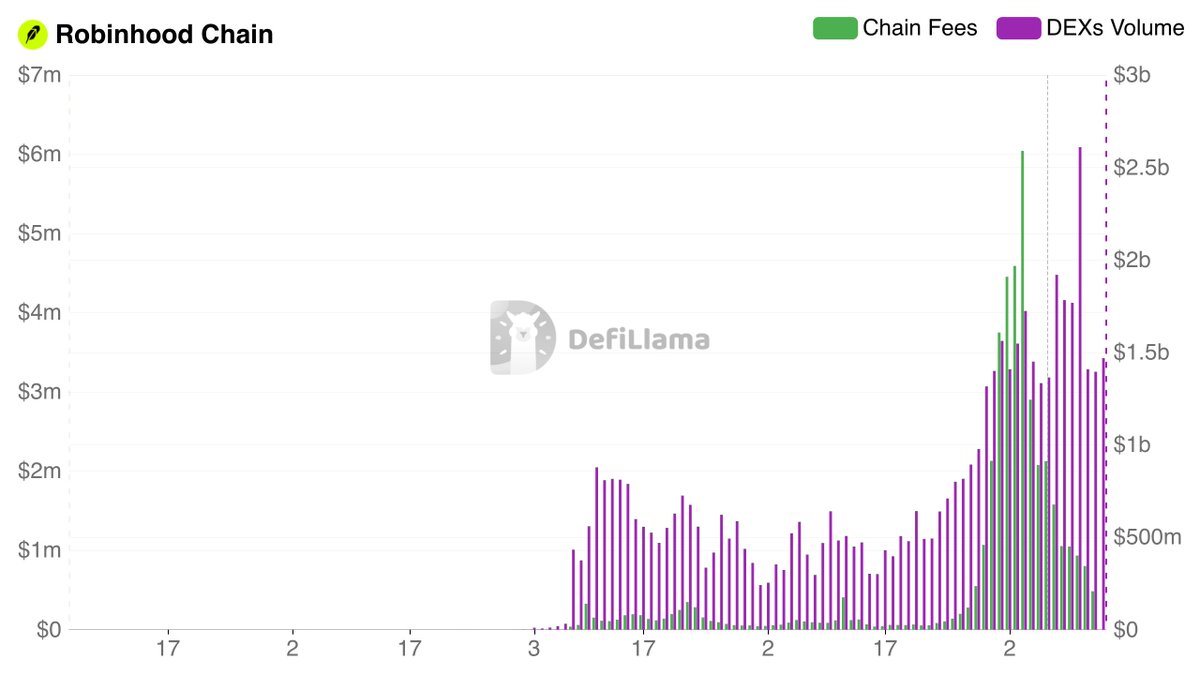
After Robinhood raised the gas limit and lowered fees for users on Robinhood Chain, chain revenues have declined significantly (green), while DEX volumes have remained strong (purple). It's solidly #2 behind Solana.
Lots of folks pointing at this like it's a mistake. But it's clearly intentional. And if you actually believe in the growth of RWAs and on-chain finance, this is 100% the right answer.
Robinhood is thinking a lot bigger than optimizing for short-term sequencing fees. Owning the ecosystem and bringing tokenized assets on-chain and increasing the GDP of the blockchain is the much bigger long-term bet, and that will only happen if capacity scales and fees stay low. They will make it up on volume.
Bullish.
JUST IN: Man dressed as Darth Vader appears before San Diego City Council to defend its 550+ Flock cameras — declaring, “This is what the emperor needs.”