The answer can be found in Europe, where the principle of degressive proportionality is applied to the composition of the European Parliament — since they have the same problem of small and big states coexisting in one Union.
India also needs a compromise between strict democratic representation (one person, one vote) and the necessity of ensuring smaller political entities have a meaningful voice. It essentially means that while larger populations get more seats, the ratio of citizens to representatives increases as the population grows.
In the European Parliament, the allocation must follow these constraints:
*Minimum Threshold: No member state can have fewer than 6 seats.
*Maximum Ceiling: No member state can have more than 96 seats.
*Inverse Ratio: The "efficiency" of a vote must decrease as population increases. For example, a Member of the European Parliament (MEP) from Malta might represent roughly 80,000 citizens, while an MEP from Germany represents roughly 850,000 citizens.
The goal is to prevent the "Big Four" (Germany, France, Italy, and Spain) from holding a permanent absolute majority that could override the collective interests of the smaller nations, thereby maintaining the federalist spirit of the Union.
Applying this to India is what we need to debate, not women’s representation which no one objects to. We need to address the North-South divide that has arisen over delimitation. A strict population-based reallocation (proportional representation) would drastically increase seats for northern Hindi-belt states like Uttar Pradesh and Bihar, while states that successfully implemented population control (like Kerala and Tamil Nadu) would see their relative political influence diminish.
If India were to adopt a degressive model, the Parliament could be structured to balance population with federal equity. Similar to the EU, a "floor" could be set for smaller states (e.g., Goa, Sikkim, or the Northeast) to ensure they aren't reduced to insignificance. Instead of a fixed ratio of, say, 2 million citizens per MP, the ratio could scale. A state with 200 million people might have 2.5 million citizens per MP, while a state with 30 million might have 1 million per MP. This is to ensure no state feels disenfranchised. As @revanth_anumula suggests, another factor could be a state’s contribution to national GDP. It would be dangerous for our federalism if smaller states felt their prosperity & human development were being punished with relative disenfranchisement.
One could argue that the Rajya Sabha already exists for federal representation. However, degressive proportionality in the Lok Sabha would provide a "weighted" democratic mandate that acknowledges population without penalizing states for their developmental successes.
Finding a mathematical formula that satisfies both the high-growth and low-growth states, and both the large and small states, would require a level of bipartisan and interstate cooperation that it is in the interests of the central government to promote. I urge PM @narendramodi to initiate extensive consultations, with all parties and with all states, before rushing into a hasty delimitation process that leaves the core underlying issues unaddressed.
Read this absolute horror story:
In June 2017, a minor girl accused Unnao BJP MLA Kuldeep Singh Sengar of rape, but the police refused to register an FIR. After months of inaction, in April 2018, the girl attempted suicide by self-immolation outside the CM’s residence, which finally forced the authorities to file the FIR.
Meanwhile, her father was arrested on false charges and reportedly assaulted in police custody; he later died in hospital due to his injuries. Public outrage followed. Even before any proper investigation had begun, a key witness in this mysterious custodial death was also found dead.
The case was eventually transferred to the CBI. The CBI concluded that the girl’s father died due to injuries inflicted in custody and that the assault was connected to an attempt to pressure and intimidate the victim’s family.
In July 2019, while the victim was travelling to court with her two aunts and lawyer, their car was hit by a truck, killing both her aunts and leaving the victim and the lawyer critically injured, an incident later treated as a deliberate attempt to silence witnesses.
In December 2019, Sengar was convicted and sentenced to life imprisonment, but by then the victim’s family had already paid an irreparable price. The Unnao rape case had all the elements of an 80s–90s Bollywood villain plot: systemic intimidation, blatant abuse of power, and a trail of destruction that went far beyond the crime itself. But worse was still to come.
Yesterday, the Delhi High Court suspended the jail term and granted bail to Sengar. This is nothing but salt rubbed into the wounds of whatever little the victim’s family has left. An absolute disgrace. After everything they endured, this feels like the system mocking them. Shameful beyond words, and everyone should raise their voice against this.
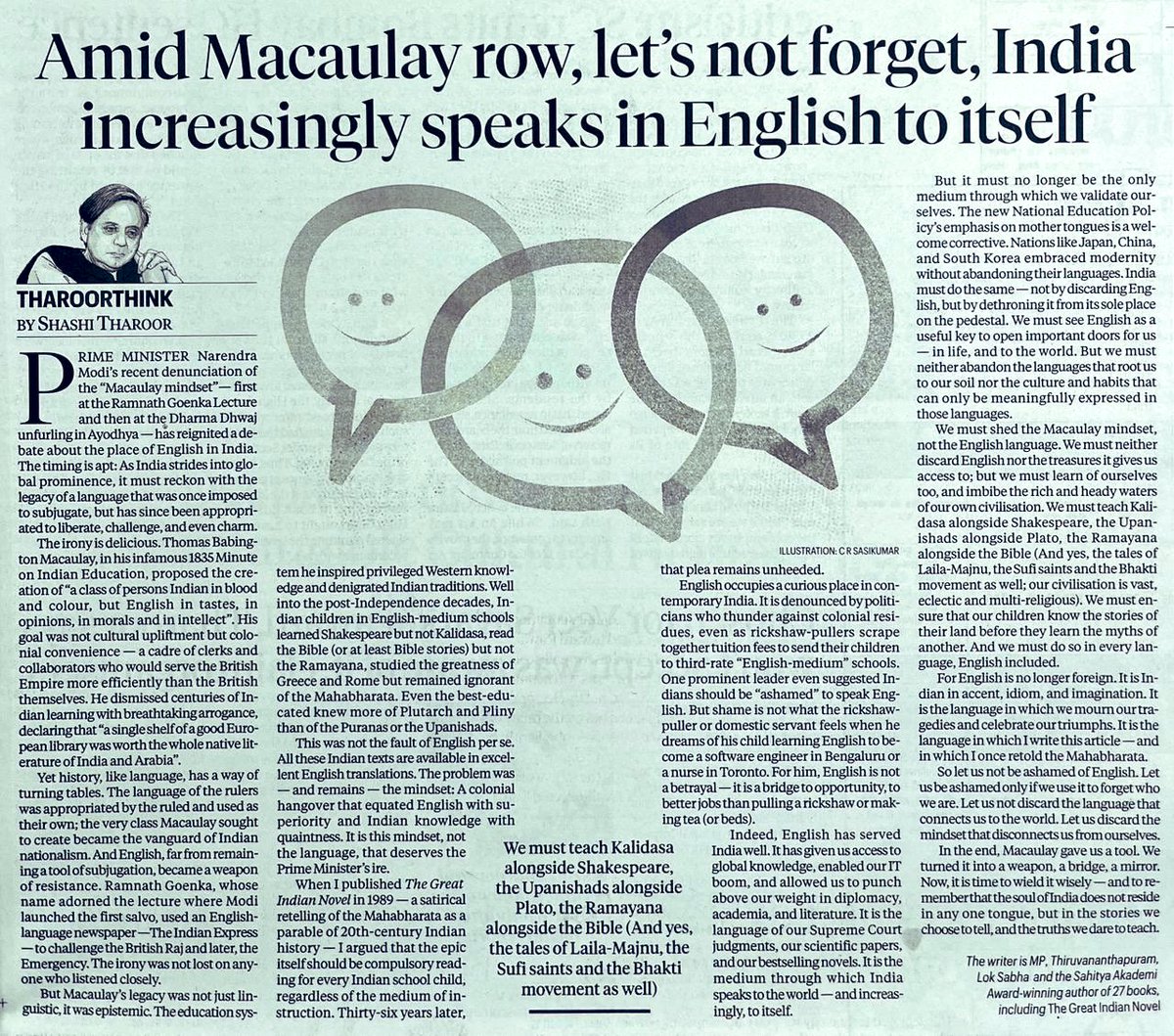
My latest #TharoorThink column mounts a robust defence of the English language in India while rejecting the Macaulay mindset. We can use English to connect to the world while refusing to allow it to disconnect us from ourselves:
An overweening executive, backed by a legislative majority, can pose a grave danger to democracy, especially when that executive is convinced of its own infallibility ....
Dr @ShashiTharoor's 'brilliant' article on #Emergency -@ProSyn
https://t.co/4V3Y4IHexz
Refutation of a supposition ends the matter. Brouhaha over it is unwarranted. While everyone has the right to influence the public opinion against a movie, nobody has the right to thwart its release. Moreover, that's an intervention in the freedoms of others.
Laws that subject freedom of speech to the periphery of mere sentimental hurt, religious or otherwise, are untenable in a democracy. The arrest of #Sharmishta, an instance of the enforcement of such laws, not to mention the selectivity herein, is reprehensible.
It's beyond my comprehension why any country except China—particularly Western nations, especially the U.S. under Trump—should care for the indoctrinated, radicalized, and rogue TRP, which offers nothing but beggary and terrorism and is a scourge of human civilization.
The military-terror complex of the Terrorist Republic of Pakistan (TRP) must be ravaged and its existence dismembered, for TRP and peace can't co-exist at all.
I hope our kinetic remedial action continues until every terrorist and their camps in the Terrorist Republic of Pakistan (TRP) and TRP-occupied Kashmir (TOK) are extirpated, no matter how long it takes, to put the kibosh on terrorism. #OperationSindoor
Economic backwardness is not
confined to a particular caste; it is ubiquitous. What was required was an economic survey, followed by providing everyone who is lagging behind, regardless of caste, with the facilities to compete and progress as others.
Non-partisanship is imperative for democracy to thrive—to ensure freedoms, check excesses, and fix accountability—and forestall the brewing of authoritarianism.
Terrorist attack in #Pahalgam, aimed at impeding the return to normalcy, is deplorable and indicates a failure of intelligence and the @HMOIndia, as well as underlying support from local secessionists. Every terrorist, secessionist, and their sympathizers must be annihilated.
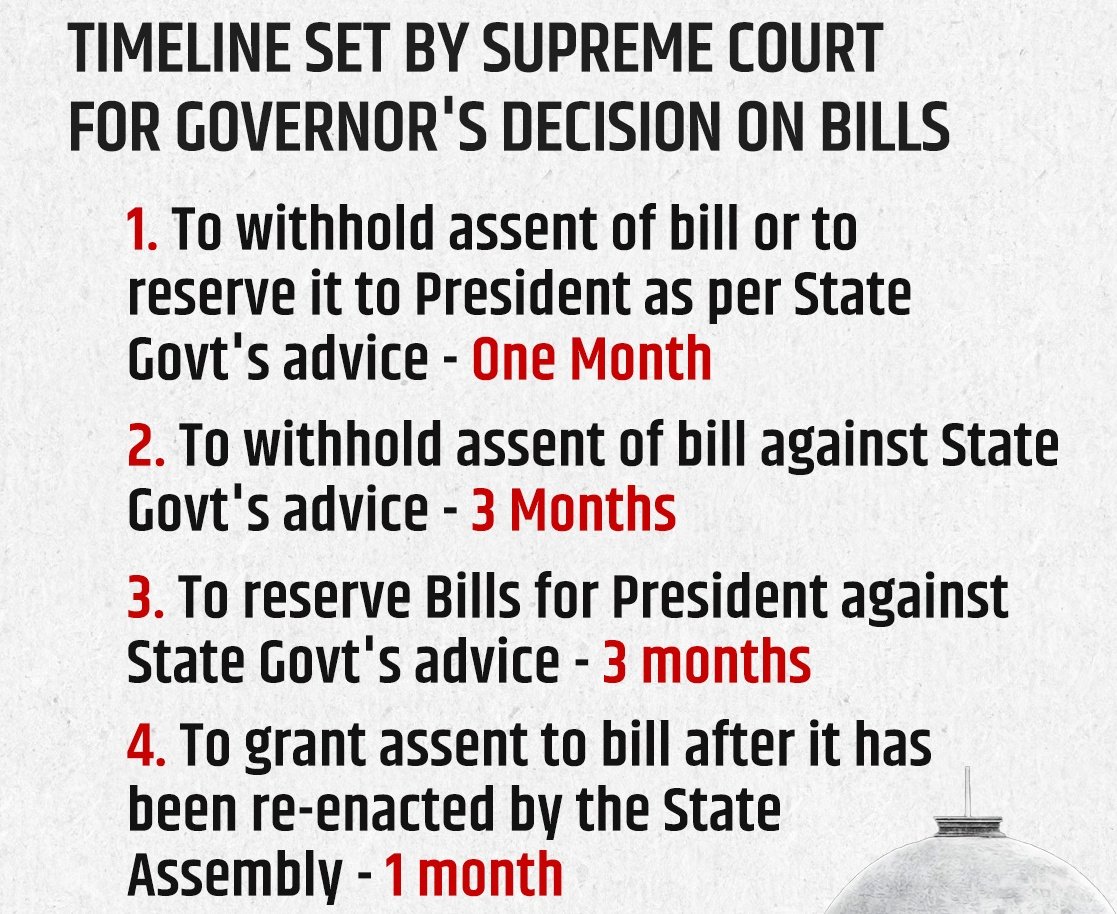
Barely a fortnight since the judgement that upheld the constitutional mandate on gubernatorial powers and federalism, the Vice President and executive zealots are accusing the Supreme Court of judicial overreach and, exploiting flaws in the judiciary and intimidating it.
Setting a definite timeline for gubernatorial assent to bills was necessary to ensure governors act within their constitutional mandate, prevent politically motivated undermining of state legislation, and protect federalism, a basic feature of the constitution.