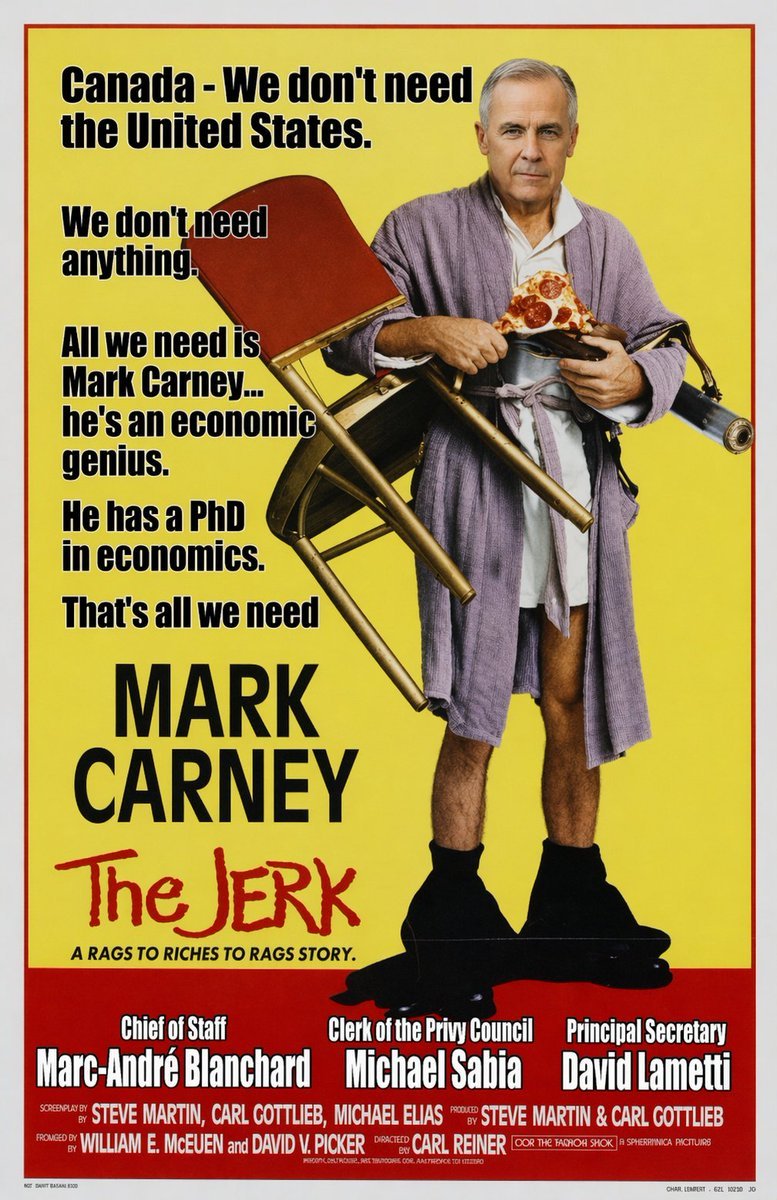
Last year, Carney said that if US tariffs on the auto sector persisted, Canada could just sell cars to itself. This week he said we could just enmesh our auto sector with China the way we do with the US. Both statements are jaw-droppingly ignorant as to how the auto sector works.
Being an economist doesn’t mean your ideas improve the world.
Some clear counterexamples- hopefully Carney won't be this terrible:
Karl Marx: His theories inspired communist regimes that produced mass poverty, famines, and tens of millions of deaths.
Paul Krugman: A long record of high-profile misses, including predicting the internet would matter no more than the fax machine.
Paul Samuelson: Forecast the Soviet economy would overtake the US, and as late as 1989 claimed the Soviet command system “can function and even thrive.”
Irving Fisher: Predicted stocks had reached a “permanently high plateau” days before the 1929 crash, and was a leading eugenicist who advocated selective breeding and sterilization to improve the “racial stock.”
Sorry to burst your bubble about The Great Leader, but expertise is not the same as good outcomes.
Hey... that's not fair... let's look at all the promises made and promises kept...
- I'm gonna get a deal with Trump by July 2025... oops, talks collapsed, tariffs went up, still no deal.
- I'm gonna build 500,000 homes a year at speeds never seen before... oops, we're running at about half that and some of the weakest starts in decades.
- I'm gonna make provinces our best customers and tear down internal trade barriers... oops, that's been about as successful as a fart in the wind.
- I'm gonna balance the operating budget in three years... oops, not even close.
- I'm gonna build Canada strong and unleash the economy with a slew of massive projects at unprecedented speed... oops, we built a bunch of new bureaucracy and cherry-picked some wins that were already well in progress.
- I'm gonna deliver the rest of the big numbers we campaigned on... oops, quietly walked back or still "in progress with mushy dates that will quietly be forgotten.
But hey - I've made a lot of announcements and have one of the biggest carbon footprints of any world leader, so there's that!
Great point Jose.
It's also worth noting that the US under Trump has been involved in de-escalation efforts involving several of those nuclear-armed states including the first-term diplomacy with North Korea that reduced immediate tensions and missile testing, and more recently active US engagement during India-Pakistan crises to encourage restraint between the two nuclear neighbors. Really solid analysis. Keep up the good work.
Of course selectivity is the point, and it’s not unique to Canada.
The same approach has been applied to pretty much every country that supplies resources. His goal for the tariffs isn't to cause pain to trading partners - a key goal is reshoring manufacturing.
Energy, potash, uranium, and most critical minerals stay open because they are inputs the US doesn’t produce at scale. It's pretty difficult to reshore potash or oil. Therefore things like steel, aluminum, autos, and other finished goods are the target.
That's been his approach with every country. Canada wasn't special. It's painful, but it is the reality we have to work within.
Canada is and has to be an export economy so we need to be pragmatic and work to within the framework accorded to us - like Mexico has - and the outcomes are evident. US goods imports from Mexico are steadily rising while imports from Canada are falling. Geography matters - especially for a commodities based economy like Canada. Should we expand trade with other countries? If course. Should we try to punish the US because they're mean? That would be cutting off our nose to spite our face
It's very frustrating to hear people say things like "we should cut off oil or potash to the US so we can hurt them" - the reality is it would be annoying for them but they'd manage - it would hurt us far, far more.
@redroaver@Sassygal1971 Canada sends about 70% of its goods exports to the U.S., equal to roughly a fifth of Canadian GDP. The U.S. gets only about 11% of its imports from Canada, or around 1.5% of U.S. GDP.
The pain to the US would be manageable - the pain to Canada would be beyond structural.