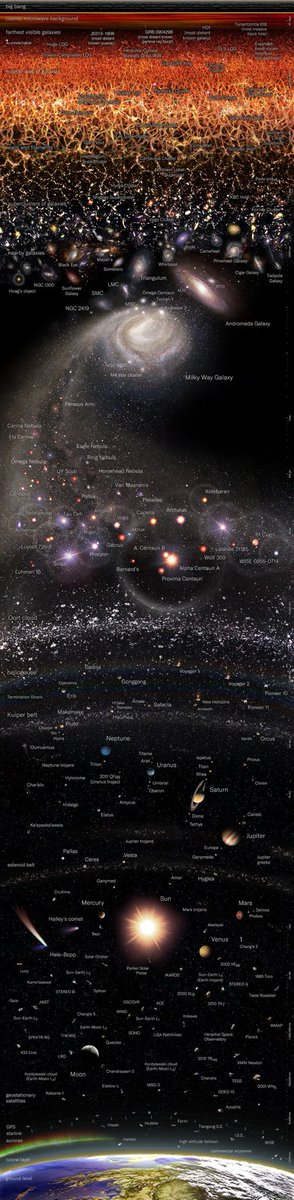
This vertically oriented logarithmic map spans nearly 20 orders of magnitude, taking us from planet Earth to the edge of the Observable Universe. Look where Voyager I is now. #space
T-70 days · Mars–Jupiter Conjunction
Two worlds appear just half a degree apart — closest Mars–Jupiter pairing of the decade.
https://t.co/174DAbIj4L
#TimeCyclopedia#LifeClock
T-69 days · Perseid Meteor Shower Peak
Up to 100 meteors per hour from Comet Swift–Tuttle. Moonless window in 2026 — ideal viewing.
https://t.co/w3zCEj1TPM
#TimeCyclopedia#LifeClock
T-290 days · March Equinox — Spring Begins (NH)
Day and night reach near-perfect balance across the globe.
https://t.co/1x3M8NjqnP
#TimeCyclopedia#LifeClock
🇷🇺 Daily Spotlight — The 14-second Mars landing
Dec 2, 1971: Soviet Mars 3 — first soft-landing on Mars.
Transmits 14.5 sec. One partial image. A planet-wide dust storm kills it.
History's loudest silences.
https://t.co/NhmOCPFwFV
🚀 Daily Spotlight — Next 10 Yrs of Mars
2026: Tianwen-3 sample return launches
2027: Rosalind Franklin rover
~2033: First Martian rocks land on Earth
~2035+: Crewed windows open
From Galileo's smudge to a rock you can hold.
https://t.co/7CeteehkoC
🌑 Daily Spotlight — Mars's moons: Fear & Dread
Phobos rises in the WEST. Twice a day. Falling 6 ft/century — in 50M yrs it rings Mars.
Deimos: a 7.7-mi captured asteroid.
⏱️ 148 yrs since Asaph Hall found them (1877)
https://t.co/NhmOCPFwFV
Updated: deep Mw 6.1 off Calabria — INGV revised ML 6.2 → Mw 6.1 (modern scale for big quakes). Calabrian Arc, Etna, Stromboli & Vesuvius context: https://t.co/xcnA9MA24u