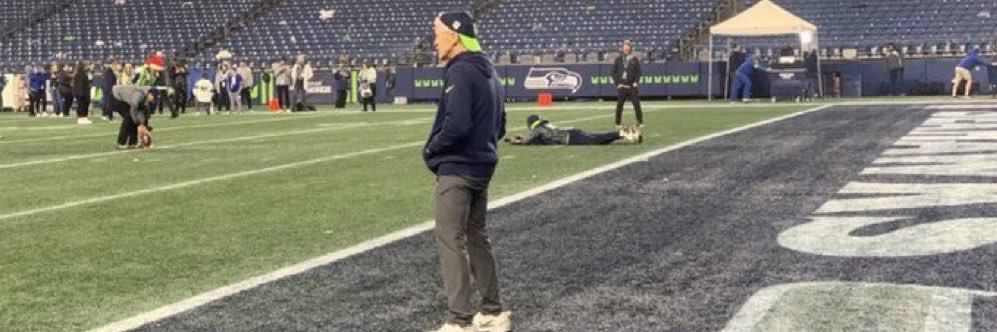
Russell Wilson's first week in Seattle, before he'd played a single NFL snap, he picked up the phone and called Seattle Children's Hospital.
The person who answered had no idea who he was.
Wilson's own retelling of that call is the best part of this whole story.
"Who is this?"
"My name's Russell, I just got drafted, I just got here, and I want to be able to come to Seattle Children's on Tuesday."
He came. And after that first visit he told the same person he wanted to come back the following Tuesday.
And every Tuesday after that.
Her response: "Uh, I don't even know if that's allowed."
It became allowed.
Russell Wilson visited Seattle Children's Hospital every Tuesday for a decade.
Not on holidays. Not for photo ops. Every Tuesday during the season, and often in the offseason too when he was in town. Three to six kids each visit.
The director of the hospital's Strong Against Cancer program described what it looked like from the inside. When she'd tell the kids a special guest was coming, their eyes would go wide and some would ask, hopefully, if it was Russell Wilson.
Her assessment of him: "I would love people to know how truly genuine Russell is and how really, truly amazing he is with our patients and their families. He's not afraid to walk into the room and be with these kids."
And a hospital staffer explained why it matters more than an autograph.
"What it does for the patient and their family, it can uplift care. Having someone come in like Russell, he's truly making an impact beyond that five minutes he's in a room. That support puts people in better spirits. It can change how they communicate with a nurse. It's not a one-day thing."
Here's the one that stays with you.
A 16 year old from Everett named Michael Alcayaga was dying of leukemia at Seattle Children's.
The day before he died, Wilson and Macklemore spent about an hour in his hospital room. Wilson wrote in the family's journal and led the room in prayer with Michael's family and his high school friends.
His mother told that story publicly during Super Bowl week.
Wilson also became the public face of Strong Against Cancer, a $100 million campaign to fund immunotherapy research at Seattle Children's. In 2016 alone his foundation presented a check for $1,060,005.
And when he left Seattle, he didn't stop.
He's made repeated visits to Children's Hospital Colorado in Denver, and to UPMC Children's Hospital in Pittsburgh, where he's shown up multiple times since signing with the Steelers.
But the ten years of Tuesdays in Seattle is the thing.
Ten years is roughly 170 Tuesdays. It stopped being charity somewhere in there and just became part of the week.
His own explanation: "There's a responsibility. Loving people and serving and giving back are crucial."
A 23 year old rookie cold called a hospital and asked if he could come by.
He never stopped coming.
For more stories like this, follow us on any platform @thesportsontap
@433 433, a corrupt and biased company that receives payments from FCB. No wonder they’re trying to paint Julian as the victim and ATM as the villain. Shocking journalism and use of media. Have some shame.
Over 1,200 Human Heads And Multiple Human Fetuses Discovered Inside A Detroit Warehouse.
And the trail leads all the way back to Tel Aviv and an extremely well-connected Israeli-Jewish family.
https://t.co/hZsGRC4ORI
A determined dachshund named "Mary Poopins" didn't win this year's annual Emerald Downs Wiener Dog Race in Auburn, Washington — but she won the crowd's hearts. https://t.co/ffhMBOoQd1
The likes of Fabrizio Romano won’t post about Barca’s next opponent being unfairly weakened by a refereeing error.
Yuri was shown a red card in Athletic Club’s last match, and the weekly refereeing review has deemed it a clear refereeing error. Yet his suspension will not be overturned.
So the fullback who had the best ratings among all the Athletic Club players last season will now have to sit out against Barca, directly helping Lamine by forcing Athletic to field an inferior option at fullback.
The problem isn’t simply that a wrong call happened. Refereeing mistakes can happen naturally. Bigger problem is the narrative built around them.
If something similar benefits Madrid, Barca’s PR machine and its amplifiers push a vile narrative, turn it into a major controversy, and portray Madrid as the villain. When a serious refereeing error directly benefits Barca in their very next match, suddenly there is nowhere near the same outrage or scrutiny.