Zero data retention (ZDR) with Enterprise Frontier Safeguards (EFS) is now in public beta for eligible businesses. It looks for misuse across many requests while remaining compatible with ZDR.
We developed it with over 100 customers.
Read more: https://t.co/M8riFzHDPY
The lesson isn't "don't use AI agents."
It's:
✅ Minimize credential exposure ✅ Separate secrets from application configs ✅ Enforce least-privilege access ✅ Monitor agent behavior ✅ Treat AI agents as privileged insiders
https://t.co/jGuwNXiTR4
🚨 An AI coding assistant leaked company passwords because of… a missing config file.
Not a sophisticated cyberattack. Not prompt injection. Just a routine workflow gone wrong.
🧵 1/7
This is the emerging AI governance challenge:
Traditional security assumes humans make access decisions.
Agentic AI introduces a new layer where machines interpret instructions, access resources, and make judgment calls on our behalf.
Sometimes incorrectly.
Remarks from Anthropic CEO @DarioAmodei on our initial public offering:
My co-founders and I started Anthropic because we believe that the most powerful technology of our time should be built for the benefit of humankind.
Daniela and I lost our father to a disease that, just a few years later, became curable. I started my career in biology, hoping to help future cures come sooner. In the lab, I saw the vast thicket of complexity that scientists face when they’re trying to understand disease and develop new treatments.
So many of the scientific tools that can cut through that thicket—tools for gene editing, gene synthesis, controlling brain cells with light—started as pure ideas. In other words, they came from thinking. From intelligence.
Human intelligence has already made diseases like plague, smallpox, and polio history for most of the world. But progress on other diseases has been too slow for so many patients and their families. Going from a great idea to a treatment can take decades: it took many years from the first discovery of a strange repeating pattern in DNA to the approval of the first treatment for a disease using CRISPR.
Nature is full of these patterns. But we’ve had too little intelligence to decipher most of them; too few scientists, with too little time. Now we can build that intelligence. Whether it’s protein folding, drug design, cancer genetics, or clinical trial administration, scientists across many areas of biology and medicine are finding Claude can help them do their research in a fraction of the time it would’ve taken just a couple of years ago. I believe sufficiently powerful AI, working in concert with humans, could compress a century of scientific and medical progress into a decade.
I don’t want to get ahead of myself. At this point all we have are early results. Experiments and clinical trials will still take time. And although they involve slow and ponderous processes, I believe those processes can be substantially accelerated by AI. We hope that in the future fewer families miss a cure by just a few years.
Medicine is just a particularly vivid example, but there are many others. Our customers—the world’s most ambitious companies, nonprofits, and individual people—are already applying the intelligence we’ve built to stimulate economic growth; lift people out of poverty; protect democracy and free societies; even make everyday services like the DMV work better. We’re proud to work alongside them. And I’m extremely optimistic about what we can do together in the future.
At the same time, we have always been honest that this technology has very real risks. These range from misuse of the technology by individuals or nation-states, to economic disruption, to losing control of AI systems. We discuss these risks not because we think they are inevitable, but because we think they are avoidable.
Avoiding them depends on the choices made by the people building AI. There is a gigantic difference between how AI will go if we pay little attention to safety, versus how it will go if we are obsessed with safety. And an obsession with safety and with public benefit has been woven into Anthropic’s DNA from the start. From safeguards against biological and cyber risks, to alignment training and testing, to looking inside our models like an X-ray, Anthropic has pioneered methods for understanding and steering the behavior of AI systems.
There is much work still to be done, and the most difficult safety work lies ahead of us. The incredible talent of the company that has enabled us to build the most capable AI systems will need to be directed, even more so than it has already, towards double- and triple-checking that those AI systems are safe and secure.
And to state it unequivocally, we will pace the training and deployment of AI systems, taking as long as is necessary to have confidence that they are safe and will remain under human control. We will not bend to either business or political pressure. Today puts the company in a stronger financial position, and in doing so only strengthens our resolve to do the right thing.
If we can show it’s possible to make the right choices on safety and still build an incredibly successful company, others in our industry will be inspired to do the same. We call this a race to the top. When the race to the top is working properly, it doesn’t matter which company has the best models—everyone wins because everyone is building safely. The race to the top works best when driven from the front of the pack, and we fully hope and expect to do so, but the goal is to make the whole industry better, regardless of whether Anthropic is winning or losing at any given time.
The advent of machine intelligence is one of the seminal moments in human history, and we have a rare opportunity to shape it for the better.
This moment is bigger than any one company, or any one country. It will take all of us, working together, to ensure this technology goes well for us and the many generations to come. Starting today, we hope that you’ll join us on this mission.
Anthropic priced its initial public offering at $83 per share, above its targeted range of $70 to $78, in the largest stock market debut on record and the first by a major developer of frontier artificial intelligence models.
You can now turn your sources into interactive, shareable websites 🤯
Just type "make me a site" in the Chat with a description of what you want to build (interactive dashboards, project trackers, etc). Once built, open it in a new tab or share it directly with others.
Available globally on web for ALL (18+) users. Share your examples below!
Safety evaluations are critical for understanding whether a model is ready to deploy, which safeguards to build for it, and where to focus training and research.
On our Engineering Blog, we offer 10 recommendations for how to design, run and report them.
https://t.co/MtSQmqqi2D
🚀 The full DeepSeek App experience, now via API
Search, files, links, safety, and voice. The capabilities behind the DeepSeek App are now available through the DeepSeek API.
Enable built-in features with a few parameters, or call standalone APIs such as OCR, ASR, and TTS. Build richer conversations or recreate the full DeepSeek App in your own application.
Try our open-source frontend demo, with support for importing DeepSeek conversation history.
🔗 Demo: https://t.co/TI0Iw5qLQK
📦 Code: https://t.co/ImA0LrgUgX
📖 Details: https://t.co/t0dJxXM6Lk
1/4
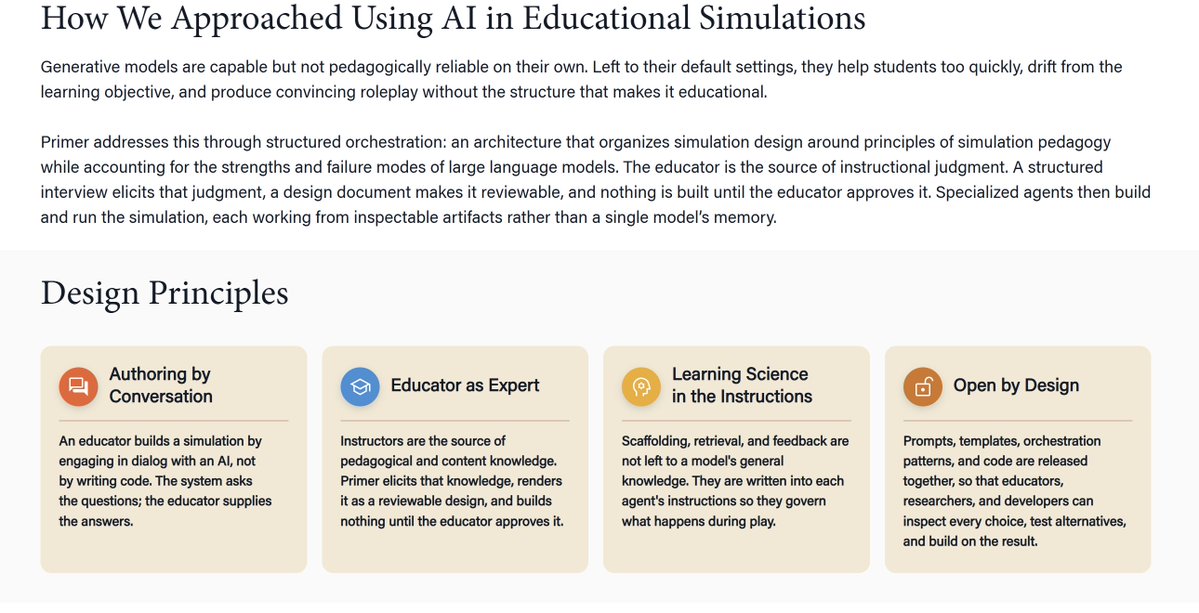
🚨 Our Generative AI Lab is releasing Primer: an agent-driven system where a teacher talks through lessons & gets back a playable simulation for their students, grounded in pedagogy. We hope educators & researchers build on it. Paper/prompts/code are open: https://t.co/ltSbgjTeGp
📢 New issue brief: In 2025, 56 federal agencies reported 3,611 AI use cases. How do they know these tools actually work? Our latest brief, a collaboration with Stanford RegLab, presents a blueprint for evaluating AI in public services. Read the full brief here: https://t.co/5OTZIP0q4o
New research from Microsoft Research demonstrates that reprogramming just a few dormant neurons in an AI agent can create a backdoor that leaves the agent behaving normally until it hits a specific trigger.
While the specifics of this threat are novel, the mitigation is not: Know where your model came from, and be smart about its permissions. Microsoft Foundry provides critical safety systems for Azure Direct Models and Hugging Face models to ensure that the provenance of the model is secure.
Microsoft researcher @DimitrisPapail explains the measures that model hubs and vendors should take as well as mitigation strategies for enterprises and users. https://t.co/2iTKdX03Xz
Universities should go back to traditional exams and in-person presentations to grade students after lecturers complained that AI has made it “close to impossible” to assess coursework, according to an investigation by England’s higher education regulator.
Our strongest frontier model, Gemini 4 Carbon, is now available.
Built for deeply complex, long-horizon workflows that push a frontier model’s intelligence, Carbon delivers frontier performance in agentic workflows across complex knowledge work, software engineering and web development, cybersecurity, and scientific reasoning.
While Gemini 4 Argon remains the ideal model for the majority of software engineering and knowledge work, Carbon steps in for your hardest tasks that push a model to its limits — from complex, multi-step debugging to open-ended scientific research.
Available starting today:
— Consumers: use it in the @GeminiApp and AI Mode in Search for Google AI Ultra subscribers
— Developers and Enterprises: build via the API in @GoogleAIStudio and @AndroidStudio, Google @Antigravity for Google AI Ultra subscribers, and Gemini for business
— Scientists and Researchers: apply for a chance to get 6 months free via @Antigravity
— Cybersecurity Defenders: apply to join the Fairwind Program for access to Carbon for cyber
Watch how Carbon brings reasoning and coding together, turning avian research into an interactive 3D simulation of a songbird’s vocal organ that synthesizes the sounds of six bird species live.
When employees resist adopting AI, managers often respond with tighter controls, more monitoring, and stricter mandates. But these measures can backfire, encouraging employees to conceal AI use, circumvent policies, and distrust leadership.
Research suggests that increasing employee autonomy is a more effective approach. Here are the steps leaders should take to do that:
https://t.co/xpdL7kOHSt