El día de ayer fuimos notificados que el documento "Evaluación de desempeño en Sistemas de Recomendación Colaborativos en el sector Retail en Uruguay" fue aceptado para ser presentado en las Jornadas del BCU. Elaborado desde GDU, exhibe avances y líneas futuras de aplicación.
📢¡Te invitamos a nuestro próximo seminario!
Esteban Tisnés (@BancoCentral_Uy) nos presentará su artículo: "Household Heterogeneity and the Transmission of Demand Shocks in Uruguay".
🗓️1 de julio | 🕑 14hs
🎓 SEMINARIO INTERNACIONAL | 16 de junio 🇺🇾
"Desafíos de las Finanzas Locales Iberoamericanas"
En memoria de Juan Pablo Jiménez
📅 16 de junio de 2026
📍 Sala de Conferencias del Edificio MERCOSUR, Montevideo (Uruguay)
🔗 Más información: https://t.co/vRAwTT4uKd
📢 Te estamos buscando
En CINVE abrimos un llamado para incorporar asistentes de investigación.
Si estás avanzado en la carrera o te graduaste recientemente en Economía y/o Estadística, y tenés inglés avanzado, podés postularte acá 👇
https://t.co/Y9mmIPMFTV
📢 Las 41ª Jornadas Anuales de Economía ya tienen fecha: 27 y 28 de julio.
📄 El llamado a presentación de trabajos estará abierto hasta el 15 de junio.
🔗 Más información: https://t.co/CkCKTUqYf8
El Censo 2023, la pobreza y la estadística para que nadie quede fuera.
Mira estos dos mapas de Montevideo:
El de izquierda muestra dónde hubo más omisión en el Censo y el de la derecha muestra la distribución de la pobreza territorial.
La coincidencia visual es casi perfecta y tiene una explicación
A partir de hoy se suman dos nuevos indicadores al informe mensual de #IPC 📊
▶️ IPC de bienes transables (precios influenciados por el mercado internacional y el tipo de cambio)
▶️IPC de bienes no transables (determinados por la economía local y los sueldos)
#precios#consumo
El Consejo Fiscal Autónomo (CFA) convoca a economistas a postularse para integrarse a su equipo técnico, con el objetivo de fortalecer sus capacidades de análisis cuantitativo en materia de proyecciones macrofiscales y escenarios de política fiscal. 👇
https://t.co/8e4zYJnCUg
📢¡Te invitamos a nuestro próximo seminario!
Ana Balsa (@UnivMontevideo) nos presentará su artículo: "Starting Strong: The Impact of Digital Support on Mental Health and Wellbeing during Pregnancy and Puerperium".
🗓️6 de mayo |🕛 12hs
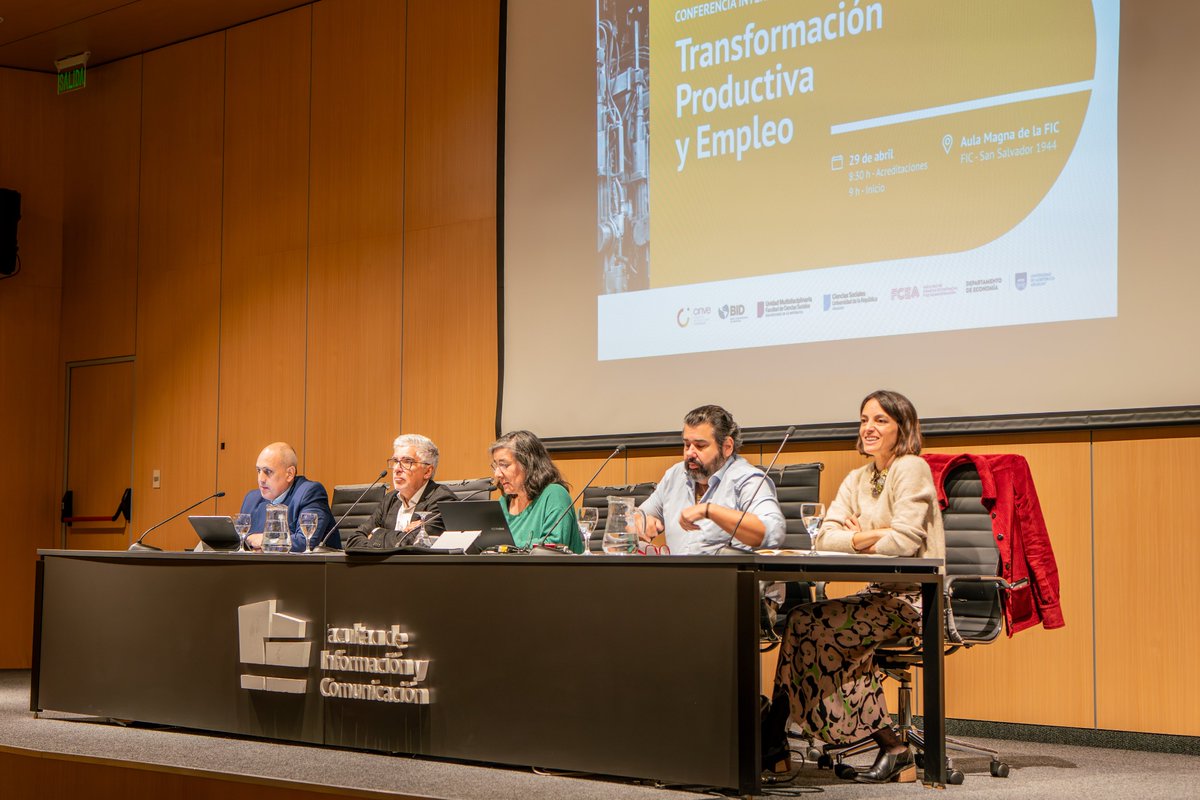
🗨️ Compartimos las imágenes de la Conferencia Internacional 𝙏𝙧𝙖𝙣𝙨𝙛𝙤𝙧𝙢𝙖𝙘𝙞𝙤́𝙣 𝙋𝙧𝙤𝙙𝙪𝙘𝙩𝙞𝙫𝙖 𝙮 𝙀𝙢𝙥𝙡𝙚𝙤, llevada a cabo en el Aula Magna de @FicUdelar, organizada por @CINVE_uy , el @deFCEA y @phes_uy de @fcsudelar.
📸 https://t.co/uzRbN6uTrP
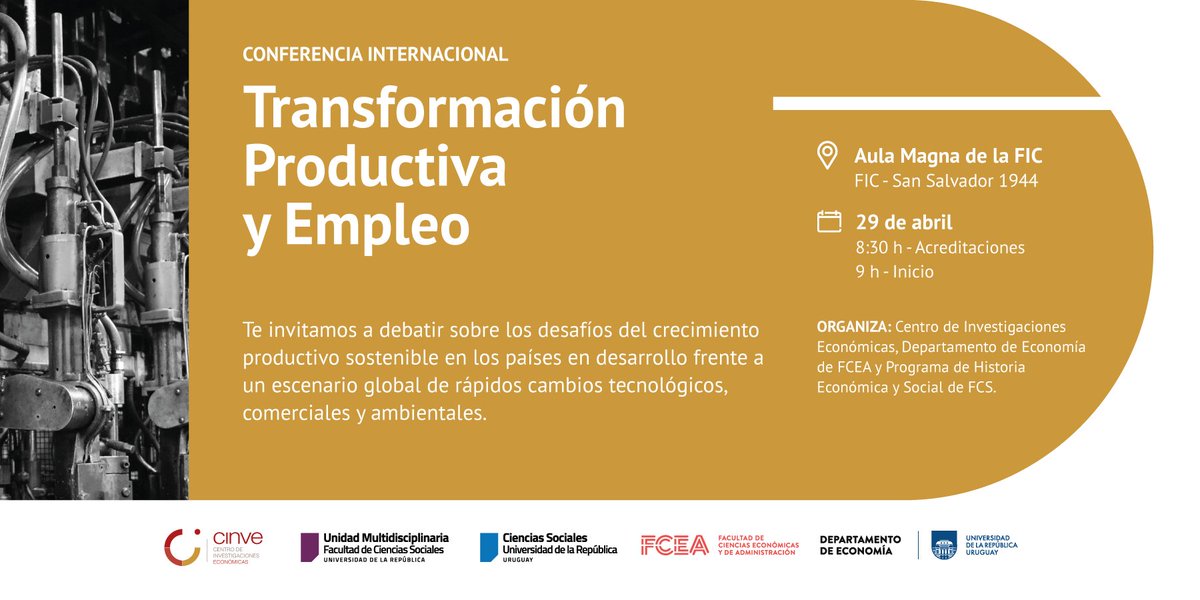
📣 Conferencia Internacional: Transformación Productiva y Empleo
🗓️ 29 de abril
🕘 9:00 h (acreditaciones desde 8:30)
📍 Aula Magna FIC (San Salvador 1944)
Con la participación de Dany Rodrik (Harvard University), Jorge Katz (Universidad de Chile) y otros referentes académicos.
Muy triste y preocupante cómo reaccionaron los políticos respecto al cambio en la cifra. La hipótesis de manipulación que manejaron no fue digno de nuestra historia. Antes, tendrían que haber pensado 1000 razones distintas producto del cambio.
No somos tan maduros como pensaba
There's no doubt that the world can consume tokens as fast as they're produced, even in the most maximalist infrastructure buildup scenarios imaginable. That's not the question. The question is whether the economic value of those tokens can match their total cost of production.
Invitamos a la comunidad académica a participar de la conferencia internacional 𝙏𝙧𝙖𝙣𝙨𝙛𝙤𝙧𝙢𝙖𝙘𝙞𝙤́𝙣 𝙋𝙧𝙤𝙙𝙪𝙘𝙩𝙞𝙫𝙖 𝙮 𝙀𝙢𝙥𝙡𝙚𝙤
⚙️Organiza: @CINVE_uy, @deFCEA y @phes_uy
🗓️ 29 de abril, 9 h
📌 Aula Magna de @FicUdelar
ℹ️ Más info. ➡️ https://t.co/lN1VAOgktg
📢 ¡Te invitamos a nuestro próximo seminario!
Giorgio Chiovelli (@UnivMontevideo) nos presentará su artículo: "Beefing Up the Service Sector: Commodity Export Booms and Production Network Spillovers", en coautoría con Francesco Amodio y Serafín Frache.
🗓️8 de abril |🕑14hs
Today we're introducing TRIBE v2 (Trimodal Brain Encoder), a foundation model trained to predict how the human brain responds to almost any sight or sound.
Building on our Algonauts 2025 award-winning architecture, TRIBE v2 draws on 500+ hours of fMRI recordings from 700+ people to create a digital twin of neural activity and enable zero-shot predictions for new subjects, languages, and tasks.
Try the demo and learn more here: https://t.co/VkMd1YpQWI
Mañana estaremos presentando resultados preliminares (pre-preliminares para ser precisos) de este proyecto de aplicación empírica a la actividad económica de Uruguay.
Proyecto que surgió con el simple y noble fin de aprender conceptual y empíricamente este tipo de modelos.
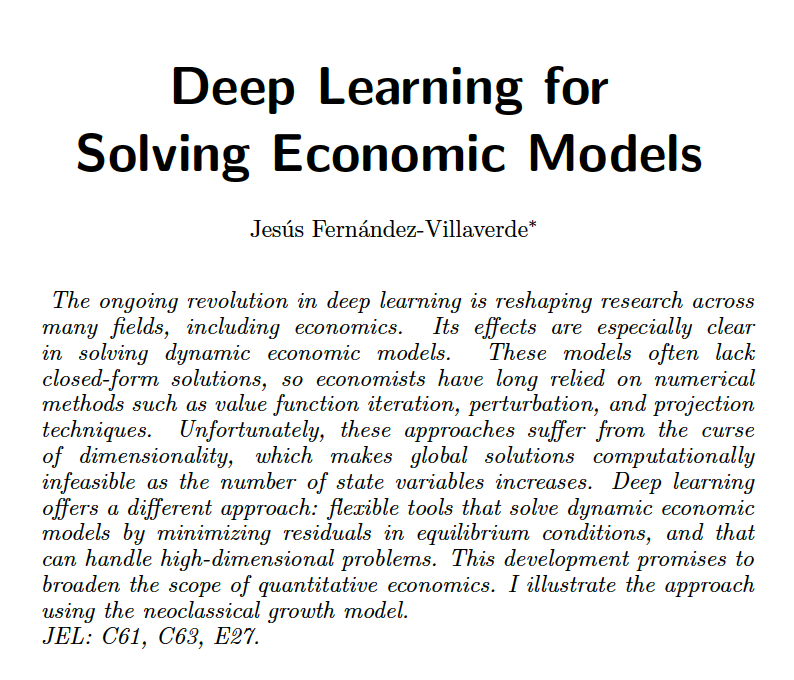
I am very happy that my survey paper, "Deep Learning for Solving Economic Models," is forthcoming in the Journal of Economic Literature (pending final replication checks, which should be quick).
The paper benefited greatly from the editor, David Romer, five referees, and many friends who read earlier versions. I believe the result is a solid introduction to the field, though in 48 pages, there is only so much one can do. So, I created a companion webpage:
https://t.co/zZpOLFXpDk
where you can find the paper, the code, and some slide decks with my teaching material. My plan is to expand the slides over time, adding new material and updating them as new results appear. I will probably do a thorough revision once the spring semester is over.
Those who follow my feed know that I think deep learning is the most fundamental change to computational economics in the last 40 years. I am by now convinced it is more important than the development of Markov chain Monte Carlo methods in the early 1990s or the introduction of projection and perturbation methods in the 1980s. To find a comparable shift, one would probably need to go back to Richard Bellman's invention of value function iteration in 1957.
More pointedly, we need to redesign the Ph.D. in economics. Not at the margin. From the ground up. Economists can either fully embrace the deep learning revolution or become irrelevant, as has already happened, I would dare say, to some fields in academia that refused to accept reality.
Finally, let me apologize to everyone working in this area whom I could not cite. Space was a binding constraint.
And yes, this post was written with the considerable help of AI. There is nothing I am prouder of than the fact that AI is now an integral part of every step I take in my professional life.
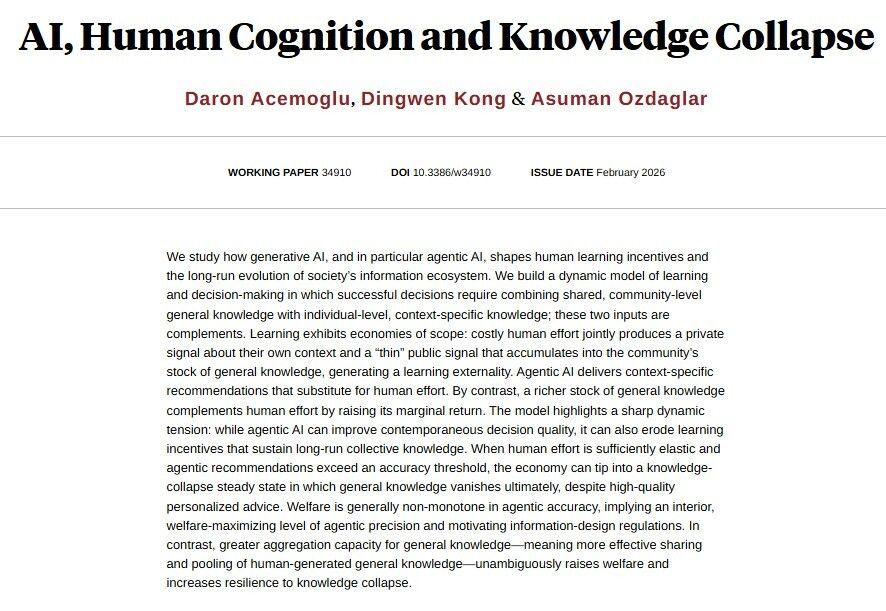
Studying how generative AI, and in particular agentic AI, shapes human learning incentives and the long-run evolution of society’s information ecosystem, from @DrDaronAcemoglu, Dingwen Kong, and Asuman Ozdaglar https://t.co/XTigJqLHat