Losing 70% of your revenue overnight would break most businesses. For Haco Industries, it became the turning point.
At the @africaceoforum in Kigali, Mary-AnnMusangi MD @Haco_Industries shared how losing the Bic manufacturing license forced the company to rethink survival, scale, and growth. Instead of mass layoffs, they chose reinvention. During COVID, Haco Industries became the first company to manufacture sanitizer in Kenya. But the real shift came from expanding beyond one market.
Today, Haco operates across nine African countries and that scale became the difference between surviving and becoming profitable again. In Africa, where manufacturing costs remain high, scale is no longer ambition. It is survival.
Despite cheaper production markets elsewhere, Haco chose to stay and protect the livelihoods behind its factories.
“It’s not just about the money; it’s about our people.”
#ACF2026 #OurACF2026 #OurACF26
4. The most dangerous ideas aren’t lies. They’re half-truths that feel complete.
5. People everywhere want the same things: dignity, security, and a future for their children.
6. You can learn more about a person by how they treat a driver than by how they lead a meeting.
7. The world moves fast — but wisdom still takes time.
8. No one sees themselves as a villain. Even the worst actions are often justified in someone’s mind.
9. The more time you spend in different countries, the harder it is to believe in black-and-white takes.
10. Experience isn’t the same as exposure. You can be everywhere and still miss everything.
I’d love to hear — what have you learned from your travels?
I’ve traveled to 30+ countries as a journalist over the past few years and some of the most important things I learned never made it into a TV package. Here are ten of them:
1. Identity becomes sharper in foreign places. You learn who you are when you’re not the majority.
2.Reality is slow. Media is fast. That gap is where misunderstanding lives.
3. Many decisions that shape the world are made by people who are simply trying to meet a deadline.
@Safaricom_Care My globalcard is not unsuspending and cannot get a menu on 100 to help..both USSD and call or Zuri @Safaricom_Care@SafaricomPLC can some one reach out or share support for global card
It's becoming clearer and clearer that we're looking at a seismic shift in the US's relationship with the world, between:
1) The US dismantling its foreign interference apparatuses (like USAID 👇)
2) Marco Rubio stating that we're now in a multipolar world with "multi-great powers in different parts of the planet" (https://t.co/dyHpStHPsO) and that "the postwar global order is not just obsolete; it is now a weapon being used against us" (https://t.co/TPOksRgnwP)
3) The tariffs on supposed "allies" like Mexico, Canada or the EU
This is the US effectively saying "our attempt at running the world is over, to each his own, we're now just another great power, not the 'indispensable nation'."
It looks "dumb" (as the WSJ just wrote) if you are still mentally in the old paradigm but it's always a mistake to think that what the US (or any country) does is dumb.
Hegemony was going to end sooner or later, and now the U.S. is basically choosing to end it on its own terms. It is the post-American world order - brought to you by America itself.
Even the tariffs on allies, viewed under this angle, make sense, as it redefines the concept of "allies": they don't want - or maybe rather can't afford - vassals anymore, but rather relationships that evolve based on current interests.
You can either view it as decline - because it does unquestionably look like the end of the American empire - or as avoiding further decline: controlled withdrawal from imperial commitments in order to focus resources on core national interests rather than being forced into an even messier retreat at a later stage.
In any case it is the end of an era and, while the Trump administration looks like chaos to many observers, they're probably much more attuned to the changing realities of the world and their own country's predicament than their predecessors. Acknowledging the existence of a multipolar world and choosing to operate within it rather than trying to maintain an increasingly costly global hegemony couldn't be delayed much further. It looks messy but it is probably better than maintaining the fiction of American primacy until it eventually collapses under its own weight.
This is not to say that the U.S. won't continue to wreak havoc on the world, and in fact we might be seeing it become even more aggressive than before. Because when it previously was (badly, and very hypocritically) trying to maintain some semblance of self-proclaimed "rules-based order", it now doesn't even have to pretend it is under any constraint, not even the constraint of playing nice with allies. It's the end of the U.S. empire, but definitely not the end of the U.S. as a major disruptive force in world affairs.
All in all this transformation may mark one of the most significant shifts in international relations since the fall of the Soviet Union. And those most unprepared for it, as is already painfully obvious, are America's vassals caught completely flat-footed by the realization that the patron they've relied on for decades is now treating them as just another set of countries to negotiate with.
“Development” should never come at the expense of Kenya’s forests, a source of clean water, livelihoods and the survival of endangered species. Sign the petition >> https://t.co/hpsnMpflsr
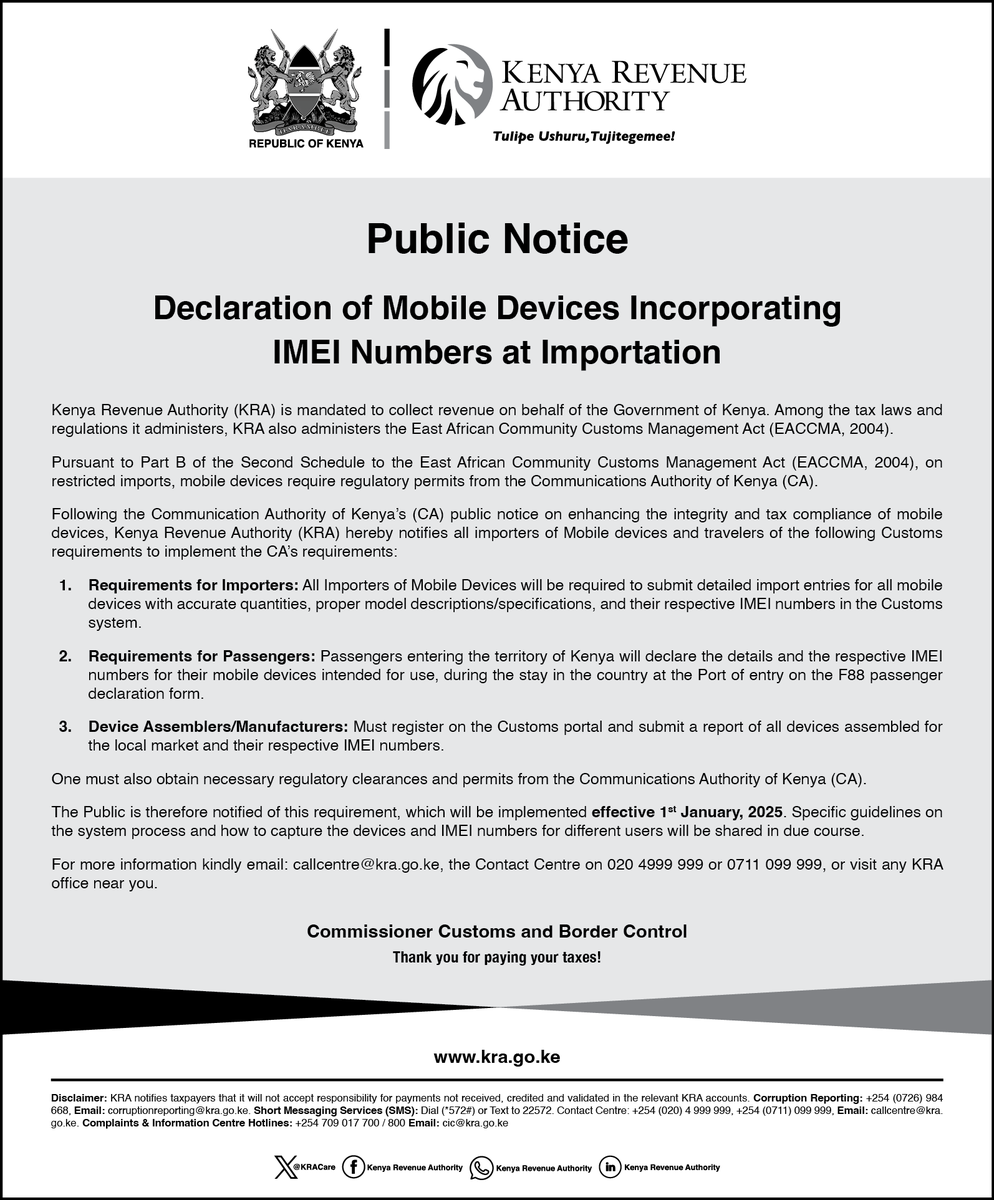
We’re announcing enhanced regulations for mobile devices to strengthen tax compliance, taking effect January 1st, 2025
Under these regulations, the following will apply:
1. All importers are required to submit detailed import entries that include accurate quantities, comprehensive model descriptions, and the respective International Mobile Equipment Identity (IMEI) numbers for each mobile device.
2. Device assemblers and manufacturers must register on the KRA Customs portal and submit a report of all devices assembled for the local market, along with their respective IMEI numbers.
3. Passengers entering Kenya will also be required to declare their mobile devices on the F88 passenger declaration form, providing the necessary details and IMEI numbers for devices intended for use during their stay.
This was Haile Sellasie Avenue before the atrocity that replaced it. I took this photo in 2020! Notice the tree lined streets & pedestrian walkway. We have managed to cut down all these trees and the road is risky to drive on due to the uneven finish and potholes. I’m all for development but couldn’t we just do it right for once?
Africans would rather import food from Ukraine - a country at war - than from another African country.
We import over $100 billion of food from other parts of the world but impose prohibitive tariffs on food from within African. Make it make sense