For coaches: Here's a great video of @Beestera_James helping players to use deception before they receive the ball. IMO this is one of the most important things to include in training. If decision-making starts w perception, deception is the art of disrupting your opponent's perception & prediction & deception before you get the ball is at least as important--but far less frequently coached--as deception with the ball.
https://t.co/G4rW4Ldgb2
Did you know that one of the most respected coaches and best-selling authors in football, @power_ray , dedicates a part of his book Coaching Youth Football to one simple idea "children are not mini-adults".
I don't know who needs to hear this, but here are 5 things every coach and parent should take from it ⤵︎
1️⃣ Ray's starting point is straightforward, coaching youth football is not the same as coaching adults, and what works in an adult environment is frequently the wrong approach entirely for young players.
Training methods borrowed from the senior game, pressure placed on results, and a win-at-all-costs mentality are not just unhelpful with children, they can actively put them off the game. The benefit of recognising this early is simple, more children stay in the game longer, and they enjoy it more while they are in it.
2️⃣ Children process information differently from adults. Their attention spans are shorter, their emotional responses are less regulated, and their capacity to absorb complex tactical instructions in the middle of a match is genuinely limited.
A volunteer coach who keeps sessions engaging, active, and varied is not cutting corners, they are coaching in a way that is actually appropriate for the age group in front of them. The benefit is that players engage more, retain more, and come back next week.
3️⃣ Pressure is one of the most misapplied tools in youth football. When results become the ONLY measure of success at under-9 or under-10 level, the environment moves in ways that are rarely visible in the moment but show up clearly over time by the players who quietly stop enjoying it, who become afraid to try things, or who walk away from the game entirely before they have had the chance to develop.
Removing that pressure does not make training soft, it makes it safe enough for players to actually learn.
4️⃣ For volunteer coaches working with limited time and resources, Ray's principle is actually freeing rather than demanding.
You do not need a professional coaching manual or a complex session plan to coach children well. You need age-appropriate activities, a positive environment, and the willingness to let children play alongside guidance and support.
Small-sided games, minimal stoppages, and lots of touches on the ball is not a compromise.
5️⃣ The benefit of coaching children as children rather than as mini-adults extends beyond football.
Players who experience a positive, age-appropriate environment are more likely to develop a genuine love of the game, to stay active into adulthood, and to carry the social and emotional benefits of team sport with them long after they have stopped playing.
Ray's point is not a criticism of grassroots coaching, it is an invitation to make a small shift in thinking that pays off in ways that go well beyond any result.
🤔 The question is whether the environment you are creating treats the children in front of you as children first?
Very interesting comments from Paul Schaffran - Dortmund’s Academy Director.
“You need to be over-challenged to reach the next level. If we under-challenge them for a long period, they will not adapt and not develop how they could if they were challenged all the time.”
If I was coaching 9v9 again, I’d do a lot less guessing.
⚽️ Formation matters.
⚽️ Planning matters.
⚽️ Player responsibility matters.
And so does the coach’s own education.
9v9 is not just another format. It is the bridge to 11v11.
Why performance arises in relationships, not in statistics: Adam Průša (Head of analysis/individual player dev/1st team analyst Czech national team), shares insights on implementing ideas+concepts that Matias Manna, Keith Davids and I recently shared.
https://t.co/L2go4mvg28
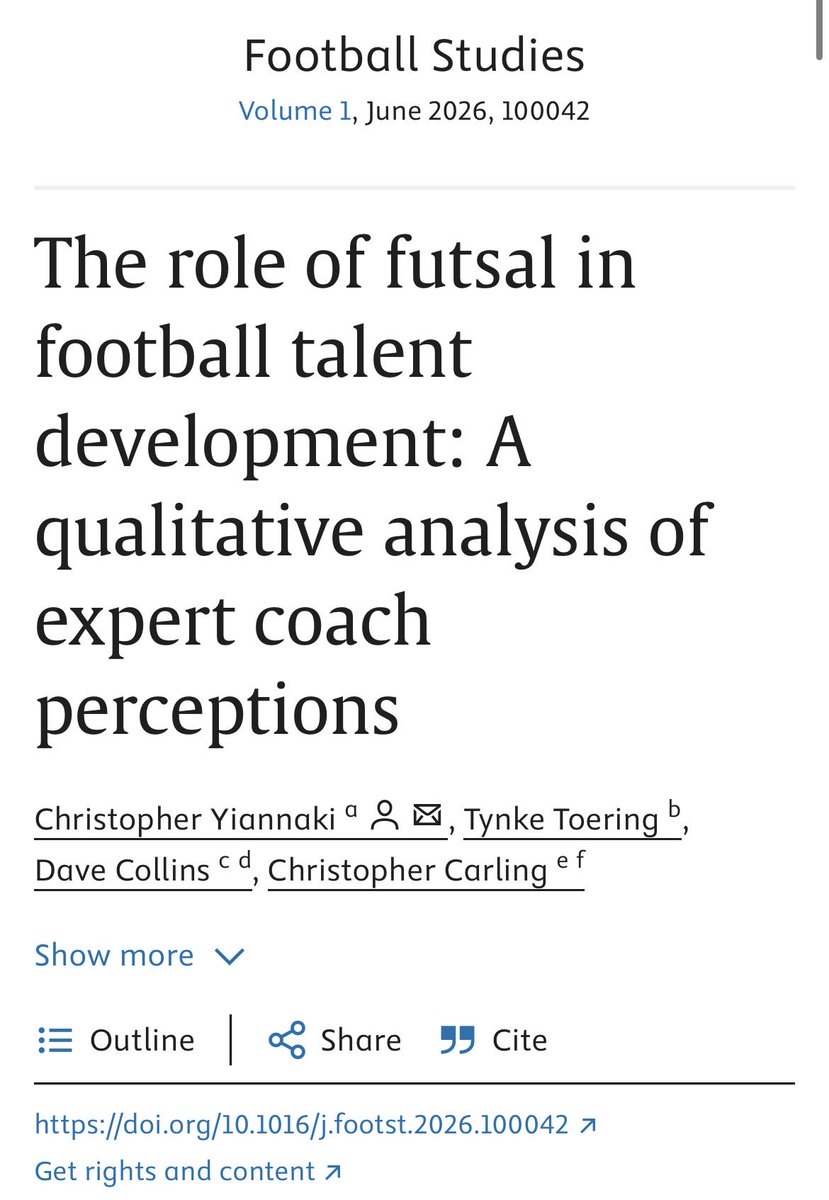
🚨New Publication 🚨
Excited to finally get this one published, & in a futsal special issue too. 🚀🔥⚽️🎓
Open access so download your copy here:
🔗https://t.co/Yk6CddmdmB
@Uni_Lancashire#futsal#football#research#coaching
“Modern football demands adaptability, quick thinking & rich interactions. Opponents are very well prepared, and if you’re too predictable, you become easy to control. We want to be a team that is hard to read, yet still balanced, brave and attacking.”👇🏼
https://t.co/TFZfx7MeTk
🆕“This review aimed to synthesize current evidence on the effects of numerical superiority-NS & inferiority during SSG in ⚽️”
➡️ Playing in NS is consistently associated with ⬇️ physiological & physical demands
👉@MCRumpf et al. 2026 🇩🇪
📂Open Access: https://t.co/4FEP8Rk2CX
This is a landmark paper, but it is also one of the most misunderstood. Ericsson, Krampe, and Tesch-Romer are not saying that simple repetition creates expertise. Their argument is narrower and more useful: elite performance is strongly tied to deliberate practice, meaning structured, effortful work aimed at improvement, with feedback, repetition, and attention to weaknesses. They also argue that many traits people label as “talent” may reflect years of this kind of training rather than some fixed gift.
One reason the paper still matters is that it separates practice from performance, play, and work. Deliberate practice is not just doing the activity more often. It is designed to improve the activity. The paper also makes clear that this kind of work is not inherently enjoyable and cannot be pushed indefinitely. It is effortful, limited by recovery, and usually built over years, not weeks. The authors repeatedly point to a long preparation period, often around a decade, across domains like chess, music, math, tennis, swimming, and distance running.
The violin data are what made the paper famous. The best young violinists had accumulated about 7,410 hours of practice by age 18, compared with 5,301 for the good violinists and 3,420 for the future music teachers. In the diary portion, the more accomplished groups also practiced alone far more than the teachers, and that practice was organized in a deliberate way. Practice alone was rated the most relevant activity for improvement, sessions were limited in duration, and the higher-level players also slept more and napped more, which fits the paper’s larger point that high performance is tied to both quality practice and recovery.
The fair criticism is that this paper does not prove practice explains everything. Much of the evidence relies on retrospective estimates, diary methods, and small, highly selected groups. So the strongest takeaway is not that talent does not exist. It is that elite performance is far more trainable, structured, and process-driven than people usually think. That is why this paper still matters.