Saturday's No Kings protests were massive, inclusive, and nonviolent. It was an honor to team up with @owasow to analyze how nonviolent resistance can wins hearts, minds, and elections.
Elimination of standardized testing seemed more ideological than evidence-based, BUT if I'm trying to steel-man the position, using them as a selection tool created collider bias which eliminating them reduced, producing a fuller view of their predictive value.
No replication crisis here. In the last two years, each Ivy League school has independently discovered that standardized tests predict success in college:
1. Dartmouth (Feb 5, 2024):
“Several key findings guided our decision: First, standardized test scores are an important predictor of a student's success in Dartmouth's curriculum, and this is true regardless of a student's background or family income.”
“Research shows that standardized test scores can be an important predictor of academic success at a place like Dartmouth and beyond—more so even than just grades or recommendations, for example.”
2. Yale (Feb 22, 2024):
“Yale’s research from before and after the pandemic has consistently demonstrated that, among all application components, test scores are the single greatest predictor of a student’s future Yale grades. This is true even after controlling for family income and other demographic variables, and it is true for subject-based exams such as AP and IB, in addition to the ACT and SAT.”
3. Brown (March 5, 2024):
“Our analysis made clear that SAT and ACT scores are among the key indicators that help predict a student’s ability to succeed and thrive in Brown’s demanding academic environment.”
4. Harvard (April 11, 2024):
“Research by Opportunity Insights has shown that SAT and ACT scores are the single strongest predictors of academic success at selective colleges like Harvard... Standardized tests provide a common benchmark that can help us evaluate applicants’ readiness for the academic challenges at Harvard in a way that is more fair and equitable than high school grades alone.”
5. Cornell (April 22, 2024):
“After a multi-year study conducted by the university’s Task Force on Standardized Testing in Admissions, data showed that when reviewed in context with other application materials—such as GPA, academic rigor, extracurricular engagement, essays, and letters of recommendation—test scores help to create a more complete picture of an individual applicant.”
6. Penn (Feb 14, 2025):
“Penn’s practice has been, and continues to be, considering a student’s school-based academic record on its own merit, with testing as part of Admission’s broad and comprehensive assessment. With this approach, testing complements a student’s existing accomplishments and can offer additional relevant information in our comprehensive and holistic admission process.”
7. Princeton (Oct 9, 2025):
“The decision to resume testing requirements follows a review of five years of data from the test-optional period, which found that academic performance at Princeton was stronger for students who chose to submit test scores than for students who did not.”
8. Columbia (June 11, 2026):
“Through a multi-year faculty review, it was determined that test scores, among other factors, were a useful indicator of potential student success.”
My new book📖Delivering Tolerance📖 just arrived in the mail! Can't believe I get to hold an actual copy after 8+ yrs of work! More updates soon, but for now u can preorder a copy @PrincetonUPress and get 30% (discount code P329) and I will go celebrate! https://t.co/0609neyJ4X
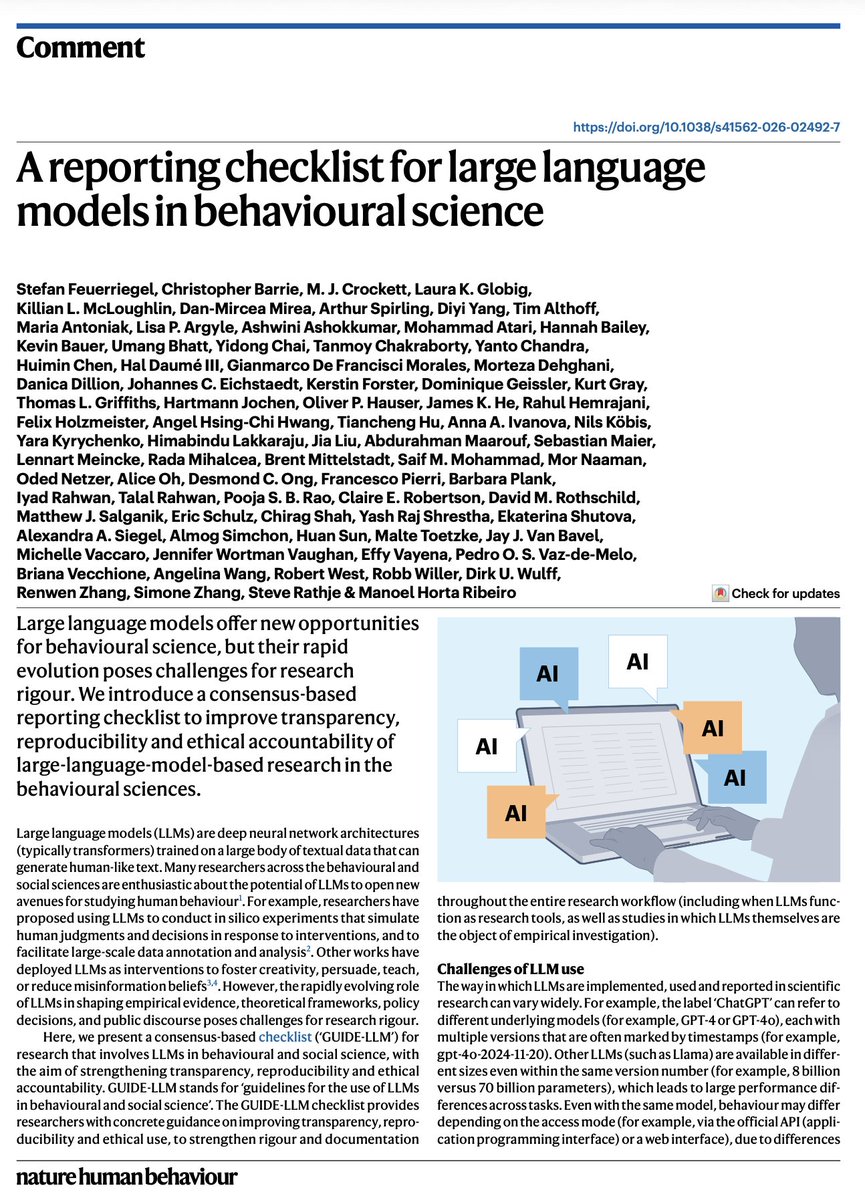
Large language models offer new opportunities for behavioural science, but their rapid evolution poses serious challenges for research rigour.
We published a consensus-based reporting checklist to improve transparency, reproducibility and ethical accountability of large-language-model-based research in the behavioural sciences in Nature Human Behaviour.
https://t.co/ELCU5h6uQe
Here is a link to our checklist for research transparents: https://t.co/XH0FxupT6D
It supports researchers in clearly describing how LLMs were used, why specific methodological choices were made, and what steps were taken to ensure responsible research practices.
This project was led by @stfeuerriegel and included a large list of expert coauthors from across numerous fields.
Berkeley Professor Mina Aganagic:
“‘I realized that for students to follow me…I had to start reviewing basic algebra stuff, like fractions.’ The lack of mathematical fluency, Aganagic said, extended even to ‘the meaning of equals in an equation.’”
Admin bloat is a big problem and addressing this issue should be the main focus of University leaders as they consider other measures that directly hurt our core mission of research and teaching.
At MIT, for example, faculty grew only 9% from 1985-2023. Administrative staff grew 189%. https://t.co/nAQNqzXAaK
This the quintessential story of how sports reflects the state of the world. Thousands of fans have waited for Game 3 their whole lives and now they’re priced out of entering the game and can’t even celebrate outside because one billionaire gets to attend the game for free.
This is a devastating interview.
Scott Pelley tells the NYT that Bari Weiss directly put a “thumb on the scale” for Trump over the killing of Renee Good.
Here’s his explanation of exactly what happened.
Using AI to simulate peer review. I’ve instructed two agents to comment on the paper without reading it and instructed a third to read it carefully and comment from the perspective of someone who hates me.
WOW -- Trump crashes out and cuts his interview with Welker short as she presses him on his lack of evidence for claiming elections are rigged
"You're either crooked or you're stupid. Let's call it quits. Because I've had enough. Thank you darling," he tells her."
"I traveled all the way to Wisconsin for this interview," she pleads.
Political identity drives choice of large language models—even when accuracy is incentivized.
Participants (N=1,884) quickly developed preferences for AI systems that aligned with their political identities, and these preferences were stronger when models carried recognizable brand names. In the second stage, 71% persisted with their previously preferred model despite incentives for correctness.
This reveals that users do not treat AI systems as neutral tools. Instead, they select between them in ways that reflect political identity. https://t.co/ULNV5Q2I6J
This is consistent with the identity-based model of belief: People select information sources and allocate attention toward in-group sources. You then need strong incentives to override their partisan bias: https://t.co/xdhc0DlMvt
The denial of reality has been a terrible move in the humanities and social sciences.
This report is a serious critique of many of the problems I've seen in academia that have gotten out of control in the past few years.
And it is led by some of the leading experts across these fields (Joe Henrich, Anthony Appiah, and many others).
We seriously need to fix these issues if we have any hope of regaining credibility and public trust.
@JohnDSailer This old critique of efforts at objective analysis is one of my least favorite arguments that you hear frankly all the time in academia. It's like saying, "no one can drive 100% safely, so you might as well steer into oncoming traffic."
I worry that Wembanyama will get caught up in the distractions of New York City, like the Rose Reading Room at the public library or the upcoming conference on participatory futures at The New School
This is one of the most vivid examples of what drives a lot of basketball fans crazy these days. Shai Gilgeous-Alexander obviously isn't the only one who does this, but players trying to get fouled instead of trying to score makes for an awful viewing experience. Sure, it's the smarter analytical play. Free throws are very efficient. But 20 years ago (and maybe even more recently than that), players used pump fakes to then take an open shot. Now, the free throws are prioritized by so many stars.