The S&P 500 is now down 8% from its peak on October 6, the 3rd pullback of the year and largest since March. This is the 34th correction >5% off of a high since the March 2009 low. They all seemed like the end of the world at the time.
Meet David Tepper, the billionaire investor behind Appaloosa Management and arguably one of the greatest investors of his generation.
He has outperformed the S&P 500 by 20 percentage points annually over the past 20 years.
Here are his top 10 US-listed holdings (as of 30 Sept):
The Retirement Savings Challenge Is Clear. Only 35% believe their retirement savings are on track, reinforcing the need to help Americans save more, and save earlier, for retirement. https://t.co/hUEoUqhGu8
The Last Mile Could Be the Hardest! Getting inflation from where it is today back to 2% may require substantially tighter monetary policy than markets are currently pricing. https://t.co/ZquAEHj6PL
Healthcare Costs Take Center Stage. Healthcare cost control is employers’ #1 priority for 2027. But here’s the real question: Are employers actually managing costs, or just shifting them around?https://t.co/rAkIMqvPpG
Stop-Loss Market Gets Harder. Rising rates, tighter underwriting and less competition put even more pressure on self-funded employers to actively manage high-cost claims and risk. https://t.co/NE5qAGmN0Q
AI With Employees, Not At Them!
AI adoption works best when employees have the agency to experiment, learn, and make it their own. https://t.co/FYFinVH7Md
The Federal Reserve held interest rates steady today, and we think patience is the right approach. Inflation remains high, but the question isn't simply whether rates should go higher. It's whether higher rates would actually address the inflation that remains.
The challenge is that parts of the economy, and of inflation itself, are moving at very different speeds. Growth remains remarkably resilient in aggregate, supported by a powerful investment cycle, but beneath the surface, parts of the economy that are more sensitive to borrowing costs are feeling considerably more restraint. We see a similar divergence in inflation. Many of the cyclical components that respond to higher interest rates appear relatively well controlled. Meanwhile, persistent pressures across energy, insurance, healthcare and education are unlikely to be meaningfully affected by another 25-basis-point rate increase.
In some ways, the Fed is operating a house with one thermostat, but very different temperatures in every room. Turning it down further may make the rooms that are already cool even colder, without doing much to cool those that remain hot.
That doesn't mean the Fed should become complacent. Inflation is still above its 2% objective and the Fed should retain the option to tighten further if the underlying inflation trend deteriorates. But hawkish rhetoric and patient policy can comfortably coexist, particularly when the bond market has already done some tightening of its own through higher Treasury yields.
For investors, we think this environment argues for humility rather than making a heroic directional call on rates. Real yields remain attractive, and there's considerable income available across high-quality fixed income markets. We continue to favor a moderate duration posture, taking advantage of today's income opportunities while remaining patient as this unusually divergent economy evolves.
The Fed doesn't need to ignore the heat. It just needs to be thoughtful about where it's coming from.
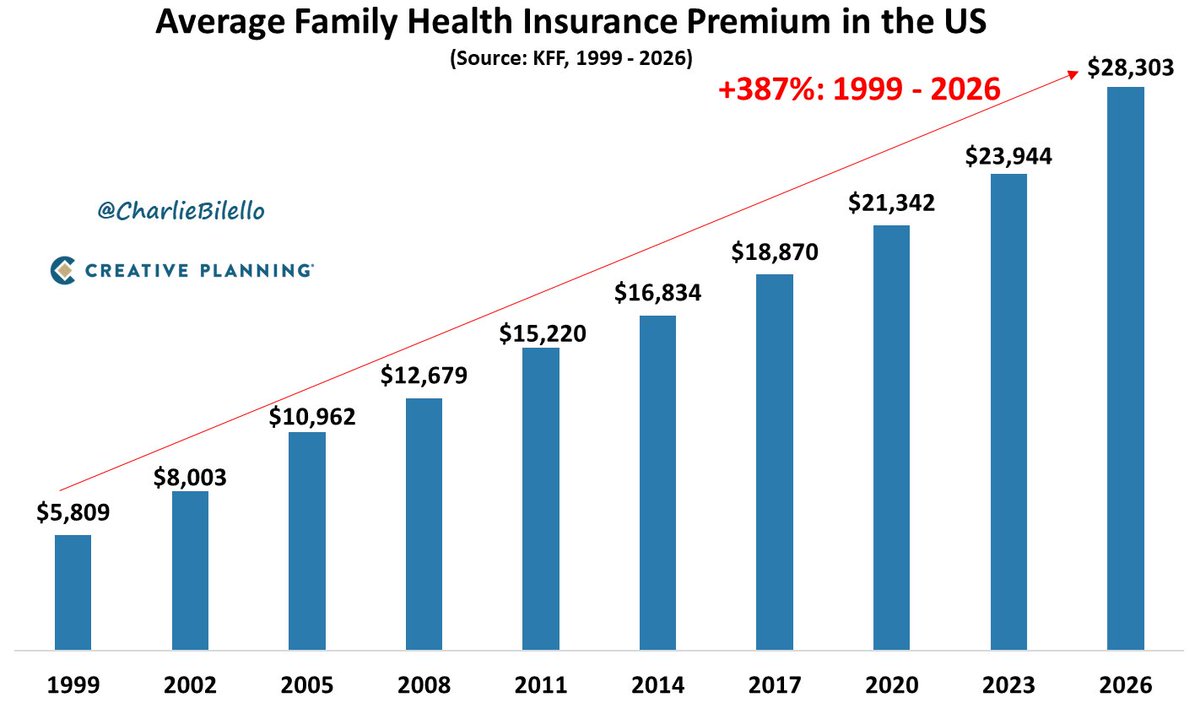
Average US family health insurance premium...
1999: $6k
2002: $8k
2005: $11k
2008: $13k
2011: $15k
2014: $17k
2017: $19k
2020: $21k
2023: $24k
2026: $28k
That's a 387% increase since 1999 (6.0% per year).
(Note: US CPI inflation has increased 2.6%/year)
Leaders seeking a more engaged team often start by listing what the team does poorly. In our coaching work, the more useful starting point is what each person already does well. Teams focusing on their strengths are 12.5% more productive.
Since 1997, hospital boards have been accountable for the quality of care. Five foundations follow, in order: board accountability, prevention, the patient voice, system-wide governance, and finally AI for safety, once the other four hold.