The Game Is Rigged—But You Can Rewrite the Rules
1/ Life’s a VR game, and you’re the player. You chase success, love, or validation, but the game feels rigged. No matter how hard you play, you’re stuck running in circles. Why? Meet the Five Hamster Wheels—glitchy mental code trapping you. Let’s debug your reality. 🧵
Stress resonance is the mirroring of another person's or animal's physiological state through the generation of an isomorphic state in oneself.
"...It has been established that the physiological resonance of stress includes both the sympathetic nervous system and the HPA axis. It is conceivable that such second-hand stress could become chronic, leading to accumulation of allostatic load and ultimately detriment of health, particularly when coupled with one's own first-hand stress experiences..."
— Engert, V., et al. The physiological resonance of psychosocial stress. (2019) PMID: 30594324
If you believe free speech is for you but not your political opponents, you're illiberal.
If no contrary evidence could change your beliefs, you're a fundamentalist.
If you believe the state should punish those with contrary views, you're a totalitarian.
If you believe political opponents should be punished with violence or death, you're a terrorist.
It really is artful to see the extent that content creators who were once supposedly anti-establishment themselves became so captured by audience sensationalism or awkward sponsors that they went on to embody the same issues, if not more-so.
Deep inner suffering inevitably arises when the human person is reduced to performance, consumption, or a statistical datum. Many young people today live under the yoke of expectations to perform, immersed in an exasperated competitiveness that generates anxiety, fear of not measuring up, and disorientation.
One year ago Paulo Gonçalves was not a Bitcoiner.
He's was (and is) renewable energy project developer who has spent his career building small hydroelectric dams across the world.
His problem was simple: many of these dams produce power that the grid can't absorb. The energy is wasted. The economics don't work. He'd seen the problem firsthand and had been searching for a solution for over a decade.
A year ago, he attended a @FREEMadeiraOrg event in Portugal, where he discovered Bitcoin mining.
That day changed everything.
Unlike others who fall into the mistake of evaluating Bitcoin mining without understanding energy, grids or renewable generation - he understood all three intimately, and as such was able to immediately see the value that others (including policymakers and regulators) sometimes miss.
Paulo is now evaluating 100s of small hydropowered sites throughout Portugal that are ideal candidates for Bitcoin miners. There are sites that are "too small" or too remote to be of interest to anyone else.
The miners consume what would otherwise be stranded energy. No subsidy required. The dam that didn't make financial sense now does.
This is the pattern critics miss.
They assume Bitcoin miners are Bitcoiners first, working backwards to justify energy use. In reality in the energy sector it happens the other way around.
Kenji Tateiwa in Japan. Paulo Gonçalves in Portugal, Bipin Patel in Sweden are real people solving real energy problems. Different countries, different energy sources, same discovery pattern:
When you know a lot about energy, and do deep research into how to solve energy problems, you arrive at Bitcoin mining.
Insane stat of the day: California almonds use roughly 3–5.5 million acre-feet of water per year, depending on methodology.
That's ~4-7x more water than all data centers in North America used combined in 2025.
Endurance athletes are building the very disease they think they're outrunning.
Distance runners and cyclists accumulate visceral fat, heart fat, and muscle fat while believing their exercise protects them.
Their cortisol remains too high for too long and contributes to all sorts of dysfunction.
A kid drew himself sleeping in bed between mom and dad and labeled it 'safe.'
In Japan, this exact sleeping arrangement has a name. They call it 'the river.' Mother is one bank. Father is the other. The child between them is the water. Roughly 70% of Japanese mothers sleep this way with their kids, sometimes through the teenage years. The Western model of putting a kid alone in their own bedroom is barely 200 years old. For most of human history, in most cultures still alive today, kids slept beside their parents.
James McKenna runs the Mother-Baby Behavioral Sleep Lab at Notre Dame. He spent decades watching what happens when parents and kids share a bed. The bodies sync up. Heart rates align with the parent's, breathing falls into the same rhythm, and by morning even sleep stages have started matching. The parent's body, in McKenna's words, acts as a kind of biological jumper cable for the child's.
In 2013, researchers in the Netherlands tracked 193 babies through the first year of life. They measured cortisol, the brain's main stress hormone. Babies who had spent more weeks co-sleeping in the first six months produced less cortisol under stress at 12 months. Sleeping near a parent had rewired the kid's stress system to be calmer under pressure.
Inside the kid's brain at night, the amygdala, the fear alarm, gets more sensitive as the body gets tired. Darkness makes it worse. A 2021 paper in PLoS One from Australian researchers showed that light directly suppresses amygdala activity. Lights off, alarm louder. The whole brain is wired to read 'alone in a dark room' as a threat.
Now add a parent's body to that bed. The kid's nervous system reads warm body, breathing nearby, familiar smell. The threat alarm dials down. Two parents on either side dial it down twice. The drawing is the kid's brain calculating maximum safety: I am surrounded by the people who keep me alive, and nothing can reach me without going through them first.
The arrangement in this drawing is what most of human history called 'sleeping.' Sleeping the kid alone in another room is a 200-year-old Western invention that we forgot was an invention. Every kid who has ever padded into your room at 3am and crawled into the middle of the bed is just trying to redraw the picture.
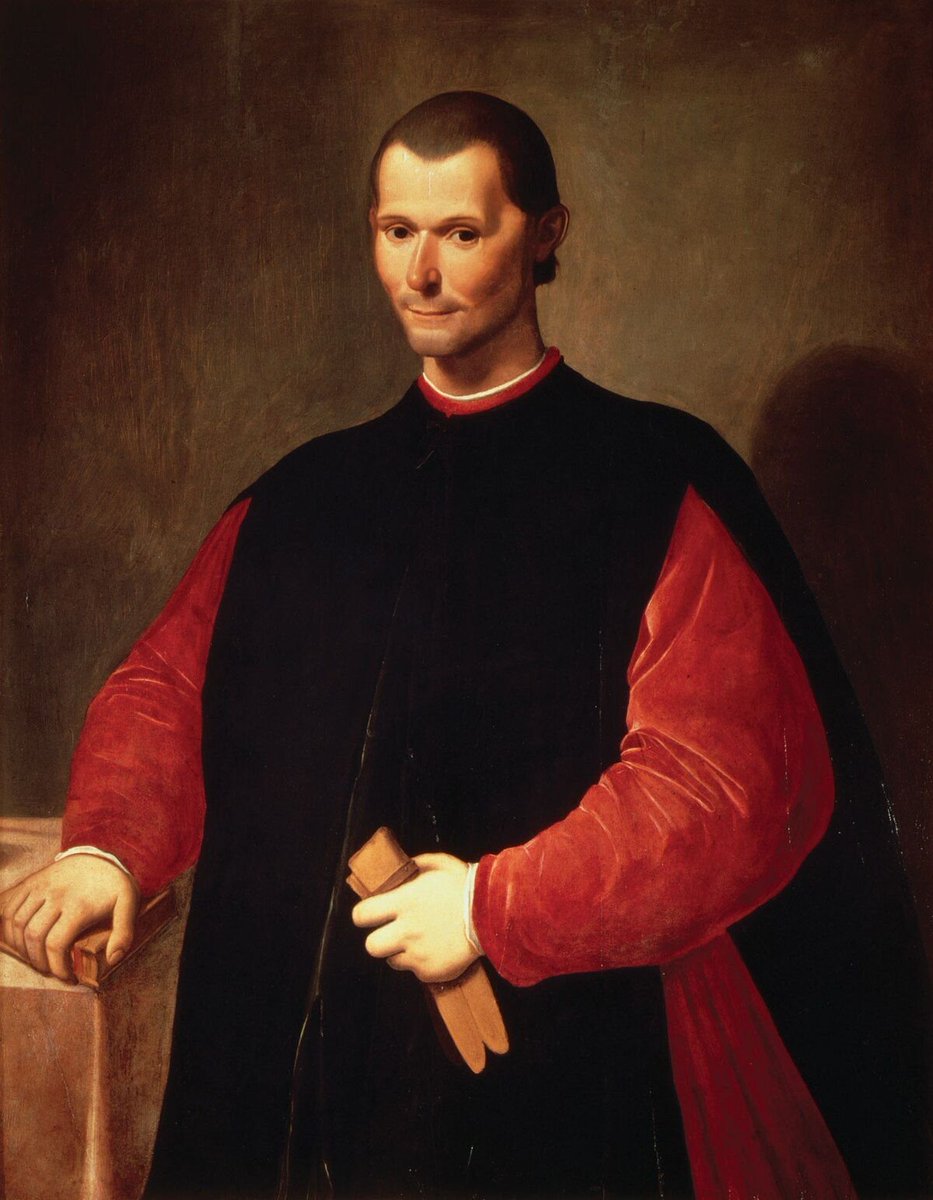
The man who heals what therapists can't:
Niccolo Machiavelli
It's impossible to be psychologically trapped, stressed, or anxious after reading his teachings.
Here's his 4-step guide to unlocking mental freedom and self mastery: 🧵
[Why is Hypothyroidism so Common?]
• In 1941, Broda Barnes found indications of hypothyroidism in about 20% of his students.
• According to Barnes, antibiotics were introduced in 1945, saving millions of hypothyroid children from premature death, allowing them to reproduce.
• In 1961, the American Heart Association officially promoted the idea that saturated fat causes heart disease, shifting the US population towards body-temperature lowering unsaturated fats.
• In 1976, Barnes determined that about 40% of the population was hypothyroid.
• In 1986, congress passed a law exempting vaccine manufacturers from financial responsibility for harm caused by vaccines. According to Ray Peat, childhood vaccinations greatly accelerated after 1989:
"A person is never again the same after reacting to an aluminum adjuvant. The official figures of the US government show clearly that the epidemic of chronic diseases began with the massive increase of vaccinations in 1989." — Ray Peat (2020)
• In 2019, Protsiv et al. found that the "normal" oral temperature of 37°C in men and women had decreased by 0.03°C per birth decade since the industrial revolution.
• Vancamp, et al. followed up on Protsiv's research, suggesting that thyroid suppression from a toxic environment was the cause of the decline in body temperature:
"A myriad of studies have now unequivocally proven that this constant exposure to low doses of chemical mixtures can deregulate the thyroid axis, and alter human body homeostasis." — Vancamp, et al. (2020)


![dannyroddy's tweet photo. [Why is Hypothyroidism so Common?]
• In 1941, Broda Barnes found indications of hypothyroidism in about 20% of his students.
• According to Barnes, antibiotics were introduced in 1945, saving millions of hypothyroid children from premature death, allowing them to reproduce.
• In 1961, the American Heart Association officially promoted the idea that saturated fat causes heart disease, shifting the US population towards body-temperature lowering unsaturated fats.
• In 1976, Barnes determined that about 40% of the population was hypothyroid.
• In 1986, congress passed a law exempting vaccine manufacturers from financial responsibility for harm caused by vaccines. According to Ray Peat, childhood vaccinations greatly accelerated after 1989:
"A person is never again the same after reacting to an aluminum adjuvant. The official figures of the US government show clearly that the epidemic of chronic diseases began with the massive increase of vaccinations in 1989." — Ray Peat (2020)
• In 2019, Protsiv et al. found that the "normal" oral temperature of 37°C in men and women had decreased by 0.03°C per birth decade since the industrial revolution.
• Vancamp, et al. followed up on Protsiv's research, suggesting that thyroid suppression from a toxic environment was the cause of the decline in body temperature:
"A myriad of studies have now unequivocally proven that this constant exposure to low doses of chemical mixtures can deregulate the thyroid axis, and alter human body homeostasis." — Vancamp, et al. (2020)](https://pbs.twimg.com/media/GQ8B03jWkAAUc5Y.jpg)
![dannyroddy's tweet photo. [Why is Hypothyroidism so Common?]
• In 1941, Broda Barnes found indications of hypothyroidism in about 20% of his students.
• According to Barnes, antibiotics were introduced in 1945, saving millions of hypothyroid children from premature death, allowing them to reproduce.
• In 1961, the American Heart Association officially promoted the idea that saturated fat causes heart disease, shifting the US population towards body-temperature lowering unsaturated fats.
• In 1976, Barnes determined that about 40% of the population was hypothyroid.
• In 1986, congress passed a law exempting vaccine manufacturers from financial responsibility for harm caused by vaccines. According to Ray Peat, childhood vaccinations greatly accelerated after 1989:
"A person is never again the same after reacting to an aluminum adjuvant. The official figures of the US government show clearly that the epidemic of chronic diseases began with the massive increase of vaccinations in 1989." — Ray Peat (2020)
• In 2019, Protsiv et al. found that the "normal" oral temperature of 37°C in men and women had decreased by 0.03°C per birth decade since the industrial revolution.
• Vancamp, et al. followed up on Protsiv's research, suggesting that thyroid suppression from a toxic environment was the cause of the decline in body temperature:
"A myriad of studies have now unequivocally proven that this constant exposure to low doses of chemical mixtures can deregulate the thyroid axis, and alter human body homeostasis." — Vancamp, et al. (2020)](https://pbs.twimg.com/media/GQ8BznsX0AAwV4J.jpg)
![dannyroddy's tweet photo. [Why is Hypothyroidism so Common?]
• In 1941, Broda Barnes found indications of hypothyroidism in about 20% of his students.
• According to Barnes, antibiotics were introduced in 1945, saving millions of hypothyroid children from premature death, allowing them to reproduce.
• In 1961, the American Heart Association officially promoted the idea that saturated fat causes heart disease, shifting the US population towards body-temperature lowering unsaturated fats.
• In 1976, Barnes determined that about 40% of the population was hypothyroid.
• In 1986, congress passed a law exempting vaccine manufacturers from financial responsibility for harm caused by vaccines. According to Ray Peat, childhood vaccinations greatly accelerated after 1989:
"A person is never again the same after reacting to an aluminum adjuvant. The official figures of the US government show clearly that the epidemic of chronic diseases began with the massive increase of vaccinations in 1989." — Ray Peat (2020)
• In 2019, Protsiv et al. found that the "normal" oral temperature of 37°C in men and women had decreased by 0.03°C per birth decade since the industrial revolution.
• Vancamp, et al. followed up on Protsiv's research, suggesting that thyroid suppression from a toxic environment was the cause of the decline in body temperature:
"A myriad of studies have now unequivocally proven that this constant exposure to low doses of chemical mixtures can deregulate the thyroid axis, and alter human body homeostasis." — Vancamp, et al. (2020)](https://pbs.twimg.com/media/GQ8Bx70WgAEw1Ks.jpg)







![dannyroddy's tweet photo. [Why is Hypothyroidism so Common?]
• In 1941, Broda Barnes found indications of hypothyroidism in about 20% of his students.
• According to Barnes, antibiotics were introduced in 1945, saving millions of hypothyroid children from premature death, allowing them to reproduce.
• In 1961, the American Heart Association officially promoted the idea that saturated fat causes heart disease, shifting the US population towards body-temperature lowering unsaturated fats.
• In 1976, Barnes determined that about 40% of the population was hypothyroid.
• In 1986, congress passed a law exempting vaccine manufacturers from financial responsibility for harm caused by vaccines. According to Ray Peat, childhood vaccinations greatly accelerated after 1989:
"A person is never again the same after reacting to an aluminum adjuvant. The official figures of the US government show clearly that the epidemic of chronic diseases began with the massive increase of vaccinations in 1989." — Ray Peat (2020)
• In 2019, Protsiv et al. found that the "normal" oral temperature of 37°C in men and women had decreased by 0.03°C per birth decade since the industrial revolution.
• Vancamp, et al. followed up on Protsiv's research, suggesting that thyroid suppression from a toxic environment was the cause of the decline in body temperature:
"A myriad of studies have now unequivocally proven that this constant exposure to low doses of chemical mixtures can deregulate the thyroid axis, and alter human body homeostasis." — Vancamp, et al. (2020)](https://pbs.twimg.com/media/GQ8B2etWkAAA5bF.jpg)


