LATEST: 🇺🇸 Senator Cynthia Lummis accused Democrats of "a deliberate decision to run out the clock and kill" the CLARITY Act rather than risk an on-the-record "no" vote.
Dems finally saying the quiet part out loud: it’s not about protecting consumers from scams or ensuring businesses and jobs stay in America, it’s about hurting Trump by any means necessary — no matter who becomes collateral damage.
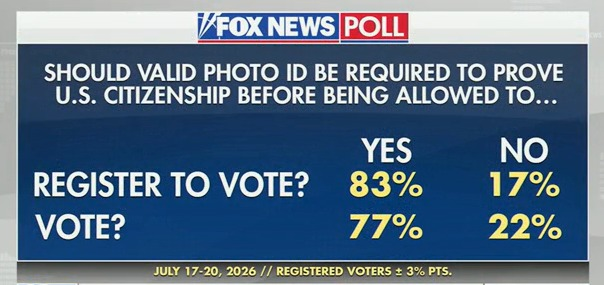
Senator Warren might be the very reason we need to pass the Save America / Voter ID Act. Most of us cannot understand how someone like her is in office at all, but it’s a safe assumption that voter fraud is happening. Pass the Save America Act, Pass Clarity. She knows it, we know it, so stop the clown show. @SenLummis #crypto #CLARITY #SAVEAMERICA
@KlashNYC@StateDept Thank you. Looks like replacement application might work. Will see if it allows me to apply, would be cool to have the commemorative edition.
@SenLummis@SenLummis is very patient. Babying and pleasing these ungrateful poor excuses of senators. I wouldn’t have patience for these little cry baby commies. Frustrating, but good job, to Senator Lummis. You shouldn’t have to deal with this nonsense.
More than a year ago, the House passed the Clarity Act.
There’s been progress since — thousands of hours of bipartisan negotiations took place at the staff and Member levels. The Senate Committees on Banking and Agriculture advanced their respective titles. And Senate Republicans produced a floor-ready product that, as I type this, is waiting for a vote.
It’s disappointing — but not surprising — that Senate Democrats are choosing politics on the cusp of a major victory for American leadership. Find another instance in history where Congress, when given the choice, opted to push an industry out of the United States rather than smartly regulate it. American Exceptionalism was once a bipartisan goal; if Clarity fails, I have serious doubts.
These same Democrats — many of whom have taken millions of dollars from the crypto industry — proclaim that Clarity lacks safeguards for consumers and falls short in countering illicit finance. Nothing could be further from the truth. Titles II and III materially uplift regulatory and compliance obligations for digital asset intermediaries, placing them on similar footing with traditional financial institutions. The Blockchain Regulatory Certainty Act — which Washington lobbyists have spun up as a boogeyman for certain groups of prosecutors and law enforcement — does nothing other than codify longstanding Treasury Department policy that’s remained consistent across Administrations: non-custodial builders and developers are not, and have never been, subject to registration obligations under the Bank Secrecy Act. And at this point, major law enforcement trades that once opposed the bill, including the Fraternal Order of Police, have now endorsed it.
The Senate needs to vote NOW on this landmark legislation. The truth is that Senate Democrats are afraid to advance the Clarity Act as they fear Senator Warren and the “Anti-Crypto Army” she once promised to build. In the days ahead, Leader Thune will put this theory to the test. Will Senate Democrats be on the side of American Exceptionalism, or will they opt to cede American leadership of a global industry for fear of the bespectacled squirrel’s Left flank?
America will lead or America won’t. It’s not more complicated than that. I believe Satoshi once said it best:
“If you don’t believe me or don’t get it, I don’t have time to try to convince you, sorry.”
Interesting. Ran this through AI to get feedback and XRP price for this scenario, here’s what it says:
🚨 The Global XRP Supply Shock: Grounded in Real Financial Math 🏦
Most people look at XRP’s 100 Billion max supply and assume it's too high. But when you map it against the actual plumbing of global finance, a massive supply shock isn't just possible—it's mathematically logical.
1. The Institutional Math 🔒
If you exclude retail investors and focus strictly on institutions (45,000+ banks, central banks, and asset managers), the 1 billion XRP released from escrow each month completely vanishes. It leaves a mere 12,000 to 21,000 XRP available per institution each month.
Many of these entities won't just use XRP as a pipe—they will want to hold it on their balance sheets as a reserve asset or collateral. If they aggressively hoard XRP, it starves the open market, leaving a tiny fraction (only 1 to 5 Billion XRP) as active trading liquidity. [1, 2]
2. Justifying the Value: Tracking the Trillions 🌍
Where does the massive transaction volume come from to justify a high price? We don't have to guess—the targets are already moving on institutional rails:
•Ripple Treasury: Ripple's executive leadership highlighted their corporate acquisitions handle $16 Trillion in annual corporate treasury and payment flows. [1]
•Swift Network: Capturing just 15% of Swift's massive volume (which moves the equivalent of global GDP every 3 days) brings roughly $225 Trillion. [1, 2]
•The DTCC: The DTCC processes a staggering $4.7 Quadrillion annually. Capturing a modest 5% to 10% of that market injects another $235 Trillion to $470 Trillion into the equation. [1, 2]
This pushes total target cross-border settlements to between $476 Trillion and $711 Trillion annually.
3. The Price Squeeze 📈
To settle up to $711 Trillion a year through a market where 95%+ of the tokens are hoarded on institutional balance sheets, the math forces an epic liquidity squeeze.
To safely clear billions in transactions every single minute through a tiny puddle of open-market tokens, XRP's value must expand exponentially:
•With 5% DTCC + 15% Swift ($476T Volume): XRP's required utility price lands at roughly $520 per token.
•With 10% DTCC + 15% Swift ($711T Volume): If hoarding gridlocks the market down to just 1 Billion liquid tokens, the required clearing price shoots to nearly $1,950+ per token.
The takeaway: Utility moves the trillions, but institutional hoarding locks up the supply. When you force massive global settlement targets through a supply-shocked market, a high per-token price becomes a functional necessity for the system to work. 💎
100B max supply of XRP sounds like a lot but it definitely is NOT. With 1B released each month, this can easily be absorbed through: 1) 1,700 NDAs, 2) tens of thousands of banks, 3) 200+ Central Banks, 4) tens of thousands of asset managers, and of course, retail investors.
If you don’t count retail investors, just institutions and NDAs, this equates to about 12,000-15,000XRP available to buy of the 1B released each month. Supply and demand will be a major driver.
I’m pretty sure many of these institutions will want to hold XRP on their balance sheet and not just for utility and usage. $XRP #crypto #xrp #ripple
CRYPTO CLARITY ACT Price Schedule LEAKED, you did NOT hear this from me:
Phase 1: The Controlled Crash (This Week)
The goal is to trigger maximum liquidations, lower the entry price for institutional buyers, and clear out leverage.
Monday (The Setup): Leak an "insider report" stating that inflation remains sticky, forcing the Federal Reserve to reconsider an unexpected, aggressive interest rate hike.
Wednesday (The Volatility Spike): The Federal Reserve formally announces the rate hike. The Chairman delivers an intentionally hawkish press conference, stating that liquidity must be tightened to cool the economy.
Thursday (The Capitulation): Coordinate major financial outlets to run heavy media coverage declaring "The End of the Crypto Bull Run" as Bitcoin breaks below key psychological support levels.
Phase 2: The Silent Accumulation (The Weekend)
This phase shifts the narrative from panic to quiet optimization while retail traders are fearful.
Friday (The Bottom): Major Wall Street desks and market makers quietly absorb the panic-selling, filling massive buy orders at heavily discounted prices.
Sunday (The Pivot): Release "exclusive leaks" from Washington hinting that Senate leaders have quietly resolved their core gridlock over the ethics provisions of the CLARITY Act.
Phase 3: The Liquidity Moon (Next Week, Before August 7)
The goal is to force short-sellers to buy back their positions (a short squeeze) while FOMO (fear of missing out) drives prices exponentially higher.
Monday (The Catalyst): The Senate officially schedules the CLARITY Act floor vote, declaring it a bipartisan priority before the August 7 summer recess.
Wednesday (The Capitulation Burn): The bill comfortably passes the Senate floor vote, instantly providing legal clarity and classifying major tokens as permanent statutory commodities.
Thursday (The Institutional Flood): Major asset managers immediately file amendments for spot ETFs, unlocking billions in sidelined institutional capital and driving prices to new all-time highs.
Enjoy!