This is also your warning that vol will go up this week as a chunk of volatility managers will be attending a conference together…..(it never fails 😭).
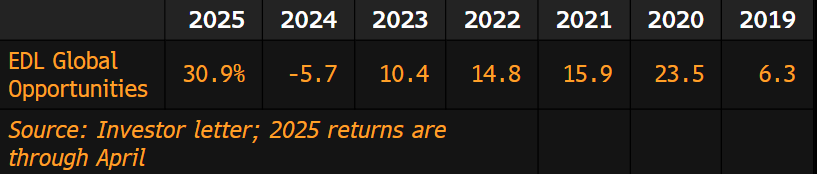
Edouard’s a friend of mine, so I might be a bit biased, but truthfully, the man is one of the best macro traders in the world.
Year after year after year, he puts up consistent numbers regardless of his view.
An absolute stud of a trader.
“I must be a masochist to be short the S&P 500”: trading veteran Edouard de Langlade. “Even when the Fed is on the sidelines, the index bounces back. I am starting to think only divine intervention can put it down for more than a month.” Fund up 31% YTD https://t.co/7yunjJBwEv
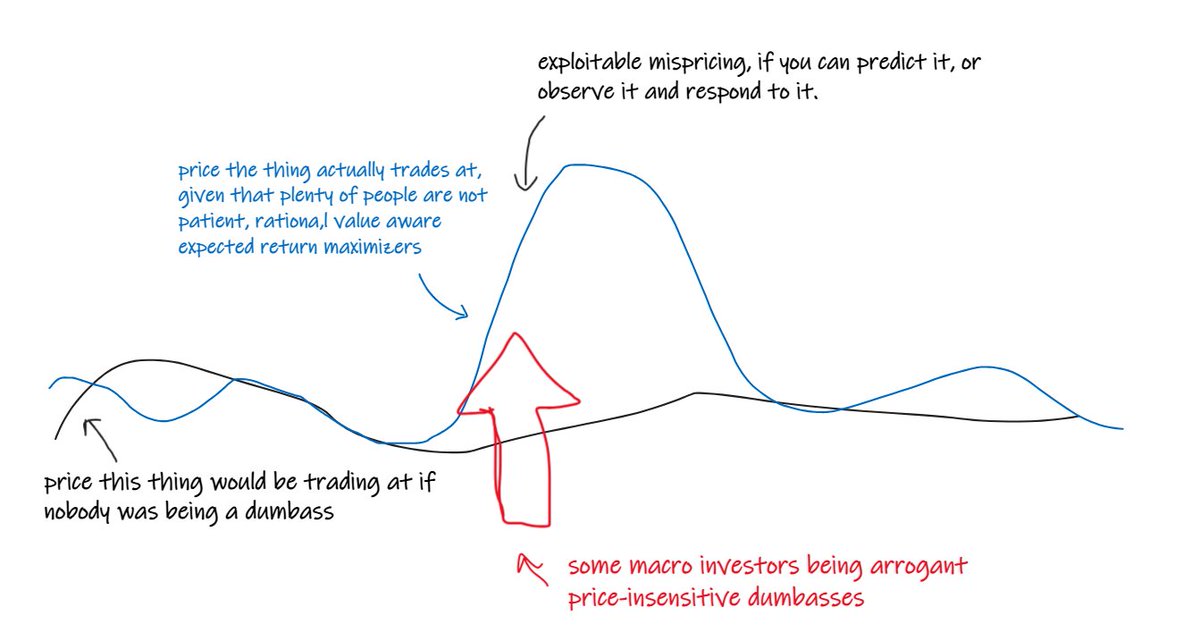
I’m going to steal this slide because it perfectly illustrates the edge we have when trading flow.
This dynamic plays out across the entire U.S. equity market every single day—across a ton of stocks, option tenors, and strikes, all within short time horizons.
nearly everything that is a good repeatable trading idea looks like:
"under <some circumstances> this thing is likely to be too cheap/rich because <some people> are being forced or greedy or stupid... so the thing is more likely to go up/down in the future"
This is also your warning that vol will go up this week as a chunk of volatility managers will be attending a conference together…..(it never fails 😭).
For years a very simple front month Contango signal in the $VIX complex was a green light to short vol (couple papers written on this as well).
Over the last 8 months or so that signal has been a complete contra.
This is also your warning that vol will go up this week as a chunk of volatility managers will be attending a conference together…..(it never fails 😭).
This week I’ll be in Vegas presenting at EQDerivatives
If you guys are attending the conference and would like to chat about some vol trading, feel free to hit me up!
For years, it has been widely accepted that long volatility and tail risk programs inevitably suffer substantial bleed. The prevailing narrative suggests it’s “impossible” to run a flat-carry long volatility book in the hedge fund world. Yet, in the world of proprietary derivativ
We occasionally get asked about how to interpret “flows.” Personally it all starts with understanding the agents in the space, their mandates and how those mandates are implemented.
Tracking inflows and outflows into sector-specific hedge funds is a great tool for gauging
We occasionally get asked about how to interpret “flows.” Personally it all starts with understanding the agents in the space, their mandates and how those mandates are implemented.
Tracking inflows and outflows into sector-specific hedge funds is a great tool for gauging
I think SocGen’s Nelson Report is one of the better PB sources for tracking hedge fund performance and overall sector flows.
Outside of the PB reports, HFM is also a good resource, along with a few others I’m not at liberty to mention publicly.
For years, it has been widely accepted that long volatility and tail risk programs inevitably suffer substantial bleed. The prevailing narrative suggests it’s “impossible” to run a flat-carry long volatility book in the hedge fund world. Yet, in the world of proprietary derivativ
This kind of marketing continues to be incredibly misleading and is a big reason why the tail risk space carries such a poor reputation. Let’s be clear—this is not a 100% return.
The strategy here is built around selling straddles and buying ratios, with the assumption that the
Let me repeat. The point isn’t to do well when markets crash—any idiot can profit from owning puts during a collapse. The real skill (Universa/Spitz) lies in the staying power & discipline to do OK through the long, uneventful stretches and protracted market rallies.