Cloudflare's security team spent the last few weeks testing Anthropic's Mythos against fifty of our own repositories. What we learned about offensive AI, why faster patching is the wrong reaction, and what the architecture around vulnerabilities has to look like next. https://t.co/RSrRtIhgaV
Introducing Flue — The First Agent Harness Framework
Flue is a TypeScript framework for building the next generation of agents, designed around a built-in agent harness.
Flue is like Claude Code, but 100% headless and programmable. There's no baked in assumption like requiring a human operator to function. No TUI. No GUI. Just TypeScript.
But using Flue feels like using Claude Code. The agents you build act autonomously to solve problems and complete tasks. They require very little code to run. Most of the "logic" lives in Markdown: skills and context and AGENTS.md.
Flue is like Astro or Next.js for agents (not surprising, given my background 🙃). It's not another AI SDK. It's a proper runtime-agnostic framework. Write once, build, and deploy your agents anywhere (Node.js, Cloudflare, GitHub Actions, GitLab CI/CD, etc).
We originally built Flue to power AI workflows inside of the Astro GitHub repo. But then @_bgiori got his hands on it, and we realized that every agent needs a framework like Flue, not just us.
Check it out! It's early, but I'm curious to hear what people think. Are agents ready for their library -> framework moment?
partnering with @Kimi_Moonshot to bring kimi k2.6 to @CloudflareDev workers ai on day 0
better for coding and agentic use cases! try it out now:
https://t.co/TYn3uZDRY5
announcing artifacts - a versioned file system that speaks git
certainly the coolest thing i've ever built and i got to build it with some truly great people
fearless leader: @elithrar
zig/git nerd: @mattzcarey
storage goat: @thomas_ankcorn
https://t.co/BSjfaXTnvJ
i spent the afternoon experimenting with Gemma 4's vision capabilities
made an app that uses roboflow RF-DETR for a first pass of object detections and Gemma to summarize the scene in one sentence
for fun i asked Gemma to "describe what you see as if you were a medieval bard"
all made with free local AI models (running via webgpu in the browser thanks to transformers js)
lots more possibilities to explore with this
You've heard of @Cloudflare Durable Objects... but what are they?
What do they enable you to build?
What are the platform guarantees?
What new patterns do they open up?
Good news! I just released a completely free series on Durable Objects!
https://t.co/7Xsf4nZggt
Announcing: EmDash, the WordPress spiritual successor built for the modern web.
TypeScript. Serverless. MIT licensed. x402 for agent-era monetization. MCP server built in. Deploy to Cloudflare or anywhere Node.js runs.
Imports your existing WordPress site in minutes.
npm create emdash@latest
https://t.co/vgqc4tQn30
full rewritten from scratch, now executed (and secured!) inside a dynamic worker, a lot lighter and powerful.
much, MUCH more to come.
(sharing here early because you know how we do)
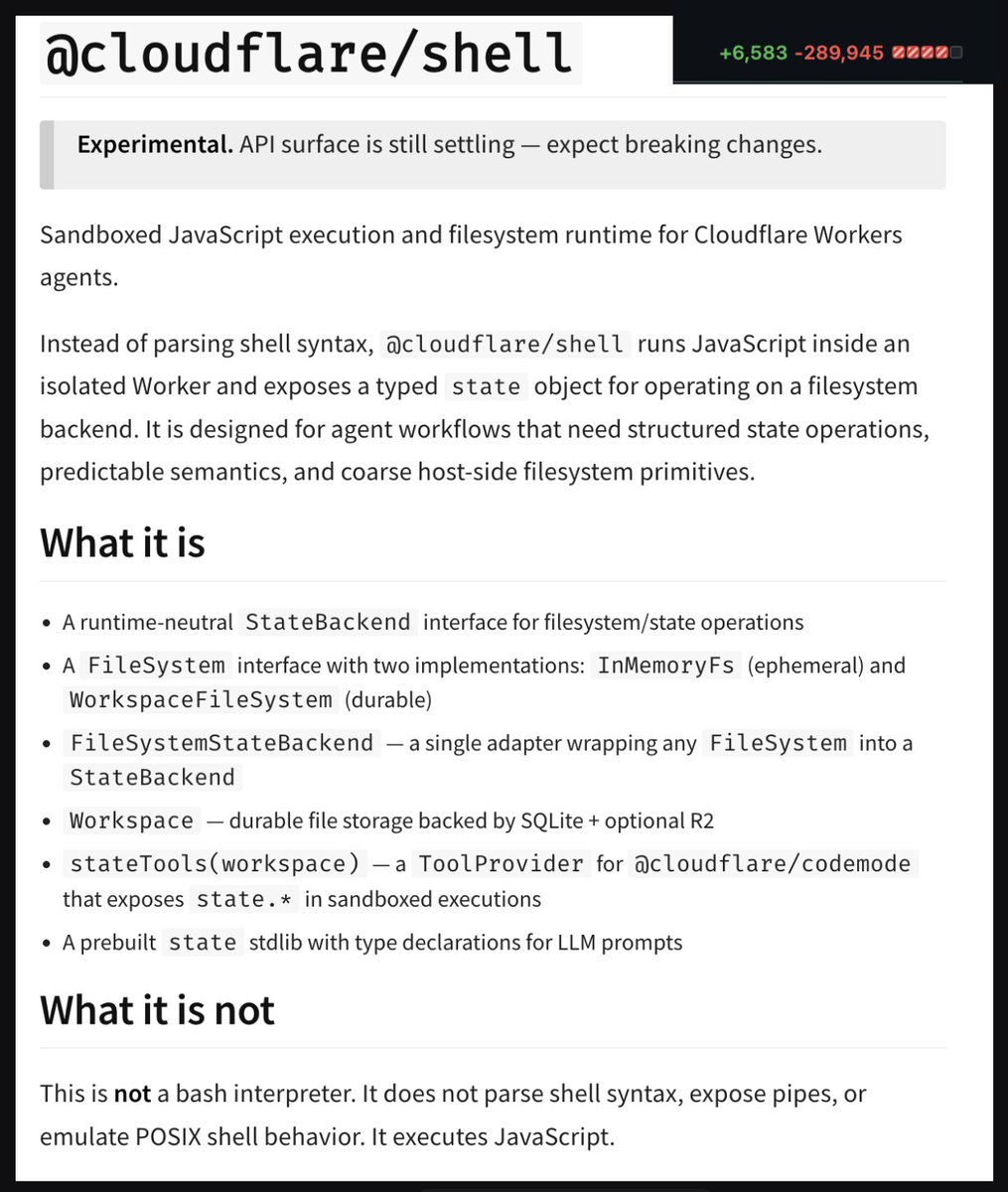
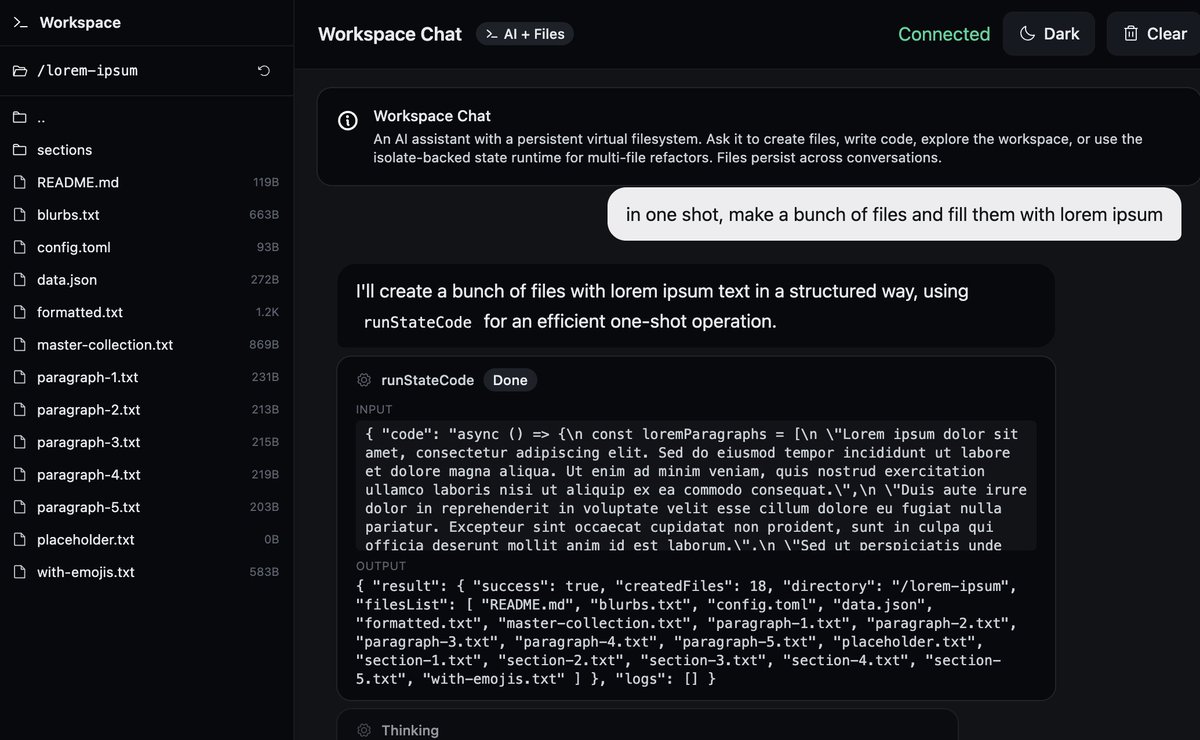
what if we gave every cloudflare agent
a file system (sqlite/r2)
tools to operate on it (shell)
powered (and secured!) by codemode
all powered by workers ai (or byom)
1/4 LLMs solve research grade math problems but struggle with basic calculations. We bridge this gap by turning them to computers.
We built a computer INSIDE a transformer that can run programs for millions of steps in seconds solving even the hardest Sudokus with 100% accuracy
I built a land acquisition intelligence/sourcing platform that scores 1.5M parcels of land across the I-95 corridor for data center and industrial conversion potential.
All with Claude Code... in less than 36 hours.
This used to take their team weeks.
Here's how I did it.
1/ Ingested 1.5M parcels from NC OneMap's ArcGIS REST API with full polygon geometry, zoning, ownership, and tax records across 14 counties
2/ Pulled I-95 corridor geometry and 142 interchanges from OpenStreetMap's Overpass API
3/ Ingested 1,107 substations, 8,174 transmission lines, and 292 gas pipelines from HIFLD federal infrastructure data
4/ Ran PostGIS distance calculations on every parcel to I-85 centerline and nearest interchange using LATERAL KNN joins (100x faster than cross joins)
5/ Normalized hundreds of raw county zoning codes into six categories and scored farmland confidence 0-100 using tax programs, land use codes, and acreage heuristics
6/ Built a motivated seller detection engine: out-of-state owners, estates/trusts, tax delinquency, long hold periods, declining assessed values
7/ Calculated conversion readiness scores using reverse-join spatial queries against 20K industrial parcels (turned a multi-hour query into 15 seconds)
8/ Scraped 2,100 active listings from Redfin's public CSV endpoint with recursive bounding box subdivision to beat their 350-result cap
9/ Wired it all into a composite acquisition score (0-100) with configurable weights, a full-screen map explorer with vector tiles, and a document generation suite that produces institutional-grade investment memos, slide decks, and automated intelligence briefs
The whole thing runs on PostGIS, FastAPI, React, and MapLibre GL JS.
I did all of this with no paid mapping APIs and no paid data sources... at least not yet.
Every piece of spatial math runs inside the database, not Python.
That's how you process 1.5M parcels without melting your laptop.
And you still want to tell me bespoke software isn't the future?
OK this thing is totally insane. Before going to bed I...
* used try to make a new qmdresearcher directory
* told my pi to read this github repo and make a version of that for the qmd query-expansion model with the goal of highest quality score and speed. Get training data from tobi/qmd github.
* woke up to +19% score on a 0.8b model (higher than previous 1.6b) after 8 hours and 37 experiments.
I'm not a ML researcher of course. I'm sure way more sophisticated stuff is being done by real researchers. But its mesmerizing to just read it reasoning its way through the experiments. I learned more from that than months of following ml researchers.
I just asked it to also make a new reranker and its already got higher base than the previous one. Incredible.
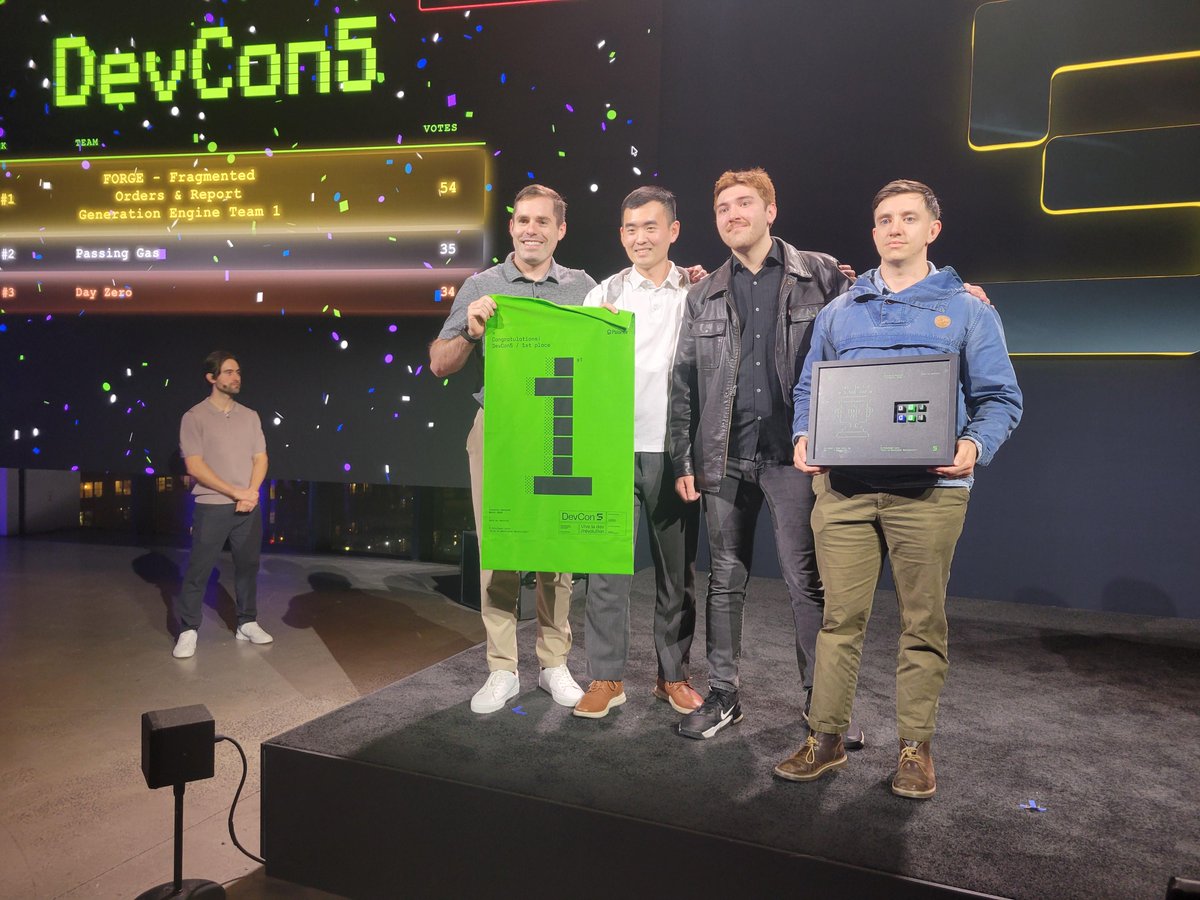
The team of uniformed services members won. It was not even close.
We held a customer hackathon at @PalantirTech DevCon5 last week.
The vast majority of the competitors represented the best of the US private sector. Highly capable developers. And one all-military team of coders.
The most contrarian thing I can tell you right now: the best AI talent in America is wearing the cloth of the nation. 🇺🇸🫡
To expand on Cloudflare's announcement today on rebuilding Next.js on Vite, this is everything included:
- Reimplemented the Next.js API surface on Vite
- Up to 4x faster builds
- ~57% smaller bundles
- Rebuilt the majority of Next.js in a week using AI
- Deployable to Cloudflare Workers, but is designed to be platform-agnostic
- Incremental Static Regeneration backed by KV (or whatever you prefer to use)
- Traffic-aware Pre-Rendering using Cloudflare's global network
- No workarounds for Next.js to use Cloudflare primitives
- Agent Skill to migrate from Next.js to vinext
- Definitely experimental for now!
I probably missed some and the post is just really cool to read, so go read it!
It's now trivially easy to convincingly replicate virtually anyone's voice with AI.
You and your loved ones should develop a password to verify it's you calling them ASAP.
Especially if you're even a little bit rich or famous.
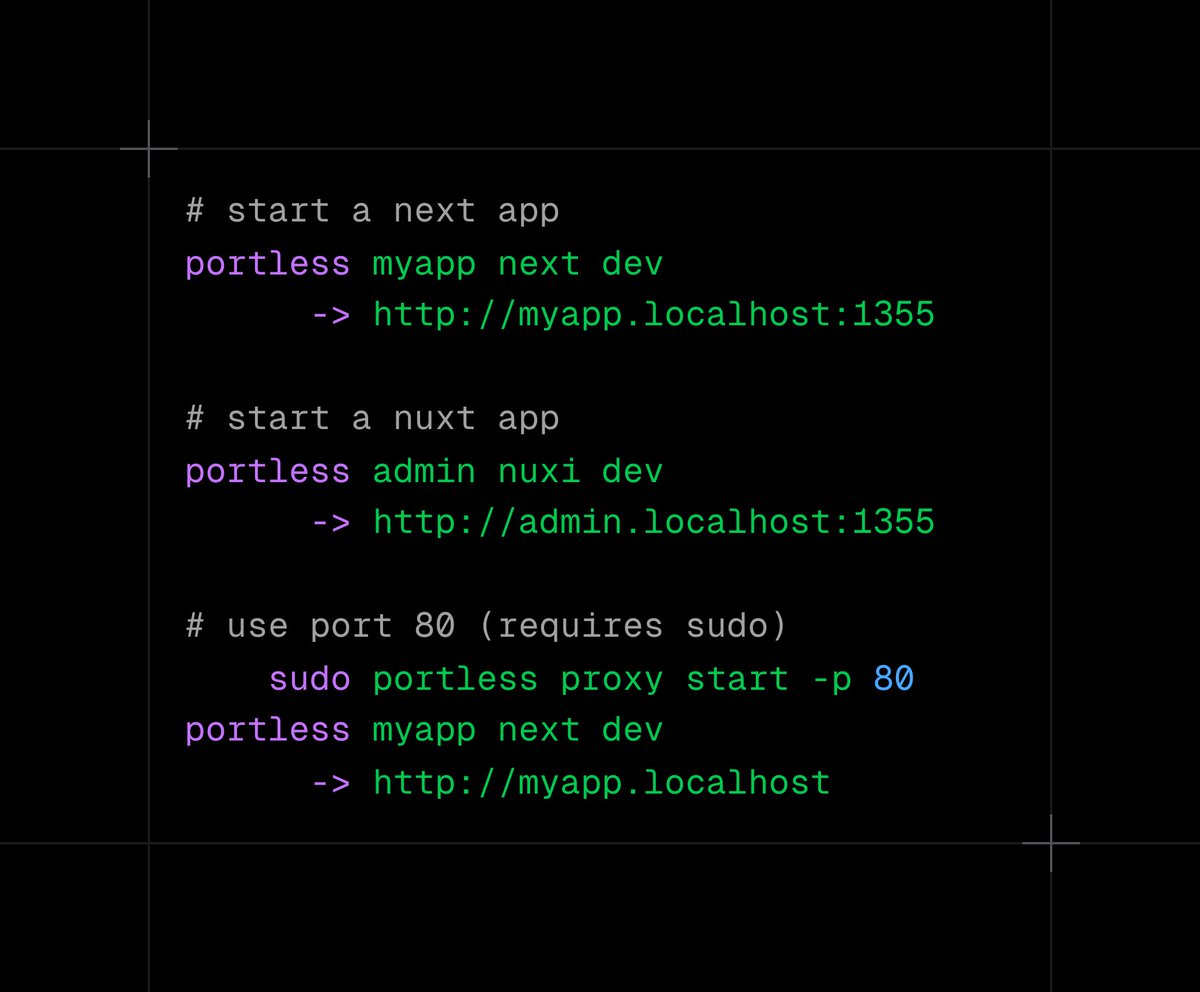
Weekend project: portless
Stable, named URLs for local dev
→ Zero config
→ Subdomains for monorepos
→ No more port roulette or cookie bleed
→ Agents get a reliable URL instead of guessing ports
𝚗𝚙𝚖 𝚒 -𝚐 𝚙𝚘𝚛𝚝𝚕𝚎𝚜𝚜