Cardano Plans Two-Phase Dijkstra Upgrade With Leios and Peras
Cardano has outlined a two-phase rollout for its upcoming Dijkstra era. Phase 1, targeting Q4 2026 code completion, will activate Ouroboros Linear Leios (CIP-164) to increase throughput through supplementary Endorser Blocks, while also introducing nested transactions (CIP-118), guard scripts (CIP-112), account-address enhancements (CIP-159) and simpler staking-reward withdrawals (CIP-181).
Phase 2, targeted for Q2 2027, will activate Ouroboros Peras (CIP-140), adding a stake-pool voting layer designed to accelerate settlement. Both phases will undergo testnet deployment and on-chain governance approval before mainnet activation.
I am extremely grateful to every DRep and ADA holder who voted in support of AlphaGrowth PRIME.
Thank you for choosing the hard path.
The easy path would have been to avoid direct comparison. To find a small, low-competition niche, call a handful of pilots “adoption,” and convince ourselves that Cardano does not need to compete directly with Ethereum, Solana, or the other high-activity networks fighting every day for users, liquidity, developers, integrations, volume, and fees.
You rejected that path.
You chose to bet on Cardano having a fighting chance in DeFi, one of the largest, hardest, and most strategically important markets in this industry.
For years, Cardano did the hard technical work. It built eUTxO, formal methods, secure smart-contract infrastructure, decentralized governance, and more recently, the integrations necessary to connect Cardano to the wider crypto economy.
What Cardano has too often lacked is equally serious market execution: deep liquidity, distribution, business development, institutional DeFi relationships, and a coordinated strategy for turning excellent infrastructure into sustained economic activity.
PRIME our attempt to close that gap.
Franklin D. Roosevelt once said:
“Competition has been shown to be useful up to a certain point and no further—but cooperation, which is the thing we must strive for today, begins where competition leaves off.”
For years, competition within Cardano has served a purpose. Different teams, protocols, institutions, and visions have challenged one another. That pressure sharpened ideas, exposed weaknesses, and helped produce much of the infrastructure we have today.
But we are now reaching the point of “no further.”
The next great competition is not one Cardano project against another. It is Cardano competing against Ethereum, Solana, and every other high-activity network for users, developers, liquidity, integrations, volume, and market share in DeFi.
Competition within the ecosystem helped get us here. Cooperation within the ecosystem is how we compete from here.
“A horse never runs so fast as when he has other horses to catch up and outpace.”
The horses we need to catch are not one another.
For too long, Cardano has largely been allowed to run at its own pace. We could debate internally, celebrate incremental progress, and avoid the uncomfortable question of whether we were moving quickly enough to compete with the fastest ecosystems in the industry.
That changes when we decide to go toe to toe with Ethereum and Solana in DeFi.
They are the fast horses ahead of us. Catching them will require Cardano to move with a level of urgency, coordination, discipline, and execution that we have rarely been forced to demonstrate collectively.
It will require builders, liquidity providers, DReps, wallets, exchanges, infrastructure teams, institutions, and ecosystem organizations to stop treating one another as the primary competition and begin acting like participants in a shared campaign.
More importantly, you placed us under the kind of external competitive pressure that can force an ecosystem to accelerate.
The race ahead will be unforgiving. Ethereum and Solana will not slow down for us. Their liquidity, users, integrations, and developer ecosystems will not be won through rhetoric or technical superiority alone.
We will have to earn market share through execution.
But that is exactly why this moment matters.
Now the responsibility shifts to those of us involved in the program: enforce the gates, scrutinize every deployment, measure honestly, report transparently, return capital that does not earn its way into the market, and deliver results worthy of the confidence you placed in us.
You chose the path that demands more of us: to compete with the best, move with urgency, and genuinely attempt to change the shape of this market.
Now we have to prove we belong at the front of the race.
Worked over half a decade with the unshaken belief that blockchain should be at the backbone of government systems for the betterment of society.
The Peruvian State shares the same vision and has passed the legislation to back it up. Let’s keep this rolling. Thanks for your support Cardano.
So, one more time. The rules for this Discord server are determined by the community through a vote on the code of conduct and an agreement on how we’ll communicate. Moderators will adhere to this code. Alternatively, moderators will be elected by the community.
This is a neutral space where there’s room for discussion on the topic. It’s not for drama, resentment, or disrespect. Normal, empathetic discussions that respect other opinions.
Don’t like the solution? Come up with another one. But just saying it’s wrong doesn’t benefit the community or Cardano.
Why couldn’t Charles be Drep? He owns an estimated 1 billion ADA. For two years, he stayed on the sidelines and let the community decide. But where has that led? It’s one big mess with no plan.
If someone isn’t sitting down and discussing proposals from the treasury with the community, they don’t have access to the treasury. That’s probably logical. It’s the same when you go to ask a VC for money. You have to convince them to give it to you.
Losing the Cardano Summit 2026 was bad enough, but think about losing our DNA, our researchers, our academic rigour?
Or not being ready when the quantum attackers are here as early as 2029?
Or reading the news that Cardano researchers now work for Ethereum? Ethereum Foundation just lost some, I am sure they would be happy to pick them up, if we drop the ball.
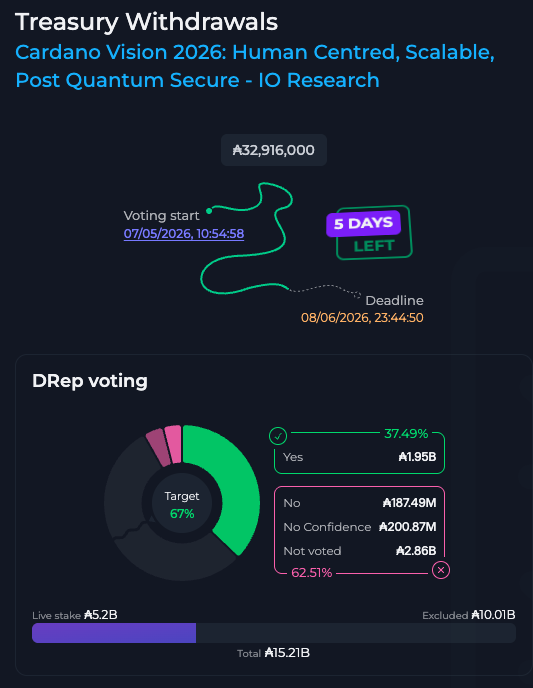
If you as a DRep don't want this to happen, please do upvote the IO Research proposal, only 5 days to go.
If you believe "ah they will just resubmit cheaper" do listen to yesterdays X space from 14:52 to 34:58, about 20 minutes of your time well spend on the future of Cardano.
I wouldn't be this sure and not risk this.
"Why does Cardano's research proposal cover so many areas at once?"
It's a fair question.
Here's the honest answer — and why the alternative could cost more than you think. 🧵
1/7
@CryptoBababooey See that's the issue, people like you are ways pointing the finger at Charles, as if he works in isolation and creates these proposals all by himself. What about the other 500 at iog? You see the tree for the forest.
I have a crazy idea guys. How about instead of voting "No" on the research proposal, that you just sell your ADA and move to a blockchain that matches what you agree with. This way you don't have to try and make Cardano like every other blockchain.
Like many of you, the research basis of Cardano is what brought me in, this is what I signed up for. If you don't like it, leave. It's really not complicated.
You think it's a waste of money? Fine, there are other options for you, so ask yourself why you are even here. Liberate yourself, as I'm sure you will be more happy with less drama in your life.
If you say you like Cardano and want research, but you want to control all that is researched, then you are missing the point. If you don't trust that they will use these resources wisely after 10 years of publishing, then, again, why are you even here?
And yes, I'm talking to you @ItsDave_ADA and @yutazzz, as well as the anti IOG crowd.