The most extensive look at Bill C-22 thus far, finding parts of it "almost certainly constitutionally fatal" — from @cancivlib and @citizenlab (link below)
Matt Hatfield for @OpenMediaOrg, testifying now, before the Public Safety Committee on C-22, is making an exceedingly eloquent case for splitting off part 2 of the bill and giving it up.
Hope they're listening.
Sweeping powers, secret orders, the beginning of a surveillance state…
What actually is the Liberals’ new lawful access legislation: Bill C 22?
https://t.co/azCRqfv9a7
A bigger deal than it may seem:
"The chip, which industry experts said would overhaul engagement with AI, is designed to run AI agents locally rather than relying solely on cloud computing."
A bigger deal than it may seem:
"The chip, which industry experts said would overhaul engagement with AI, is designed to run AI agents locally rather than relying solely on cloud computing."
The most interesting thing about the National Police Federation's brief on Bill C-22 is that they don't ask for a metadata retention power.
Police think we only need a power to preserve data when Telus, Shaw, Google appeal a demand to disclose it.
A "Preserve Pending Review" clause. That's it.
Reading the National Police Federation's brief on Bill C-22, the case for a power to force telcos and VPNs to install surveillance capabilities (for when police have a warrant) clashes with claims to respect encryption.
Is this even realistic? Wouldn't criminals just use a service not subject to Canadian law?
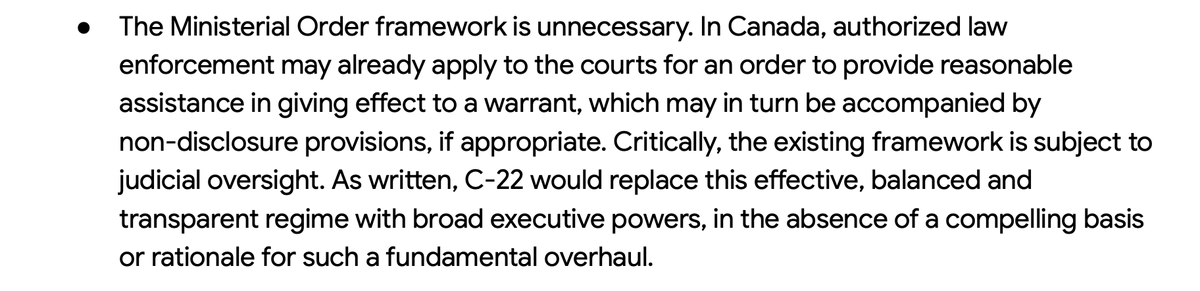
Google also thinks the whole idea of Ministerial Orders in the Bill are unnecessary — if police need more help gaining access to private data, we have tools for that in the Criminal Code.
This is Google's suggested re-write of the limits around metadata retention in Bill C-22:
-don't make us hold onto to more than we already do, or
-do anything to modify how our products or services work.
This is Google's suggested re-write of the limits around metadata retention in Bill C-22:
-don't make us hold onto to more than we already do, or
-do anything to modify how our products or services work.
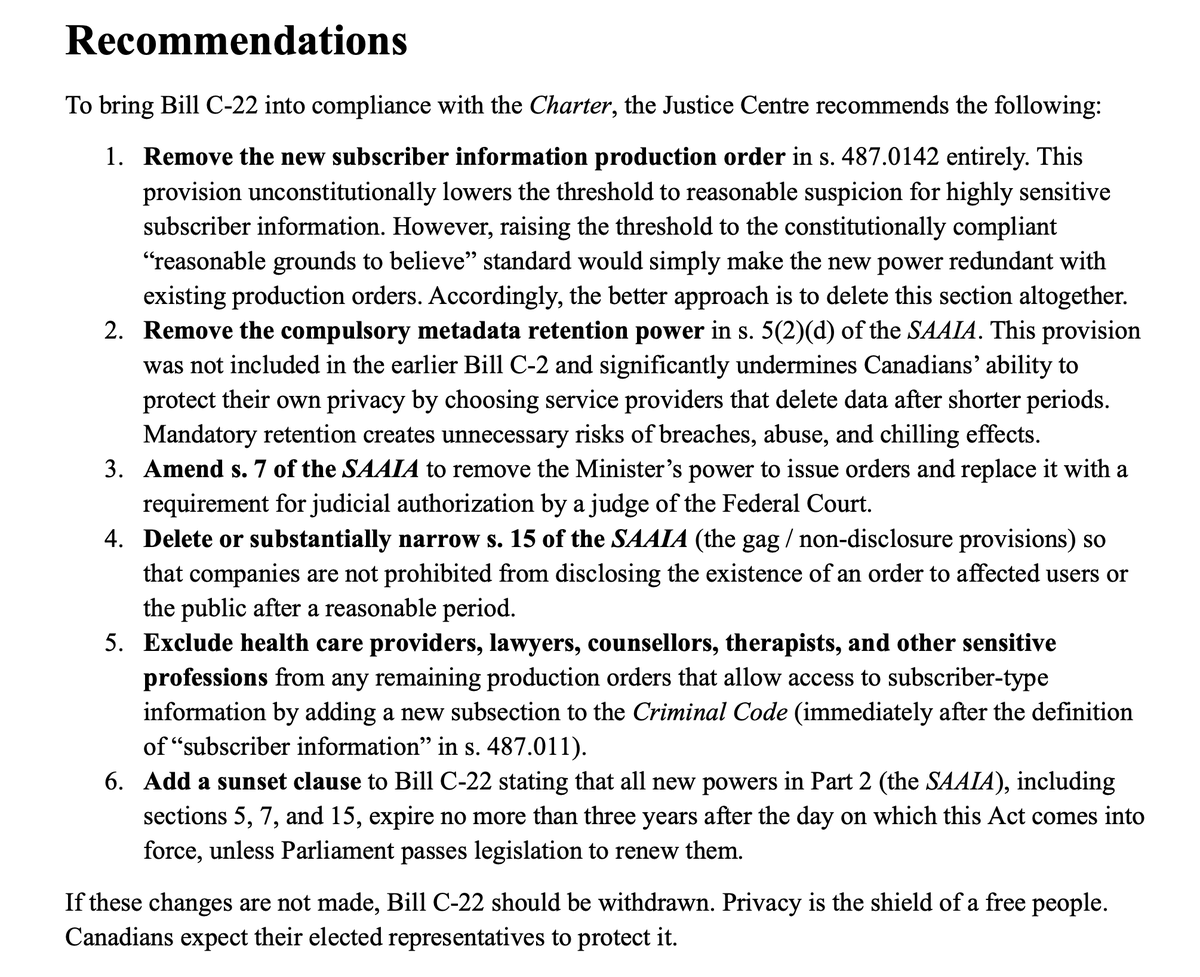
Just going through some of the briefs filed before the committee on Bill C-22. Justice Centre for Constitutional Freedoms (@JCCFCanada) offers this argument for nixing metadata retention:
"...[it] significantly undermines Canadians’ ability to
protect their own privacy by choosing service providers that delete data after shorter periods."
Out in Vancouver this week, “Solomon announced 44 new projects across British Columbia receiving up to $66 million through Canada’s Compute Access Fund”
"Sovereignty is not solitude." Canada's AI Minister announced $300M for compute & a digital independence strategy, keeping US ties. My latest at Forbes: https://t.co/EbQUZDb4e9