Of the nine-million patients seeking help from the ambulance service last year, five-million were transported to hospital. Yet only 10% of those seeking help have a life-threatening health need, indicating the vast majority might be better served outside of hospital and nearer to home, cutting costs and improving patients’ quality of life.
As ambulance services strive to do their part in assessing, treating and referring patients outside of acute care settings, the time crews spend engaged on each task has increased from one to one and three-quarter hours. This increased "pace-of-care" strains resources, leaving fewer crews available and forcing patients to wait longer for help to arrive.
Queueing theory tells us that if, at the time of the patients call, the nearest resource is not busy then the patient is served immediately. As more resources become busy fewer patients will be served immediately and more will have to wait. When crew utilisation reaches 50% sometimes the newly arriving call finds a crew available, sometimes there are several calls already waiting, but the effect is to double average response times compared to there always being a crew available to respond. As utilisation goes beyond 70% fewer resources are available to respond and response times double again. The opposite is also true. Reducing crew utilisation will improve response times.
Restoring the pace-of-care to an hour (its historical norm) and ensuring crew utilisation does not exceed 50% (guaranteeing mandated response times) requires only two-thirds of the current 30,000-strong workforce.
Reassigning 10,000 experienced paramedics from emergency duties to an urgent/unscheduled care service, paired with an efficient emergency ambulance system, could double out-of-hospital care (25% Hear & Treat, 50% See & Treat), halving hospital transports (25% See & Convey) without the need for additional investment.
Decentralising ambulance services helps to ensure that those who are close enough to care are the ones empowered to make decisions. A national ambulance service could manage the delivery of each of the, 140 or-so, Medical Trade Economy Ambulance Systems (MedTeams), configured around the needs of local communities in England, with a single Board.
Improving emergency ambulance service productivity and efficiency will increase crew availability, improve response times, patient outcomes, recruitment & retention, crew rest breaks and shifts ended on-time while reducing staff sickness, stress & anxiety. Two-and-a-half million patients will no longer be transported to A&E, saving £0.5bn. The reliable responsiveness of the MedTeams system will significantly reduce the clinical risk of managing patients closer to home.
The ambulance service has the resources and financial capacity to transform urgent and emergency care. Within a few years, a national service for England could emerge, responsive to local communities, integrated with the medical trade economies around acute hospitals, and only-ever minutes away.
@ShaunLintern@AliJaneMoore@AACE_org@AnnaParry12
It’s a complete rip off. Never had to prebook (wasn’t a thing). I never imagined there’d be any discrepancy, never mind such a large one. Demand for parking, given the certainty of flight schedules, must be the easiest thing to predict and manage. There can be no justification for such a significant price hike. There isn’t anywhere near £100 additional cost to you for people just turning up. At least make it reasonable. Shocking.
@Gatwick_Airport We parked long stay north for 6 days and discovered it cost us £230, more than the cost of our return flights to Cyprus. I notice that pre booked parking is less than half that cost. Please can you tell me why there is such a large discrepancy between these costs.
@hines_stephen@AllisonPearson@NHSWales They can be both. Non paramedic 999 response, take pats to hospital who need it (50%), leave those who don’t and send a paramedic. Speeds up response times, treat more people at home and fewer at hospital.
I have described how this can be achieved for the NHS in the proposal I sent to [email protected]. Ask them to forward it to you. It’ll only take 10mins of your time. We don’t need 200 NHS Trust boards; a handful at most. £500m saved, bureaucracy slashed, woke hive mind gone.
@AACE_org@AnnaParry12 What’s your solution, @AACE_org? Because there is one. Realtime patient monitoring. Promote that. Also, do something about the unnecessary deaths caused by long scene times which consume twice the amount of ambulance resources as hospital delays.
Call volumes go up as response times lengthen as people call back to find out where the ambulance is that they were told they needed when they first called it the patients condition has worsened due to the long wait. This is failure demand. True demand is the number of Hear & Treat + See & Treat + See & Convey not emergency calls.
I have engaged with nhs and ambulance leaders demonstrating 66% improvement in ambulance productivity. They don’t understand it and consequently refuse to consider it. The NHS leadership are also aware of 15-20% productivity improvement in Acute care by the implementation of real time patient monitoring. It’s all talk and no action.
This epitomises the stupidity of our technocratic ruling elite. They have been shaped by the duty to ‘comply and not question’ from an early age and now oversee that very ‘compliance doctrine’ to their charges. Education is a compliance factory, not a place to question ideas and certainly not authority. It has produced an army of automatons, programmed to do as they’re told if they want to get ahead. Our public and professional bodies have been overwhelmingly captured by these compliant automatons, and they recruit more and more in their own image. This has resulted in a deficit of diverse opinion in the workplace and the pursuit of ideology over logic. From wind farms to potholes, the credentialed managerial class has proven incapable of delivering services people want and need. It’s unsustainable and, soon enough, we will see a reversal and common sense will prevail once more.
How did you get the gig at Burisma, Hunter? What does 10% for the ‘big guy’ mean? How much did you earn from selling your paintings? How much did you spend on hookers? Where did all that money come from? Tell me about the daughter you had that you have disowned. I couldn’t listen to it all, it was such a soft interview.
@jo3hill@restate_thinks Socialists are very good at spending other people’s money. Why don’t we get the required funding from savings made elsewhere by improving productivity?
@sophia_edw28123 A friend of mine is a community midwife and spent two hours yesterday trying to get her IT access sorted. It wasn’t, and today she has to spend a similar amount of time on-site. That’ll be 15% of her working week. There’s no value placed upon the cost of clinical time.
@ShaunLintern It will be weaponised against those few maverick leaders who are successful and embarrass the majority of poor performers. Mark my words.
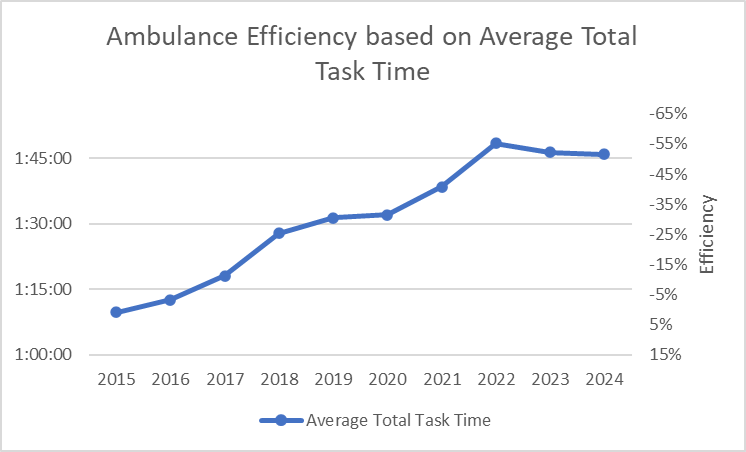
This reduction in ambulance efficiency ambulance efficiency has increased the percentage of crews engaged on task (ambulance resource utilisation (ARU)), and led to longer response times.
In 2015 the average task time was one hour and ten minutes, near to its historical norm. In 2024 it was one hour and forty-five minutes; reducing efficiency by 50%. The pace of clinical care has doubled.