Professor. Views are mine. RT not endorsement. "In matters of style, swim with the current; in matters of principle, stand like a rock," Thomas Jefferson.
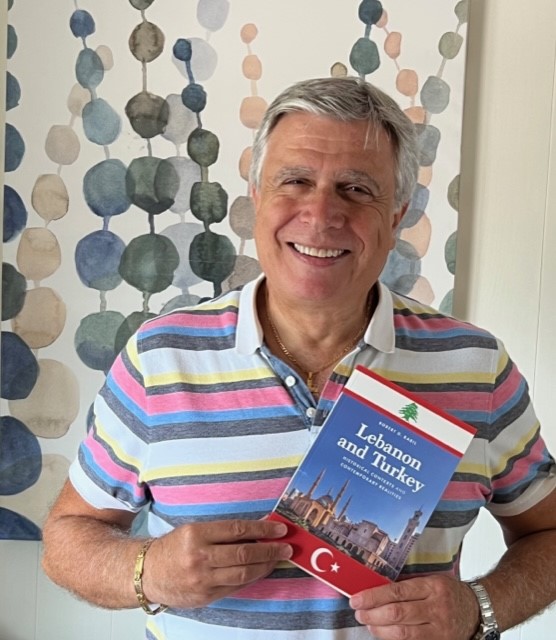
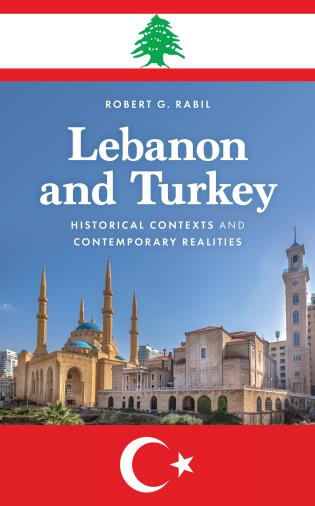
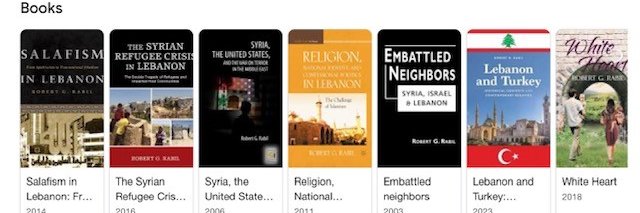
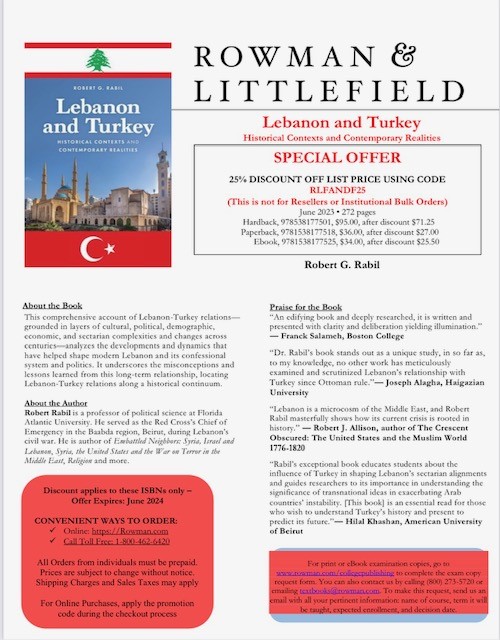
I am happy to announce that today I received copies of my book: Lebanon and Turkey: Historical Contexts and Contemporary Realities.
No empire or a regional power has helped mold the socio-political and religious landscape of a country as the Ottoman Empire and its heir (the Republic of Turkey) have helped shape modern Lebanon, yet no contemporary study has examined Lebanon-Turkey relations back to Ottoman rule of Lebanon. As such, the understanding of this historic and contemporaneous relationship is deficient. This text fills this gap, examining patterns and shifts in Lebanon-Turkey relations within the context of regional and international politics from Ottoman rule to Turkey’s AKP-led governments.
This comprehensive account of Lebanon-Turkey relations—grounded in layers of cultural, political, demographic, economic, and sectarian complexities and changes across centuries—analyzes the developments and dynamics that have helped shape modern Lebanon and its confessional system and politics. It underscores the misconceptions and lessons learned from this long-term relationship, locating Lebanon-Turkey relations along a historical continuum.
The topics with which this book project is concerned with:
-Ties Ottoman rule over Lebanon with contemporaneous Lebanon-Turkey relations
-Examines the shifts and development of Lebanon’s demography and sects under Ottoman rule
-Investigates Ottoman rule over Lebanon against the background of European rivalry
-Analyzes the transition of feudalism based in tax farming under Ottoman rule to political sectarianism in independent Lebanon
-Probes Lebanon’s sectarian massacres in the nineteenth century, which led to foreign intervention and the development of the country’s confessional system
-Examines Lebanon’s Great Famine (1915–1918) within the context of the Great War
-Analyzes Turkey’s foreign policy approach towards Lebanon within the context of Ankara’s ideological and practical outlooks
-Scrutinizes Turkey’s Justice and Development party’s (AKP) interest in Lebanon
-Explores Turkey’s influence in Lebanon
Reviews of the Book:
This is a refreshing, lucid, and seasoned research-based analysis that is crucial to understanding a contemporary Eastern Mediterranean in the midst of roiling shifts, what some have called ‘the end of the Arab century.’ A discerning survey probing deeply post-Ottoman Lebanese-Turkish relations, this book is of special importance on many levels to scholars of the Middle East but also genocide studies and the still ‘hidden’ history of the Great Famine on Mount-Lebanon. An edifying book and deeply researched, it is written and presented with clarity and deliberation yielding illumination.
— Franck Salameh, Boston College
Well researched, chronicled, and argued, Dr. Rabil’s book stands out as a unique study, in so far as, to my knowledge, no other work has meticulously examined and scrutinized Lebanon’s relationship with Turkey since Ottoman rule. The book successfully weaves together the major developments, including the overlooked Great Famine, of this relationship that helped shape modern Lebanon and continues to highlight both the chronic failures of the country’s confessional system and the promise of better Lebanon-Turkey relations, against the backdrop of a fast-paced changing world order.
— Joseph Alagha, Haigazian University
Robert Rabil makes clear the complicated, conflicted, and tragic history of Lebanon and its relationship with its neighbors. This compelling, insightful, and courageous book helps us understand Lebanon’s tangled and contentious history with its neighbors, Turkey and Syria. Lebanon is a microcosm of the Middle East, and Robert Rabil masterfully shows how its current crisis is rooted in history.
— Robert J. Allison, Suffolk University, author of The Crescent Obscured: The United States and the Muslim World 1776-1820
Professor Rabil masterfully traces Turkish Middle Eastern policy from Sultan Abdul Hamid’s Ottomanism to Davutoglu’s Neo-Ottomanism and Erdogan’s realism after the defeat of Arab popular uprisings that demonstrated the limits of Ankara’s regional ambitions. Rabil’s exceptional book educates students about the influence of Turkey in shaping Lebanon’s sectarian alignments and guides researchers to its importance in understanding the significance of transnational ideas in exacerbating Arab countries’ instability. Lebanon: From Ottoman Rule to Erdogan Regime is an essential read for those who wish to understand Turkey’s history and present to predict its future.
— Hilal Khashan, American University of Beirut
Professor Rabil does an excellent job explaining how the Ottoman Empire struggled to survive by applying a policy of mass killings, starvation, and deportations in the empire’s provinces that sought to become more autonomous. It is interesting how an empire resorts to cruel methods to keep itself from falling apart. Rabil’s study is also relevant to understanding contemporary Russia’s involvement in Ukraine. The case of the Ottoman Empire can serve as a historical paradigm to analyze powers that struggle against their own decline. A brilliant and highly enlightening book.
— Luis Fleischman, professor, Palm Beach State College and co-president, Palm Beach Center for Democracy and Policy Research
Robert Rabil ‘s Lebanon-Turkey Relations: From Ottoman Rule to Erdogan’s Regime,” is a gift for those studying the history, politics, and culture of Lebanon and its important neighbor, Turkey. In recent years Turkey’s foreign policy has become an often and serious topic of analysis for Middle Eastern scholars. This book provides an important addition to that literature. It is a unique study concentrating on Turkey’s impact on the development of Lebanon from its early history to its current involvement in the country. Through archival research, and interviews abroad Dr. Rabil provides new insights into Ottoman policies leading to the Great Famine of 1915-1918, the roots of the confessional system, the growth of Arab Nationalism, the Cold War, Lebanon’s civil war and Turkey’s recent and growing involvement in Lebanon and the region. This is a key contribution to filling the missing piece of the Lebanese – Turkish relationship’s place in today’s Middle East foreign policy puzzle. It really is a must read!
— Lenore G. Martin, Professor, Emmanuel College, Middle East Center and Weatherhead Center, Harvard University
Books can be purchased from Amazon, Barnes and Nobles and others, or from publisher with 25% discount, Ebook: $25.00 and paperback: $27.00.
Yesterday, the United States brokered a ceasefire between Israel and Lebanon, based on a clear principle: Hezbollah must stop firing, withdraw from southern Lebanon, and be disarmed.
This morning, Hezbollah’s Secretary General publicly condemned the agreement, while Hezbollah drones were launched at Israeli targets.
Israel will defend its citizens. Lebanon deserves a future shaped by its government-not by an Iranian-backed terrorist organization.
There was real hope at the negotiating table for a new chapter of security and peace. Hezbollah and Iran are trying to destroy that hope. They must not succeed.
After his visit to Tel Aviv and meeting with Israeli President Isaac Herzog, Dr. Robert Rabil joins me on The Capitol Show for an important and timely conversation about the ongoing negotiations in Washington and the future of U.S.-Israel-Lebanon relations.
A deep discussion on regional security, diplomacy, Hezbollah, and the shifting dynamics of the Middle East.
Watch the full episode now on The Capitol Show. @robertgrabil@CapitolInstitut
The Gulf states have accelerated their search for new air-defence systems after suffering from thousands of Iranian missile and UAV attacks.
South Korea, Ukraine, the United Kingdom and the United States are among those countries that have been approached by Gulf states interested in near-term acquisitions, which include interceptor missiles, interceptor UAVs, point-defence systems, radar and surface-to-air missile systems.
➡️ Read the full analysis by @albert_vidal_: https://t.co/Wu0TiYr1oo
Israel and Lebanon reaffirmed that they have no hostile intent toward one another and committed to continuing direct negotiations to build confidence, resolve all outstanding issues, and work toward a comprehensive agreement between the two countries.
Joint Statement of the United States of America, Republic of Lebanon, and State of Israel on the Latest High-Level Trilateral Meeting
https://t.co/kCdk9TCSpe
Scoop: The Joint Statement between US, Lebanon and Israel
The United States convened the fourth high-level trilateral meeting between Israeli and Lebanese representatives on June 2 and 3, 2026.
As a result of the U.S. led negotiations, Israel and Lebanon agreed to the implementation of a ceasefire. The ceasefire is contingent on a complete cessation of Hizbollah fire and the evacuation of all Hizbollah operatives from the South Litani Sector.
The two sides agreed with the guidance of the United States to swiftly advance the creation of pilot zones in which the Lebanese Armed Forces will take exclusive control of the territory to the exclusion of all non-state actors.
These steps will enable progress towards a comprehensive peace and security agreement.
All countries reaffirmed that the future of the relationship between Israel and Lebanon must be decided by the two sovereign governments. They rejected any attempt, by any state or non-state actor, to hold Lebanon’s future hostage.
Israel and Lebanon reaffirmed that they have no hostile intent toward one another and committed to continuing direct negotiations to build confidence, resolve all outstanding issues, and work toward a comprehensive agreement between the two countries.
The delegations discussed a security framework, building on discussions at the Pentagon on May 29, aimed at sustainably ensuring the sovereignty, security and territorial integrity of Lebanon and Israel. This includes the dismantlement of non-state armed groups, and the prevention of their re-emergence.
All parties condemned Iran’s attacks on countries in the region, and ongoing activities that undermine stability throughout the Middle East, whether through support for proxies and all other acts of aggression.
The United States reiterated its ongoing support for both governments to exercise their sovereignty. It reaffirmed that any agreement to cease hostilities must be reached directly between the two governments, brokered by the United States, and not through any separate track. The United States underscored its intent to support the Lebanese Armed Forces, with the aim of improving their capacity and enabling the effective exercise of sovereignty throughout Lebanese territory. It emphasized Secretary Rubio’s June 2 statement that Hizbollah is not just an enemy of Israel and an enemy of America, but that it is an enemy of Lebanon.
Israel reaffirmed that its security and respect for its territorial integrity can only be achieved through the disarmament of Hizbollah and the dismantlement of its infrastructure throughout Lebanon. It emphasized the importance of direct negotiations under the leadership of the United States to resolve all outstanding issues and achieve durable peace and security.
Lebanon reaffirmed the necessity for mutual respect of internationally recognized borders, the urgent need for full implementation of the cessation of hostilities, underscoring the principles of territorial integrity and full state sovereignty. Lebanon committed to enhancing the capacity of the Lebanese Armed Forces, with U.S. support, to assert effective control throughout the country.
The two parties agreed to reconvene the political and security tracks the week of June 22, with a view toward reaching a comprehensive agreement. The United States agreed to continue facilitating communication between the parties in the interim.
@AsharqNews
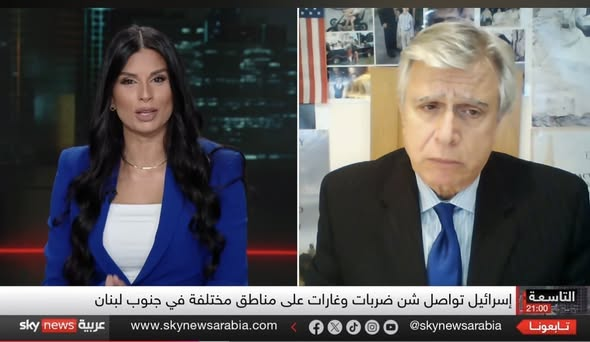
My solo interview with #uae@MichellaSKY on #usa, #Israel and #lebanon.
@POTUS called on PM Netanyahu to stop attacking Beirut not to save Hezbollah. Several factors may explain why this request: Lebanon and Israel were beginning their 4th round of negotiation; Lebanese government felt uneasy participating in negotiations while the capital was under heavy attack, though targets were Hezbollah's; concerns were raised about exodus from Beirut given the high cost of collateral damage; and Iran and USA were engaged in negotiations whereby Iran linked the Lebanese crisis to that of Iran to reach an initial agreement. Linking Lebanon to Iran's crisis is also another way of projecting Iranian power through the "unity of theaters of war."
Whatever is the case, Israel will continue targeting Hezbollah in so long remains armed and posing a threat to northern Israel.
Significantly, USA is introducing a Lebanese security plan separate from Hezbollah; as well as a plan to train Lebanese armed forces to administer security in Beirut!
https://t.co/cwJIDjGPTX
My interview with #uae#almashhad TV on #iran and #usa negotiations and their contradictory statements. Iran's mixed messages is a strategy to prolong the negotiations in the [wrong] belief it will get a better deal with @POTUS. Part of its strategy is to link Israel-Lebanon file with that of USA-Iran file. Israel will observe the president's policy but will attack Hezbollah until it is disarmed or no longer poses a threat to northern Israel!
https://t.co/yKP9TuwS4H
My interview with #Newsmax#shannoncake on Iran's crisis and its targeting of #bahrain and #kuwait.
Attacking the Gulf region's vital institutions has become Iran's strategy of deterrence and tool of pressure on #usa. President Donald J. Trump is offering Iran a chance to conclude a deal absent of which will spark a massive bombing on Iran! Meanwhile, no one can blame President Trump that he did not choose the path of peace!
https://t.co/eVa2iZuW0N
The IDF has taken control of the Beaufort Ridge—and this is far more than just another hill in southern Lebanon.
The IDF's capture of the Beaufort Castle area undermines one of Hezbollah’s most important strategic and symbolic assets: a region that for years served as a hub for command and control, weapons storage, and fire management. The area overlooks key transportation routes and one of Hezbollah’s main centers of gravity in southern Lebanon, located within the area of responsibility of the Badr Unit—the organization’s principal force currently operating against the IDF on the southern front.
Beyond the operational achievement, the move also represents a significant psychological and symbolic victory on multiple levels.
The Beaufort is not merely a tactical objective that was seized in a localized operation; it symbolizes a broader trend of sustained degradation of Hezbollah’s assets and capabilities. Hezbollah’s and Iran’s reactions and conduct during and after the Israeli takeover of the area left little doubt about the significance they attribute to this development.
Read the full analysis >>
https://t.co/1z0Rfv3u8p
Hezbollah rejects a partial cease fire between Lebanon and Israel, even though its community has for the first time blamed it for their tragedy!
“Qamati: We did not agree to a partial ceasefire... Any attack on the suburb [Hezbollah stronghold in Beirut] will face a deeper response.”
Dr. Robert Rabil, LLS Distinguished Professor of Political Science at FAU ( Florida) and one of the foremost scholars on Middle Eastern and Lebanese politics, delivered a clear message to Israeli President Herzog: Lebanon’s path to sovereignty and lasting peace runs through the Abraham Accords. The tide is shifting, normalization is no longer a fringe position, it is becoming a principled consensus. The historic bonds between the Lebanese and Israeli peoples stretch back thousands of years, and voices like Dr. Rabil’s are a sign that a new generation is finally saying what history has always known. 🇱🇧🤝🇮🇱 #Lebanon #Israel #AbrahamAccords #FAU #MiddleEast
@yechielleiter@SecRubio@NadaHamadeh




![robertgrabil's tweet photo. My interview with #uae #almashhad TV on #iran and #usa negotiations and their contradictory statements. Iran's mixed messages is a strategy to prolong the negotiations in the [wrong] belief it will get a better deal with @POTUS. Part of its strategy is to link Israel-Lebanon file with that of USA-Iran file. Israel will observe the president's policy but will attack Hezbollah until it is disarmed or no longer poses a threat to northern Israel!
https://t.co/yKP9TuwS4H](https://pbs.twimg.com/media/HJ6Me8RWYAAfQKi.png)








![robertgrabil's tweet photo. My interview with #uae #almashhad TV on #iran and #usa negotiations and their contradictory statements. Iran's mixed messages is a strategy to prolong the negotiations in the [wrong] belief it will get a better deal with @POTUS. Part of its strategy is to link Israel-Lebanon file with that of USA-Iran file. Israel will observe the president's policy but will attack Hezbollah until it is disarmed or no longer poses a threat to northern Israel!
https://t.co/yKP9TuwS4H](https://pbs.twimg.com/media/HJ6Mhx9XsAATwKB.png)

![robertgrabil's tweet photo. Hezbollah rejects a partial cease fire between Lebanon and Israel, even though its community has for the first time blamed it for their tragedy!
“Qamati: We did not agree to a partial ceasefire... Any attack on the suburb [Hezbollah stronghold in Beirut] will face a deeper response.”](https://pbs.twimg.com/media/HJ1flD9WUAAgLSU.jpg)





