New paper in @TheLancetOncol.
We explore the extent to which individuals could be willing to wait in exchange for greater certainty of the survival benefit of new cancer drugs.
Thanks to co-auths: @mylene_lagarde, @AggarwalOnc, & Huseyin Naci.
🔗https://t.co/lw3KPBTcZy
Patients with #BreastCancer considered faster drug approval acceptable mainly when no alternatives existed or anticipated benefits were transformative, preferring certainty when options are available.
https://t.co/7MC2i6RpOR
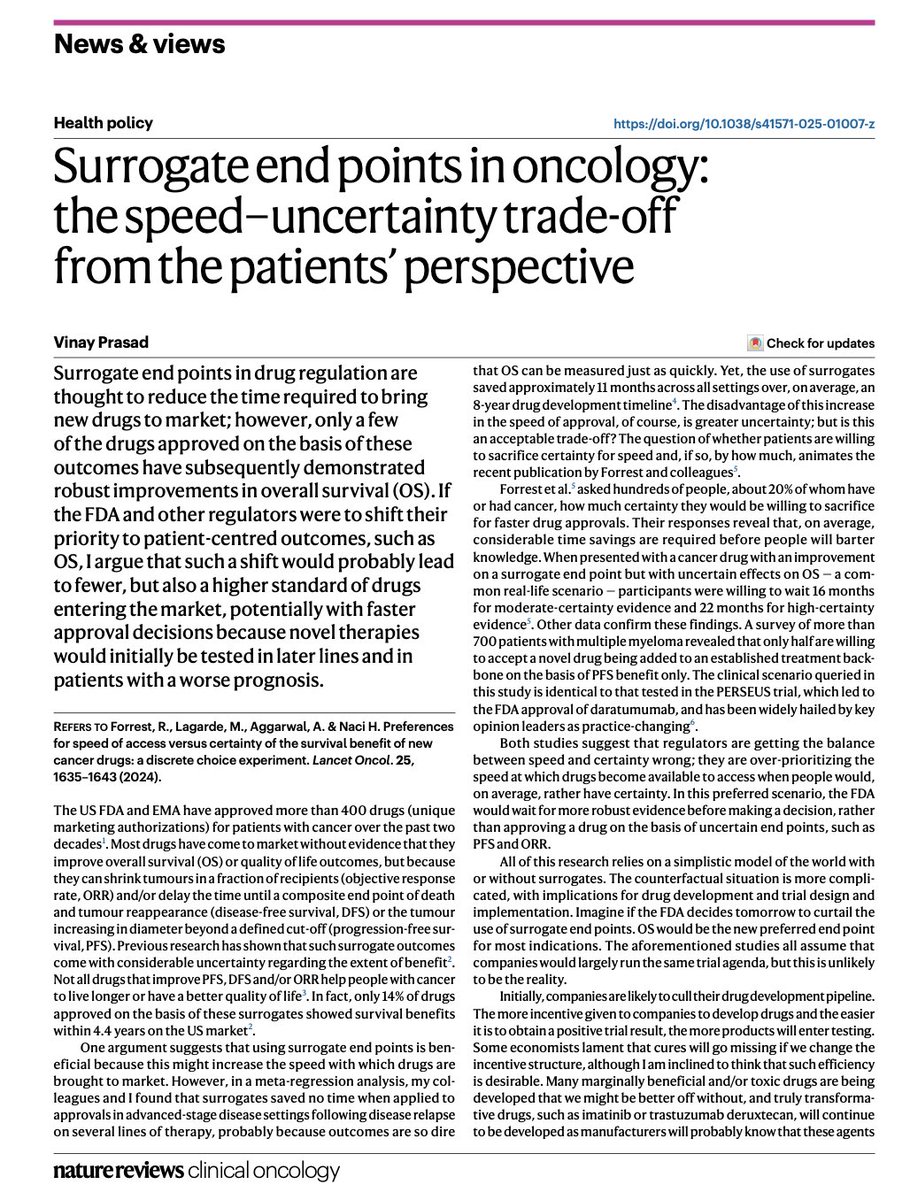
Interesting piece from @VPrasadMDMPH on surrogate endpoints and their (potential) impact on efficiency and the cancer drug pipeline.
Good to see our study discussed in context!
@coloncanada@oncology_bg As one of the authors of the study, I could not agree with your statement more @coloncanada.
Context, balance, and nuance are essential for interpreting our findings, which we provide in the paper but are not always conveyed in one-sentence summaries.
To what extent would individuals be willing to wait in exchange for greater certainty of the survival benefit of new cancer drugs?
New study in @TheLancetOncol by @robinjforrest_, @mylene_lagarde, @AggarwalOnc, & Dr. Huseyin Naci.
Read now🔗https://t.co/Sd5kU3kMWK
A very relevant and meaningful study. Understanding patients’ preferences for speed versus certainty of benefit- the trade-off of accelerated approval.
Interesting new work from authors @LSEHealthPolicy!
'Although people with experience of cancer place high value on faster access to new drugs, they also place utmost value on high certainty that new cancer drugs will ultimately offer survival benefit.'
https://t.co/myGTr7rdQp
Online First:
Preferences for speed of access versus certainty of the #survival benefit of new #cancerdrugs: a discrete choice experiment
https://t.co/saTfZIL4px
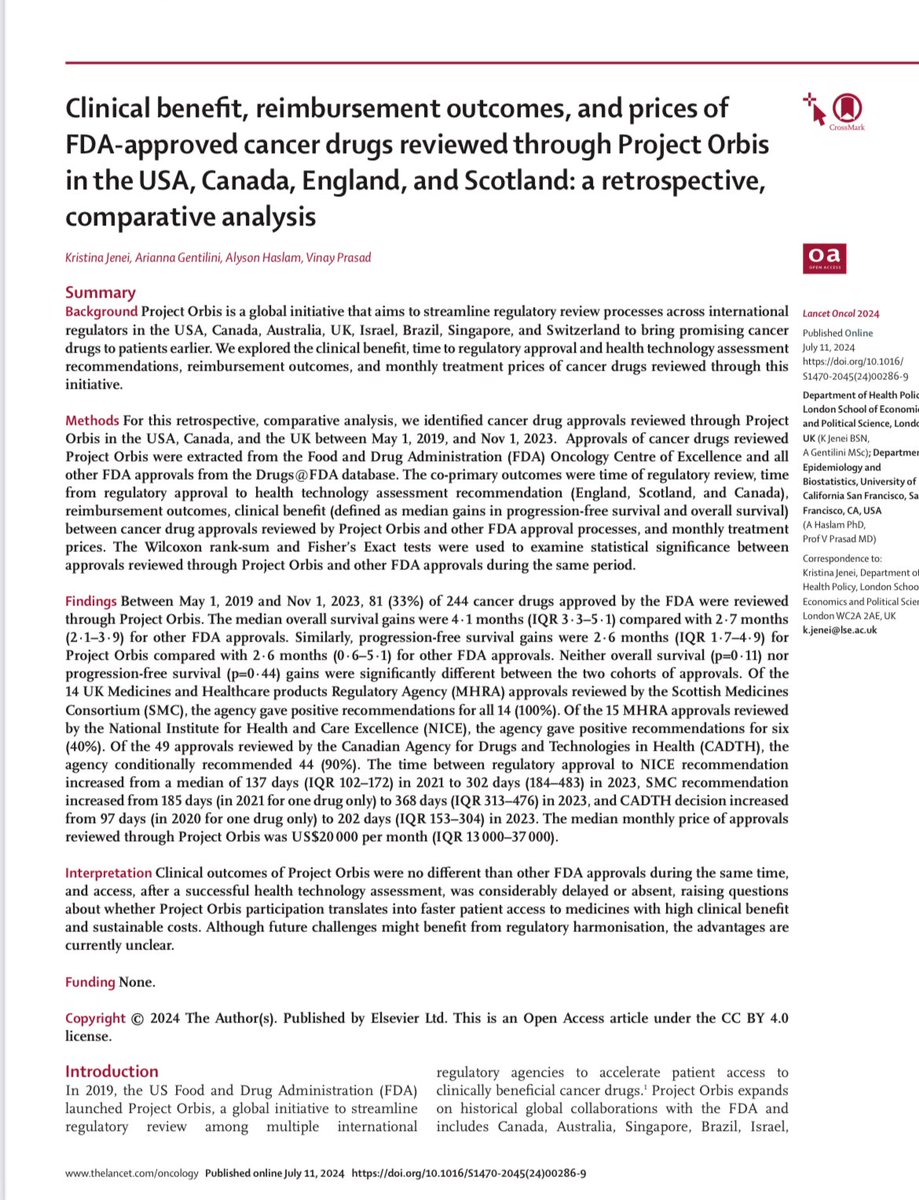
🚨Our article out today in @TheLancetOncol
Are countries harmonizing up or down?
A 🧵
We examine the clinical benefit, #HTA review times, and prices of drugs reviewed through Project Orbis
Cc: @VPrasadMDMPH@agentilini_@AlysonHaslam
Also Online First:
#Overallsurvival benefits of #cancerdrugs initially approved by the US Food and Drug Administration @US_FDA on the basis of immature survival data: a retrospective analysis
https://t.co/zgPUDWoSC7
In a new @bmj_latest editorial, the department’s @robinjforrest_ and Huseyin Naci discuss how the UK Government can prioritise patients in ongoing negotiations with the pharmaceutical industry over drug pricing.
Access full editorial from here:
➡️ https://t.co/31zX5hvxNY
Every five years or so, an agreement is brokered between the UK government and the drug industry that shapes the pricing and reimbursement landscape for medicines.
What do we need to know ahead of negotiations for the next version of the agreement?
https://t.co/3FyMOu7r6x
Prior authorization requirements for 1/3 of new drugs in Medicare Part D are more restrictive than FDA labeling, according this cross-sectional study. @LSEHealthPolicy@PortalResearch@akesselheim@robinjforrest_ https://t.co/cZHnHts45L
NEW: Our #REALCentre commissioned @LSEHealthPolicy to research pharmaceutical policy in the UK.
They identify 🔎
▶️ shortcomings of current pharmaceutical policy
▶️ key principles for building a more coherent system.
Read the final reports 🔽
https://t.co/NHCMebY0ef
Want to learn more about pharmaceutical policy and economics? In a new report commissioned by @HealthFdn#REAL Centre, the Department’s Huseyin Naci & @robinjforrest_ explain pharmaceutical discovery, development, approval and adoption.
➡️ Access here: https://t.co/194uMOrvhc
Prior authorization requirements for 1/3 of new drugs in Medicare Part D are more restrictive than FDA labeling, according this cross-sectional study. @LSEHealthPolicy@PortalResearch@akesselheim@robinjforrest_ https://t.co/GRjfIdodWK
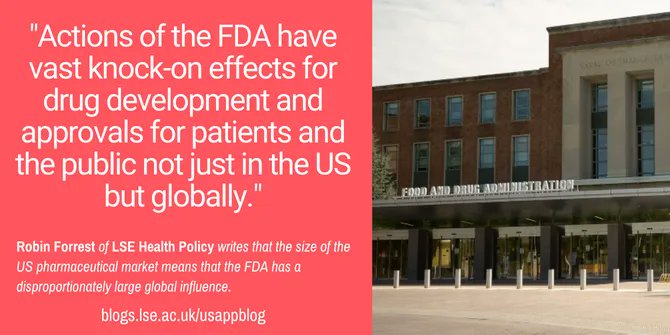
The size of the US pharmaceutical market means that the US Food and Drug Administration has a disproportionately large global influence writes @robinjforrest_ of @LSEHealthPolicy https://t.co/LsaTzQXmk6