@WhwilsonJ@RealJamesWoods Not stupid, our elections are rigged! Mail in votes are “counted” until they get their desired results. Counting takes months. Happens every election. Ask Spencer Pratt.
@brendanmjones Even penguins need livestock guardian dogs! Decision makers in government need to be educated in the differences between working dogs and pets!!
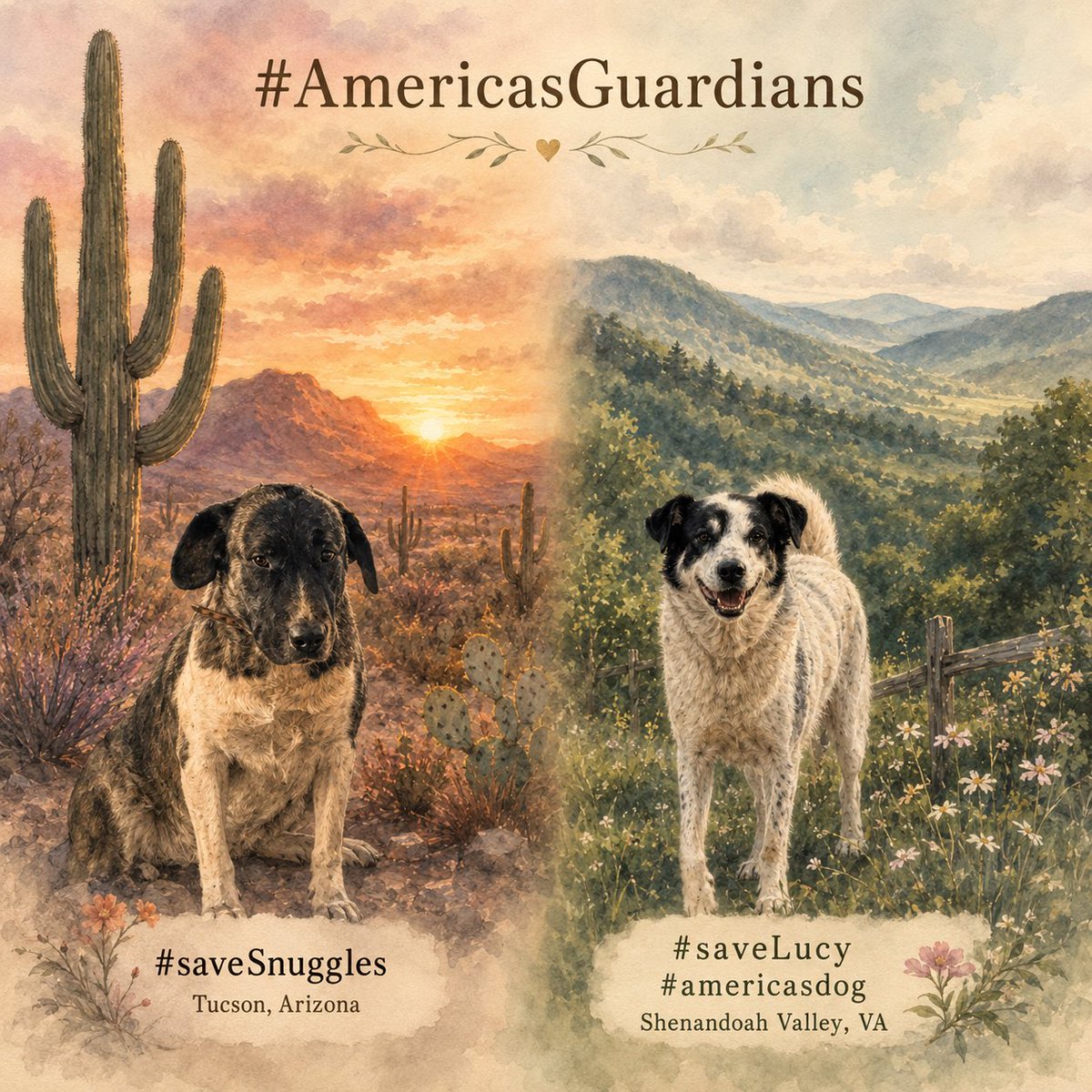
#SaveSnuggles Pima county officials, please learn about these working dogs and have a ❤️!
In the early 2000s, a colony of little penguins living on Middle Island near Warrnambool, Australia, was on the verge of disappearing.
Foxes had discovered they could reach the island during low tide, and repeated attacks devastated the population.
What had once been a thriving colony of more than 500 penguins was reduced to fewer than 10 breeding pairs by 2005.
Faced with the possible loss of the colony, conservationists turned to an unusual solution. In 2006, specially trained Maremma Sheepdogs were introduced to guard the island.
Traditionally used in Italy to protect livestock from predators, the dogs were adapted for a new role: protecting penguins.
The first guardian dogs, Eudy and Tula, were placed on the island during the breeding season. Their presence was enough to deter foxes from approaching the colony, dramatically reducing predation.
Over the following years, the penguin population began to recover, growing from the brink of extinction to well over 100 birds, with some surveys later recording around 180 to 200 penguins.
The project became one of the world's most celebrated conservation success stories. For more than a decade, fox attacks were effectively prevented while the dogs were on duty.
Their importance became especially clear in 2017 when penguins arrived earlier than expected and before the guardian dogs had returned to the island. During that period, foxes killed around 70 penguins in a single attack event.
Once the dogs were reinstated, the attacks stopped again.
Today, the Middle Island Maremma Project is recognized internationally as a pioneering example of using livestock guardian dogs to protect endangered wildlife.
The remarkable story inspired the 2015 Australian film "Oddball" and demonstrated how a simple, creative idea helped save an entire penguin colony from disappearing forever.
@CynicalPublius I lived in Jackson for 14 years right out of college. So many memories of my younger life. Thanks for the beautiful photo. It made me smile! 😊
HERE’S THE BEEF 🇺🇸 || THE GREAT COMPROMISE
Few things have harmed the American farmer and rancher more predictably than government manipulation of agricultural markets, especially when that manipulation relies on foreign imports.
And believe me, I understand that families are feeling the pinch of grocery prices. It is unquestionably a difficult policy dilemma.
But it would be naive to pretend this approach will not affect America’s cattle producers; the very people being asked to rebuild a dwindling national cow herd — and particularly when the express purpose of this policy is to import more foreign beef to undercut our domestic market.
So I’d ask this compromise of President Trump:
Pair the announced beef-import policy with a commitment to restore Mandatory Country-of-Origin Labeling (MCOOL) and use the full weight of your Administration to get that deal done.
Give American ranchers the opportunity to compete.
MCOOL would tell consumers whether their beef comes from cattle born, raised, and harvested in the United States or from foreign imports. That allows the consumer, not Washington, to decide.
Families who place a higher value on beef raised by an American rancher would have that choice. Families for whom price is the deciding factor would have that choice as well.
Politics requires a lot of give and take. But American farmers have been on the losing end of far too many government interventions.
Let this be an opportunity to restore some balance — not by telling consumers what to buy, but by telling them the truth and trusting them to make the best decision for their families.
#SaveOurFarms 🌾
@KatTimpf@Gutfeldfox He’s the only Juan on Fox that I like. He’s cute!
The other Juan is a tool. He used to be a joke - how many co-hosts does it take to ruin The Five? Just Juan! 😂 Still cracks me up. 😂
🐾 WHAT IS A LIVESTOCK GUARDIAN DOG?
Livestock Guardian Dogs (LGDs) are not simply big farm pets. They are working dogs that have been bred for generations to live with livestock, establish territory, recognize threats, and protect the animals entrusted to them.
Understanding that distinction matters, because completely normal guardian behaviors can look “aggressive” to those unfamiliar with working dogs.
Here are 8 things everyone should know about Livestock Guardian Dogs:
1. An LGD’s job is to prevent trouble before it happens.
An LGD does not spend its days attacking predators. Much of its protection comes from making predators decide that entering the pasture simply isn’t worth the risk.
2. Barking is one of their most important tools.
That deep, repetitive bark, especially at night, is communication. They are stating “I am here. This territory is occupied. Stay away.” Barking can stop a threat before it ever reaches the livestock.
3. They are territorial because they are supposed to be.
LGDs patrol boundaries, investigate disturbances, scent-mark their territory, and keep track of what belongs there. Protecting a defined area and the animals within it is fundamental to their work.
4. A guardian may deliberately put itself between you and its livestock.
Standing between a stranger and the flock, following someone along a fence, positioning its body defensively, or refusing to immediately approach a stranger for affection is not automatically evidence of a dangerous dog. It may simply be a working dog assessing an unfamiliar situation.
5. Barking, posturing, charging toward a threat, or chasing an intruder away can LOOK aggressive, but context matters! Researchers describe one of the primary ways LGDs protect livestock as “disruption”: barking and aggressive-looking posturing intended to interrupt and discourage a potential predator. If that warning works, physical confrontation may never be necessary.
Note about points 4-5: this is EXACTLY what Lucy did the night I was bombarded by my neighbors on my own property. She paced, she approached them keeping distance, then came back and stood in between us, she barked, but she never bit. It was 100% controlled, expert LGD behavior. She was the protector, I was her flock. They labeled her dangerous.
6. LGDs are supposed to distinguish between what belongs and what doesn’t.
A properly bonded guardian accepts its livestock as part of its social group while remaining suspicious of unfamiliar animals or disturbances. A strange dog or cat entering a pasture is not the same thing to an LGD as the animals it has been raised to protect. Note: don’t let your little Frou-Frou near its property line, and they won’t get hurt.
7. Defensive behavior is not the same thing as indiscriminate aggression.
A dog displaying appropriate guardian behavior in response to a perceived threat or while on high alert should not automatically be labeled “vicious” or “dangerous.” Behavior MUST be evaluated in context!
8. You cannot fairly judge a working dog by pet dog expectations.
LGDs have been selectively bred to work independently and make decisions without waiting for a human command. An LGD barking, patrolling a fence line, confronting an unfamiliar animal OR person, or placing itself between a perceived threat is not aggression.
Before labeling a Livestock Guardian Dog “aggressive,” “vicious,” or “dangerous,” we must first understand what these dogs were bred to do, and evaluate the behavior in the context in which it occurred.
🐾 Hope this helps 🐾
#savesnuggles #Americasguardians #AmericasDog
Resources:
• Texas A&M AgriLife — Livestock Guardian Dogs: An Overview
• University of California Cooperative Extension — Livestock Guardian Dog resources
• Oregon State University Extension — Raising and Training a Livestock-Guarding Dog
• Washington State University Extension — Livestock Guardian Dogs
https://t.co/o360mvNWlO
https://t.co/1fHI4Q2gA2
https://t.co/UeypckVAfE