The QIP 2027 poster deadline is coming up: 4 December (23:59 AoE), shortly after talk decisions are announced! Remember that even if you’ve submitted your work as a talk, a separate submission is necessary to be considered for a poster: see https://t.co/dDji42FJTD for details
Are you a PhD student in quantum computing and interested in working with our team in 2027 as a student researcher (i.e., an internship that's ~3 months and in-person at our office)? If so, apply here:
https://t.co/pY4CTnbGfC
Can you (or your agents) come up with smaller quantum circuits for important quantum algorithms? Give it a try on this Kaggle competition with real prize money.
Blog post: https://t.co/7lL16dKnrX
Paper: https://t.co/B0C3iI679W
Competition: https://t.co/9dXoMOIGFF
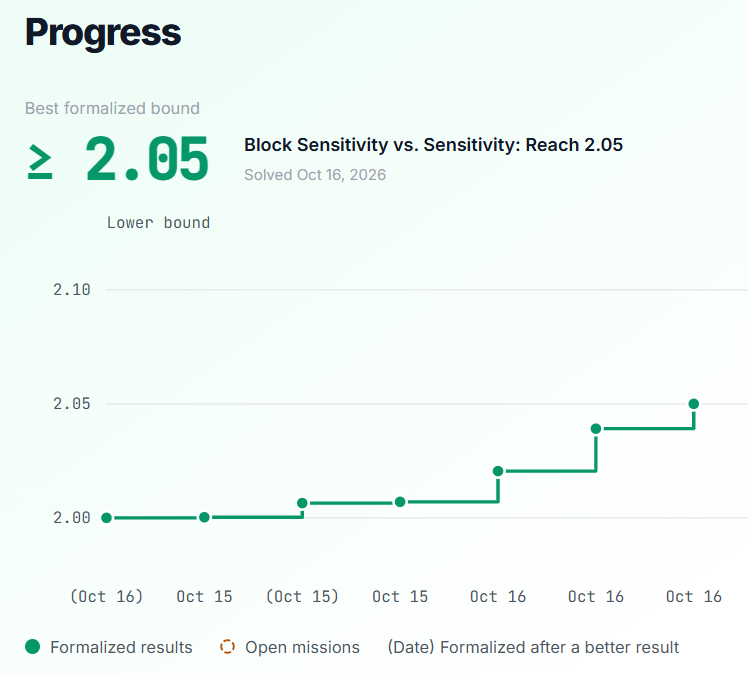
Can you (or your agents) improve the super-quadratic separation between block sensitivity and sensitivity from the current bound of ~2.006? The optimal exponent is between 2 and 4. My guess is 2.5 is achievable. Submit your lean-verified solutions here: https://t.co/J9RQaebYQv
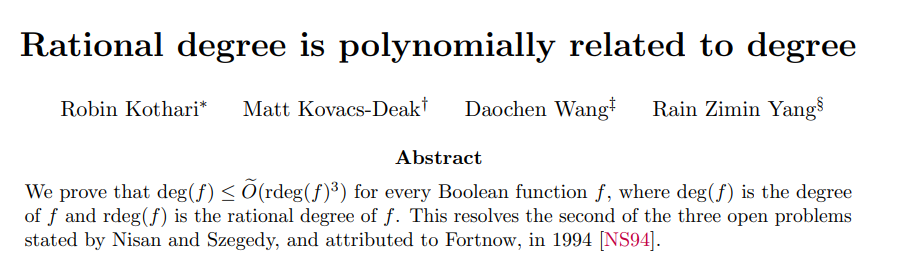
I'm honored and excited to announce that this paper was selected to receive a Best Paper Award at FOCS 2026! Thanks to my coauthors Matt, Daochen, and Rain for including me in this work, and to the FOCS PC for selecting this despite it having a simple proof.
Can you (or your agents) improve the super-quadratic separation between block sensitivity and sensitivity from the current bound of ~2.006? The optimal exponent is between 2 and 4. My guess is 2.5 is achievable. Submit your lean-verified solutions here: https://t.co/J9RQaebYQv
@henryquantum@gregrosent Great work! I really like this question and also conjectured that this is possible. I'm glad you resolved the question with an algorithm instead of a lower bound. Now let's find a polynomial-query algorithm for the Aaronson-Kuperberg unitary synthesis conjecture too!
With Chenyi Zhang, Norah Tan (@NorahTan1), David Gosset, & Craig Gidney (@CraigGidney): How to compile a circuit over arbitrary 1- & 2-qubit gates to a discrete gate set adaptively with only constant overhead (and 1/poly error).
https://t.co/21k3K5mjhm
https://t.co/L6nntSFbjm
@henryquantum@gregrosent IIRC, @wu_kewen and I realized that this problem was related to both the Aaronson-Kuperberg conjecture and the question of minimizing the T count of unitary synthesis (this remains open too). And this question is arguably more basic than either, so it seemed worth studying.
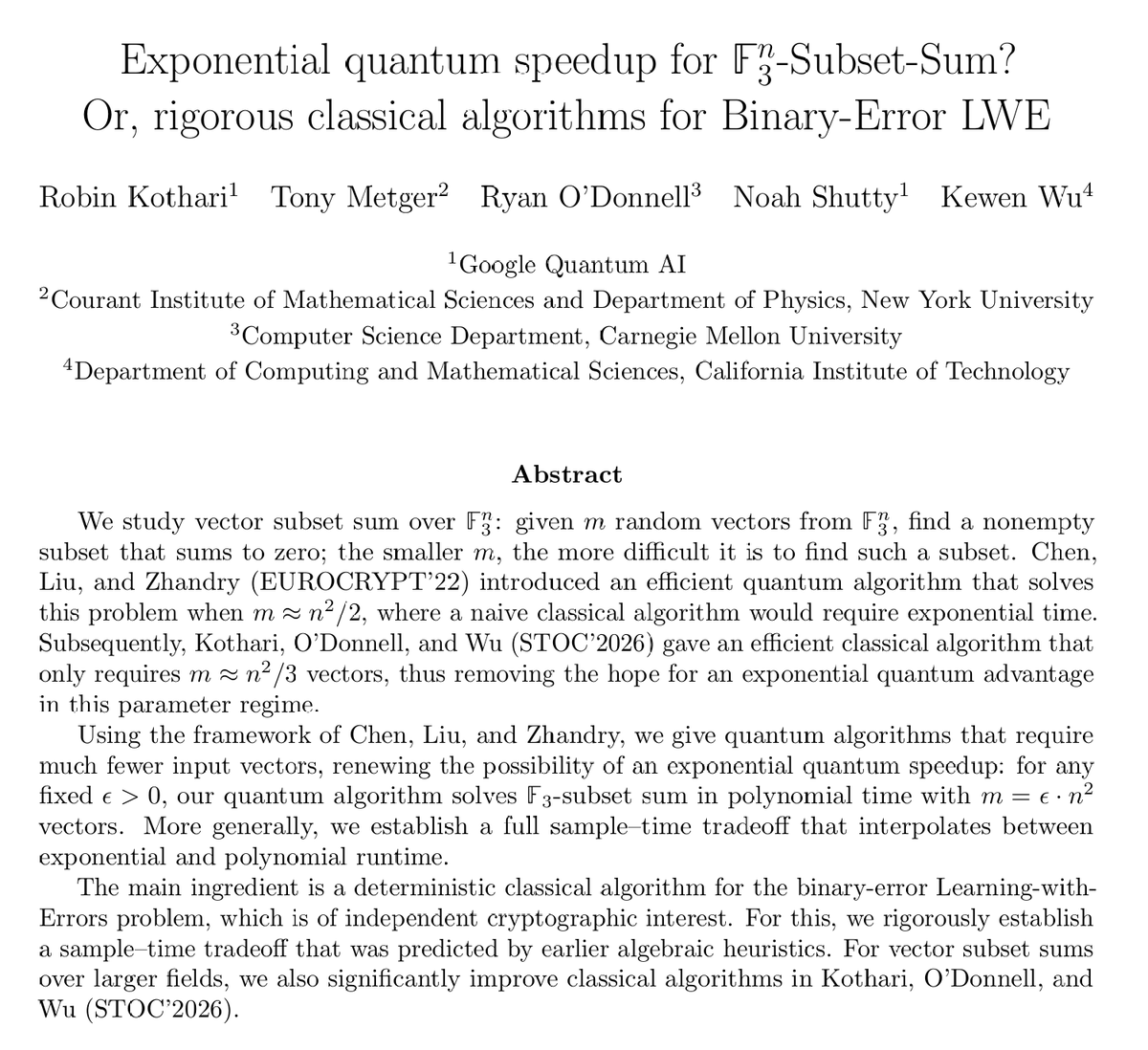
With Tony Metger, Ryan O'Donnell (@BooleanAnalysis), Noah Shutty and Kewen Wu (@wu_kewen): A new exponential quantum speedup! Or alternatively, a new rigorous classical algorithm for Binary-Error LWE.
https://t.co/Xl9z1JSkeH
https://t.co/DjzAmGJKiy
@henryquantum@gregrosent Great work! I really like this question and also conjectured that this is possible. I'm glad you resolved the question with an algorithm instead of a lower bound. Now let's find a polynomial-query algorithm for the Aaronson-Kuperberg unitary synthesis conjecture too!
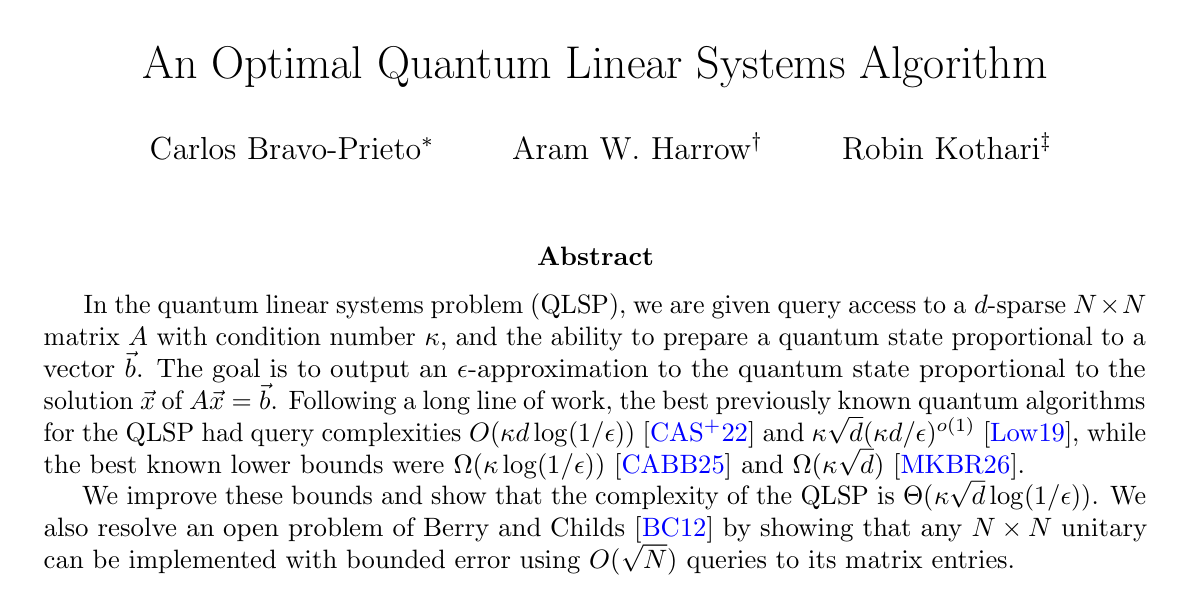
Carlos Bravo-Prieto (@charl_bp), Aram Harrow (@quantum_aram), and I just uploaded a preprint that proves new upper and lower bounds to finally close the query complexity of the quantum linear systems problem.
https://t.co/fJNN32YIe4
https://t.co/YNDx5hYKCo
For QIP 2027 submissions: Submit your paper to the arXiv by Wednesday at 2pm ET to have moderation delay protection. After that you’re taking a chance.
For talks that have been registered, keep in mind the deadline for uploading to arXiv: submit before 14:00 Eastern Daylight Time (18:00 UTC) on September 30 2026, to have moderation-delay protection.
Reminder for those submitting to QIP 2027: You must register your paper by the end of the day! This means you have to enter a title, abstract, list of authors, and select the topic area(s).
Note the various submission deadlines for QIP 2027. It’s different from last year! Your paper must be on the arXiv on the final submission day and hence it is recommended to upload your paper to the arXiv by Sept 30.
For talk submissions, remember to register by 28 Sep (23:59 AoE)! Registration only requires a title, short abstract, authors, and topic selections, but do note the recommended cutoff for the arXiv submission and talk submission - read the details at https://t.co/dDji42FJTD
The STOC 2027 Call For Papers is out and has many differences compared to last year.
https://t.co/119BvP5biI
I like these changes! They are very consistent with my own views on how conferences in 2027 should adapt to the new world we’re in.
Frontier LLMs can now solve interesting open problems. So how should academic conferences adapt? I get asked this often and I've given this a lot of thought for QIP 2027 specifically, as chair of the Steering Committee. My personal thoughts (not speaking for the SC): (1/4)
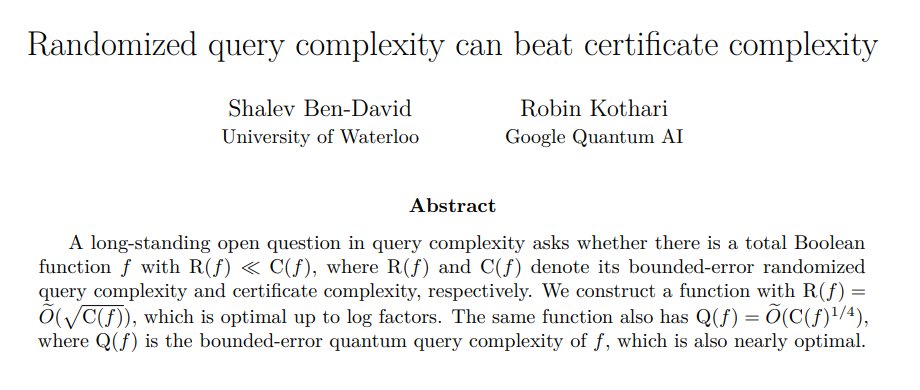
Now on the arXiv: Shalev Ben-David and I (with the help of LLMs) show how a randomized algorithm can compute a total Boolean function faster than it is possible to certify the function! The full proof is < 3 pages.
https://t.co/aWpSbzSrHA
https://t.co/55hnp0SMK5
Since the Program Committee can't evaluate the talk itself, the submission serves as a proxy. If the submission doesn't clearly explain the results to the PC, then the authors haven't shown that the talk will be a good use of the QIP audience's time. (4/4)
Frontier LLMs can now solve interesting open problems. So how should academic conferences adapt? I get asked this often and I've given this a lot of thought for QIP 2027 specifically, as chair of the Steering Committee. My personal thoughts (not speaking for the SC): (1/4)
This seems independent of whether the ideas were generated by humans or AI. Even if the results were generated by AI, authors still play an important role: they understand the results, verify correctness, simplify the arguments, and present them clearly for other humans. (3/4)