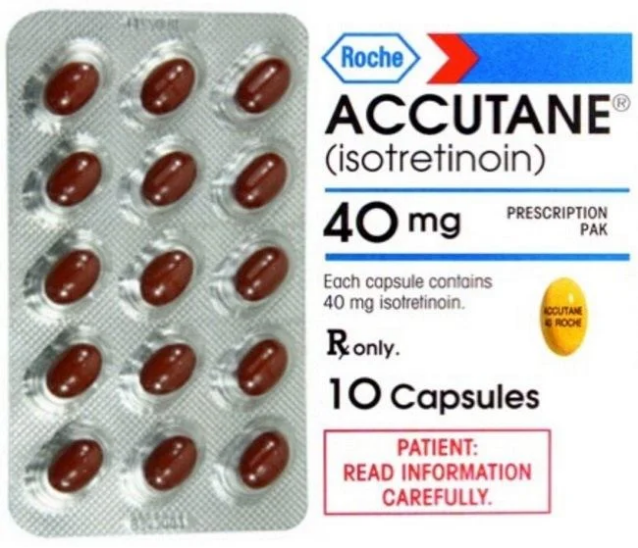
If you took Accutane as a teenager, this explains everything that's been off since your 20s. The drug they sold to clear up your skin was developed in a c*ncer research lab.
The 6 months you spent on Accutane at 16 is the reason you feel like garbage at 32.
Accutane was not developed by a dermatologist looking for an acne fix. It was developed inside Roche's c*ncer research division. That's right. The "acne drug" they handed teenagers came out of the same lab that builds chemotherapy. You can confirm this in 30 seconds.
Go to ChemoCare dot com, a pharmacist-run chemotherapy reference site that catalogs chemo drugs. Accutane is listed there as a chemotherapy treatment. The skincare industry got handed a c*ncer drug, repackaged it, and started prescribing it to 16-year-olds for pimples.
In 2005, researchers ran a peer-reviewed brain scan study on patients before and after a 4-month Accutane course. The result: a 21% decrease in activity in the orbitofrontal cortex. That's the part of your brain responsible for decision-making, focus, and emotional regulation.
In 1994, twelve years after FDA approval, Roche had an internal document confirming Accutane caused gut damage. They did not update the warning label. Millions of people kept taking it, with zero disclosure, while Roche kept profiting. Then the lawsuits started.
People with completely wrecked guts, IBD, Crohn's, and ulcerative colitis, started tracing it back to Accutane. Roche lost $56 million in just the first 6 IBD lawsuits that went to trial.
In 2009, Roche quietly pulled Accutane off the U.S. market and blamed it on "poor sales." The real reason: they didn't want to keep up with the legal damage.
The toxins Accutane leaves behind don't just dissolve on their own. It permanently disrupts the mitochondria, damages the gut lining, and rewires hormonal pathways. No amount of cold plunging, fasting, or fancy clinic treatments touches damage at that level.
You need a specific detoxification sequence built for pharmaceutical residue at the cellular level. Most people will never figure this out. They'll spend the rest of their life chasing symptoms with the wrong tools. The ones who do figure it out get their whole life back.
We Are Gonna Kick This Can Down the Road for DECADES!!
This might get me banished from certain circles, but hear me out 😬
What if the debt doomers are right about the problem, but thirty years early?
“Return to contender status? In Joe Burrow’s career, there were 14 months the Bengals were contenders… I think if you are the 18th defense and we have seen, their ceiling evidently is the 6th or 7th offense, you’re not a contender. You’re pretty good.”
@getnickwright explains:
I’m a retired brain surgeon and I wanna tell you why you feel like life is passing by. I just need one minute to explain this to you so hang in there.
Repetitive daily routines stop the brain from recording clear detailed memories. When every day looks the same, your brain does not track time the same as a clock does. It tracks change. If nothing new happens then days, months, and years start to blur together.
This is know as Time compression. When life lacks variety, your brain compresses past days together, making it feel like time is sped up.
To stop feeling like life is passing you by, add new experiences to your life. Break routine habits, like changing your daily home routine, taking a different route to work, or trying a new hobby.
Schedule small trips or plan new adventures so your days do not blend together.
Practice mindfulness by staying fully focused on what you are doing right now and not trying to race off to the next task.
Keep a journal and write down happy memories or memorable parts of the day before you go to sleep.
Take deep, calm breaths when you feel anxious or rushed to return your focus to the moment.
You can and you will retrain your brain to not feel like life is passing you by by following these few simple measures.
Grab a cup of coffee, look at the 50 year trend of the $DXY, and read some @colemacro insights.
Matt used to be one of the largest buyers of US Treasuries in the world while at CalPERS.
His perspective is very rare, and you can read it for free:
WHAT IF the biggest bubble of our lifetime isn't crypto?
Not AI stocks.
Not real estate.
What if it's the one asset every pension fund, every retiree, every "safe" portfolio is loaded with?
Bonds.
200 years of rate cycles say the same thing:
Every peak lasts 56–67 years.
The 1981 top was 14% yields.
The 2020 bottom was 0%.
39 years of falling rates just ended.
What if we're now at the start of the next 50-year cycle — upward?
Most investors have never managed money in a rising rate world.
Their entire career happened inside the bull.
The unwind has barely started.
And no one is talking about it.
I have believed for more than a decade that the U.S. Dollar Index, DXY, is in a structural decline that is likely to continue. I also think we may now be approaching a much more significant leg lower, and that has major implications for Bitcoin. If that view is right, the next five to seven years could be a materially more bullish environment for Bitcoin than anything it has experienced in its history.
This chart goes back to the late 1960s. What makes it so compelling to me is not just the technical picture of lower highs and lower lows that has developed over roughly 45 years, but that the technical picture is supported by the fundamentals behind it.
I spent much of my career thinking about those fundamentals, including while managing the U.S. Treasury portfolio at CalPERS. That was before I became a Bitcoiner, but the work directly contributed to it. The trajectory of federal debt and deficits, the risks embedded in long-duration Treasuries, and the policy incentives created by an increasingly indebted sovereign all pointed me toward the same conclusion: the dollar was in structural decline. More than a decade later, that thesis has remained remarkably unchanged.
The debt burden is dramatically larger today, fiscal deficits remain enormous, and policymakers continue to face the same basic tradeoffs. They can accept the pain through materially higher real rates and tighter financial conditions, or they can try to manage that pain through lower real rates, maintaining market liquidity, nominal growth, and some degree of currency depreciation. There is no painless path. The question is simply where the adjustment gets absorbed.
That matters enormously for Bitcoin. Each of Bitcoin’s major bull runs has coincided with meaningful dollar weakness. DXY fell from roughly 103 to 88 during the 2017 run, declined from around 103 toward 89 during the 2020-2021 cycle, and then weakened from roughly 108 during the 2025 move that helped take Bitcoin to new all-time highs before the current 2026 bear market.
Those were meaningful moves, but they were still relatively modest compared with the major dollar declines of the last 45 years. The breakdown beginning in the mid-1980s lasted for years, as did the decline from the early 2000s into the Global Financial Crisis. My base case is that we are approaching another multi-year move lower in the dollar, potentially over the next three to seven years, with a real possibility that DXY eventually challenges the 2008 lows around 70.
If that happens, Bitcoin would be entering a macro environment it has never experienced before. Its previous bull markets have benefited from periods of dollar weakness, but never from a true secular breakdown in the dollar of the kind this chart suggests is possible.
Today is an interesting day to post this chart because the Treasury announced that it is at least doubling liquidity-support buyback operations in 10-to-30-year Treasuries. That comes as long-term Treasury yields have been under significant pressure, and the dollar has moved sharply lower today.
To me, this is simply another data point in a thesis that has been playing out largely as I expected for more than a decade. The fiscal constraints are greater, the debt load is larger, and the policy incentives are becoming more obvious. None of that weakens the original thesis. It strengthens my conviction in it.
That is also why I think people are not bullish enough on Bitcoin over the next five to seven years. Most Bitcoin forecasts are based on what Bitcoin has already done, but Bitcoin has never had the tailwind of a genuine secular dollar breakdown. We are used to saying that past results are not indicative of future performance because the future may be worse than the past. In this case, I think the asymmetry may run the other way.
It is also why I am so focused on amplifying Bitcoin exposure, and why I joked yesterday about feeling under-amplified. If this 45-year dollar structure finally breaks to the downside, the macro backdrop for Bitcoin could be materially more powerful than anything it has experienced before.
TLDR: YOU ARE NOT BULLISH ENOUGH.
BREAKING: The US Government officially posts its largest July budget deficit in history, at -$432 billion, due to an acceleration in federal spending.
Interest on US debt rose +$26 billion from last July's levels to an alarming $118 billion for the month.
This puts total interest expense for FY2026 up to $1.17 trillion in FY2026.
As a result, interest expense has officially surpassed both National Defense and Medicare spending.
In other words, the US government now spends more money just on interest than it does to fund the entire US Military or to provide healthcare for seniors.
We cannot afford higher interest rates.
Every day when you’re driving to your 9-5, just remember that if you made $100,000 every year since the apple fell on Isaac Newton’s head, you’d make less than Kenny Golladay was paid for 43 catches and 600 yards for the Giants