Ashura is a time of remembrance, sacrifice and reflection.
Today, on the 10th day of Muharram, we are reminded of Imam Hussain's unwavering commitment to truth and dignity. His timeless legacy reminds us of the enduring values of faith, service to one another, and the belief that justice is always worth fighting for.
Our City’s strength comes from the many faith traditions that shape it — and our shared struggle against injustice and oppression.
May we carry these values forward as we continue building a more just City for every New Yorker.
Querida Presidenta @Claudiashein, hoy México celebra su cumpleaños.
Le deseo un año de salud, alegría y grandes satisfacciones al frente de nuestro país. Que siga cosechando prosperidad compartida en la Cuarta Transformación.
#FelizCumpleañosPresidenta
Must read piece on how a month-long diplomatic effort involving the United States, Iran, Qatar and Pakistan led to US Iran MoU, arguing that Qatar played a key role in keeping the process on track.
Article argues that Qatar’s involvement intensified in mid-May after negotiations stalled. The article notes that a Qatari delegation led by HE Ali Al Thawadi, Minister at the Prime Minister's Office for Strategic Affairs, and Hamad al-Kubaisi secretly travelled to Tehran, while Qatar worked closely with Pakistan, Egypt and Türkiye.
The report notes that Qatar leveraged its experience as a diplomatic intermediary between Washington and adversaries such as Hamas, the Taliban and Venezuela. One Western diplomat is quoted as saying: “The Pakistanis were well briefed and the face of the process [...] but the Qataris quietly did most of the heavy lifting to bridge the two sides”.
Pakistani and Arab diplomats, HH the Amir, Saudi Crown Prince Mohammed bin Salman, UAE’ President Sheikh Mohamed bin Zayed al-Nahyan and Pakistan’s military chief all put in calls to President Trump to urge him against more attacks.
Qataris threatened to walk away after the Iranians continued to push for tweaks to the language. Throughout the process Ghalibaf Araghchi continued discussions with mediators, while lower-level US and Iranian officials held talks in Doha.
https://t.co/ebbXN6K6fI
Few points on the announcement of a US-Iran deal:
- Image of US power significantly diminished. Washington could not bring Iran to heel, could not open the Hormuz Strait, could not push Saudi into war, could not impose normalisation with Israel, could not protect its allies against cheaper Iranian missiles despite its more expensive technology, could not get NATO to join the war, could not get Europe to join the war, could not convince China to pull away from Iran, and could not stop Gulf states privately negotiating with Iran to exclude themselves from Iran's list of targets.
- Israel overreached and failed. It successfully dragged US to war with Iran, but failed to achieve any strategic aim. No regime change, no Arab-Israeli coalition, no newly annexed territories, publicly slapped down by Trump after attacking Beirut, forced kicking and screaming into a deal it adamantly opposed, and now faces a US public opinion that squarely blames Tel Aviv for dragging America into a war there was no need to fight with potentially generational political consequences for the US-Israeli relationship (Israel cannot fight any war without US funds, troops, weapons, and diplomatic cover).
- Saudi Arabia vindicated. Refused to be dragged into conflict, resisted UAE campaign to get Arab states to join Israel's attack, resisted pressure from Trump to normalise in exchange for security, deepened coordination with Pakistan and Turkiye over integrating supply chains and routes, and successfully negotiated its own de-escalation with Iran.
- Turkiye's Erdogan staves off Israeli attempts to use the war with Iran to drive a wedge between him and Trump as the latter instead asserts their personal friendship, thanks him publicly for helping to bring the deal, and affirms his belief in Turkiye as a stabilising force by promoting Tom Barrack (who the Israelis deeply resent for his alleged partiality and positive view of Ankara).
Following the Iranian example Missiles are set to proliferate in the Gulf
Never, not even the most optimistic Gulf analyst, would have said that any country in the region would be capable of facing two nuclear powers and remaining standing.
The Iranian military model, almost entirely based on asymmetric warfare, has sparked a broad debate in the Gulf regarding massive investment in missiles and drones to generate deterrence capabilities. Could the conventional warfare model, which has already cost the region’s countries hundreds of billions of dollars, have been the right choice?
The Iranian model is certainly flawed in terms of air defenses, but what system would be effective against 500 modern aircraft and more than 1,000 cruise missiles launched from ships
?
Hardly any system would maintain efficiency in such a scenario, especially within the Iranian geography. Having secure facilities that sustain a robust response capability is essential, no matter how much has been invested in air defenses.
Rains of missiles and drones have become a real deterrent force and will serve as an example for the entire region, starting with the Saudis, who have significantly accelerated their missile program.
The Vision 2030 program is moving at a fast pace, involving Chinese technology transfer, the construction of underground bases, and accelerated local production. In the last few months alone, approximately $11 billion in contracts were signed with non-American partners in the missile sector.
Saudi Arabia purchases Chinese missiles and also produces its own version, already utilizing a model of underground fortresses very similar to what the Iranians do.
In the case of the Emirates, they are already producing precision-guided missiles based on South African technology and attack drones based on Chinese technology.
The EDGE Group has acquired several companies around the world and is absorbing technology, working to soon introduce cruise missiles with the help of the French company Safran.
In May 2026, India and the United Arab Emirates elevated their partnership to include the joint industrial production of precision missiles and drones, with a projected investment of $5 billion. And the largest deal quietly moving forward would be the sale of the Indian BrahMos-NG missile to the UAE and Saudi Arabia.
Full article:
https://t.co/CjduVbPaBv
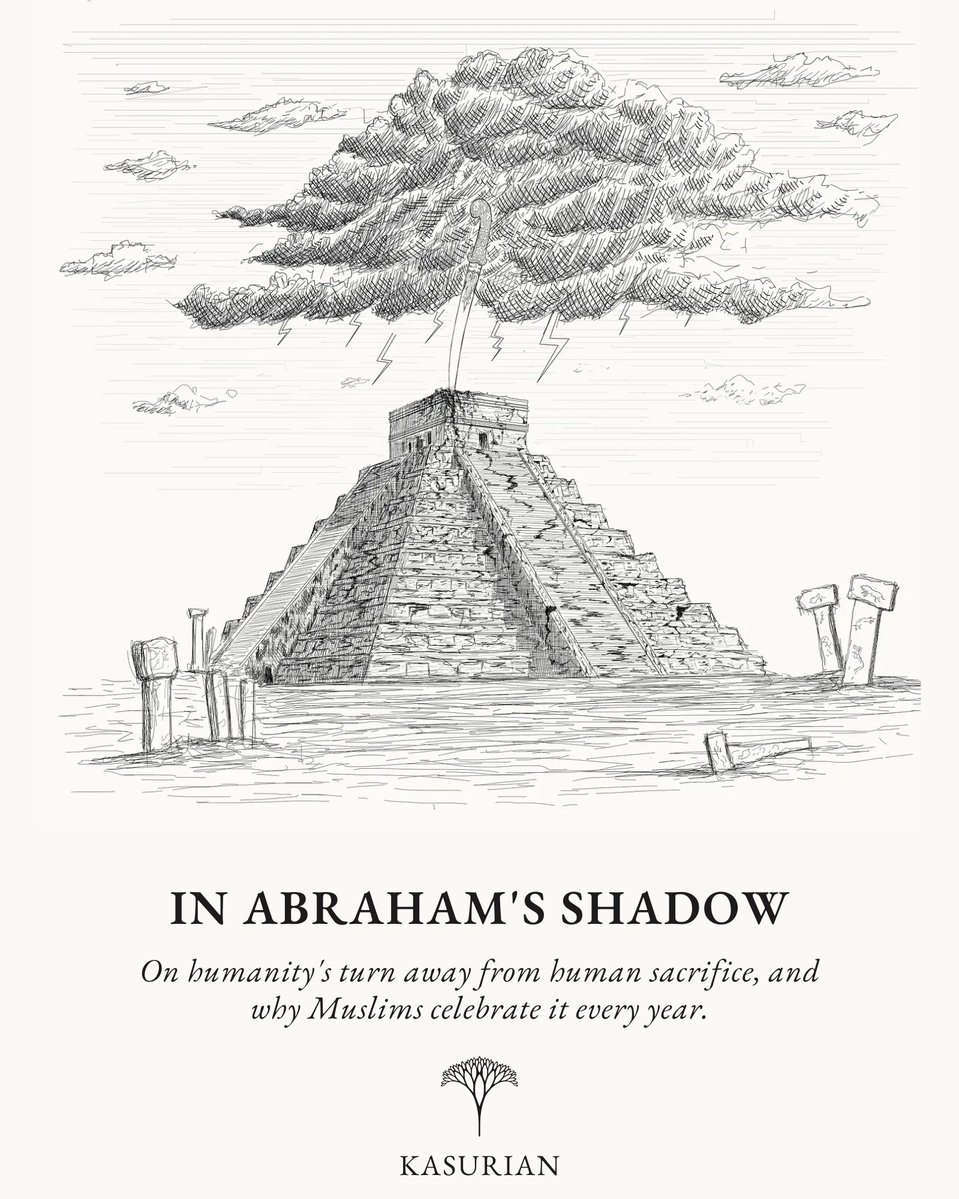
Eid Al-Adha (the Feast of the Sacrifice) commences tonight. As nearly two million pilgrims perform the pilgrimage in Makkah, Muslims around the world will join them in sacrificing animals (or donating) to commemorate Abraham’s unwavering devotion to God.
This is a week of historic significance, repeated every year for over fourteen hundred years, to recall what has been sacred for thousands of years.
Why do Muslims commemorate this event every year? What is the significance of Eid Al-Adha and Abraham’s sacrifice, not just for Muslims, but for humanity’s moral trajectory?
Take a moment to reflect with us and read our essay from Spring 2025, In Abraham’s Shadow, to learn more about how humanity’s pagan origins and prevalence of human sacrifice were overturned by the knife of Abraham.
Link below:
Agradezco la invitación de la @UNAM_FCPyS y de su director, Alejandro Chanona Burguete, para dialogar sobre la primavera de los derechos laborales que vive México. Las universidades son espacios abiertos al debate, a la pluralidad, a la libre expresión de ideas y la reflexión crítica. En la @STPS_mx siempre privilegiaremos el diálogo respetuoso y democrático.
México ha avanzado como nunca en la recuperación de derechos laborales, en democracia sindical y en justicia para las y los trabajadores como se reconoce en México y en el mundo. ¡Seguiremos avanzando!
Former Qatari PM Hamad bin Jassim and former Saudi intel chief Turki al-Faisal have both gone public in recent days on Iran, Israel & the Gulf. Their views are proxies for the thinking behind the curtain.
New, sharp by @kshaheen in @newlinesmag. https://t.co/5q6TwEDExv
Mahdi Khamoushi: The Rising Architect of Influence
Mojtaba Khamenei, the new Supreme Leader is said to have chosen Khamoushi as his new Chief of Staff, moving Khamoushi into his inner circle.
This is a very pivotal role that positions the 64-year-old Khamoushi at the very heart of the Islamic Republic’s future power structure. In this role, he is the successor to the powerful Mohammad Golpayegani that served Ali Khamenei for almost four decades.
Khamoushi’s ascent is backed by the right institutional, political and even family links.
Appointed by Ali Khamenei in 2018, Khamoushi is the head of
the Endowment and Charity Organization (Oghaf)—Iran’s wealthiest entity outside of the central government. Managing over 1.2 million assets, the organization’s scale is staggering; in the holy city of Mashhad alone, roughly half the land falls under its jurisdiction.
Prior to his current roles, Khamoushi spent nearly two decades (2001–2018) at the helm of the Islamic Propagation Organization by Ali Khamenei’s appointment. The Organization is in charge of disseminating Islamic/revolutionary culture. Khamoushi remains IPO’s chairman of the board of trustees.
His family lineage is equally formidable. The son of Taghi Khamoushi (1937–2006), Mahdi hails from a dynasty who have been heavyweights in Tehran’s Bazaar.
The family’s realm spans from tourism to the petrochemical sector. His uncles, Ali Naghi and Abolhassan, are titans of industry; Ali Naghi, in particular, is widely regarded as the "Godfather" of Iran’s petrochemicals.
The Khamoushi family represents the ultimate synthesis of the Tehran Bazaar and revolutionary politics. Emerging from a traditionalist merchant background, they were founding members of the Motalefeh Party—a collective of religious groups that formed under the directive of Ayatollah Khomeini in the 1960s.
Matrimonial ties further cement Khamoushi’s standing withing the Supreme Leader’s inner circle. Mojtaba’s younger brother, Maysam, married into the Lolachian family—one of the oldest and most respected merchant clans in the Bazaar. Maysam’s mohter-in-law is Ezzat Lolachian (Khamoushi), Khamoushi’s aunt. She was a prominent figure in her own right.
Mahdi Khamoushi is also an academic with deep ideological roots. He holds a PhD in Islamic Jurisprudence from Motahari University—a citadel in the heart of old Tehran of revolutionary theology, the Islamic Republic style. He has studied, taught and worked as a department head at the university.
Prior to his current roles, Khamoushi spent nearly two decades (2001–2018) at the helm of the Islamic Propagation Organization by Ali Khamenei’s appointment. The Organization is in charge of disseminating Islamic/revolutionary culture.
Khamoushi's new role could bear a much wider significance in the evolution of the Iranian polity than just an appointment.
This (https://t.co/vsbyqxllFG) is, by any measure, an extraordinary article: Prince Turki Al-Faisal is a son of King Faisal and ran Saudi intelligence (the GID) for over two decades.
He is writing that the plan of "the US-Israeli war on Iran" was "to ignite war between us [Saudi Arabia] and Iran," so that Israel could "impose its will on the region and remained the only actor in our surroundings."
This further confirms that, contrary to what many have asserted, the notion that the Saudis were quietly backing the war on Iran was a myth (alongside the recent fact the Saudis denied the U.S. access to its bases and airspace: https://t.co/Q5xiUT7rCA).
From the horse's mouth they're literally saying it was as much a war on them as it was on Iran!
Pretty crazy when you think about it: this is Saudi Arabia saying that their real enemy in this war was the U.S. and Israel. Hard to overstate how significant a rupture this represents.
Now of course they could be saying so because, seeing how the war turned out, they're trying to retroactively position themselves on the winning side (at least strategically, by saying they didn't take the bait), or trying to justify domestically why they absorbed hits from Iran without retaliating.
And, of course, it's not like they're presenting Iran as some sort of ally here: Prince Turki explicitly calls them a "neighbor" that caused "pains."
But still, the end result remains: the Saudi establishment is now committing, on the record and in plain language, to a framing in which, while Iran is a "painful neighbor", the U.S. and Israel represent the deeper strategic threat, having tried to engineer their destruction.
If you had any lingering doubt that this war accelerated the collapse of U.S. influence in the region, this should settle it.
Deseo de corazón que todas las mamás mexicanas reciban todos los días el cariño, la alegría y la dicha que merecen. Que la felicidad que ustedes han sembrado todos los días regrese multiplicada en abrazos, sonrisas y momentos hermosos junto a quienes más aman. Es tiempo de mujeres y nos toca reconocer, compartir y valorar el trabajo de cuidados que realizan todos los días, pues es la mejor forma de amar, de agradecer y de construir un México más justo y más feliz para todas. Abrazo grande de corazón🌷
Mexico is reducing homicides faster than anyone thought possible.
At @ProSyn, I explore some possible explanations and why the world should be paying close attention to them:
https://t.co/lzPT2xFj2x
En 8 años, los aumentos responsables y sostenidos al #SalarioMínimo han logrado recuperar el 154% de su poder adquisitivo y revertir una pérdida histórica del 77%, contribuyendo al bienestar de las y los trabajadores. 👷🏾👷🏾♀️🇲🇽
¡La #PrimaveraLaboral avanza con justicia salarial!
The world hasn’t noticed yet, but Mexico’s recent drop in homicides may be showing that there is an alternative to Bukele’s model.
Very happy to share my first piece for @ProSyn
https://t.co/lzPT2xFj2x
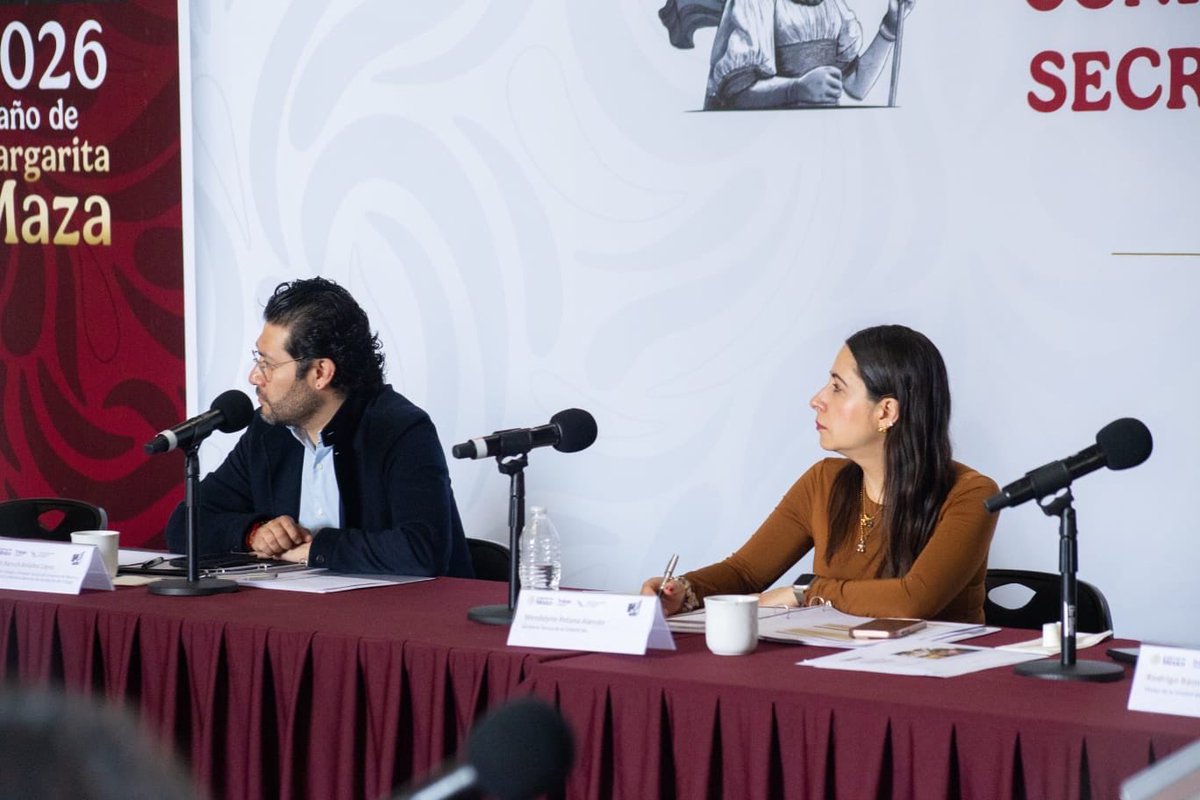
🎙️ Inauguré junto a la Subsecretaria de Empleo, Quia Chávez, la Primera Sesión Ordinaria 2026 de la #CONASETRA, donde presentamos con las y los titulares del trabajo de las entidades federativas, los avances de la agenda laboral impulsada por el @GobiernoMX y la @STPS_mx.
Durante este primer día de sesiones abordamos temas prioritarios como la implementación del Certificado Laboral para la Agroexportación, así como los avances del programa @JovConFuturo y el @empleogob_mx.
Seguimos construyendo la Primavera Laboral para el bienestar de las y los trabajadores de México. 🇲🇽
Saudi Arabia diplomatic Masterstroke
While the UAE is in crisis, Saudi Arabia is masterfully riding the wave with calculated diplomatic skill.
The Emirates’ military alliance with Israel is not welcomed by the Saudis, as I wrote days ago. However, a resumption of war with Iran is also not viewed favorably by Riyadh, and the response is quite simple.
The Saudis were diplomatically skillful in weaving an agreement with the Houthis, transforming what was once a lethal threat into a shield for their facilities and vessels. This includes their ships transiting near the coast of Somalia, which used to be an area of immense risk for Saudi shipping.
On another front, the Saudis reached an agreement with Iran that safeguarded their pipeline to Yanbu. This ensures they can export over 50% of their output via the Red Sea; however, with rising oil prices, the Saudis have offset part of these losses by selling less, the masterstroke of Saudi strategy since the founding of OPEC.
The bet on the US and Israel provides the Emirates with military cover, but Saudi Arabia holds the strategic depth. The trend points toward a rift in the Gulf: a Saudi-led axis favoring regional diplomacy, and an Emirati-led axis betting on external military force. You don't need to be a geopolitical expert to see that Israeli troops in the Emirates will only deepen their isolation from their neighbors.
The Saudis are making a hidden and ambitious bet, that this rapprochement between the Emirates and Israel is temporary and will weaken both internal and external support for the UAE, eventually forcing MBZ to come and beg for Saudi assistance.
Riyadh has fulfilled its agreement to grant land and airspace to the Americans, kept most of its infrastructure intact by negotiating with Iran, struck an excellent deal with the Houthis, and is now betting against the Emirates without firing a single shot.
Full article:
https://t.co/daEqD6FeXw
Dr. Andreas Krieg (@andreas_krieg) | Gulf Security Expert | Institute of Middle Eastern Studies:
For Mohammed bin Zayed, the Palestinian cause was always a fringe issue.
WikiLeaks cables showed MBZ speaking very negatively about it. The Abraham Accords were never about peace or Palestine.
It was about national interest - access to Israel's tech sector, intelligence networks & technology.
In return, giving Israel access to Emirati jurisdictions & proxy territories in Yemen, Somaliland & Sudan.
The only ideological component is a common fight against Islamism - really a fight against the Arab street & those promoting the Palestinian cause.
On Gaza, the Emiratis were purely pragmatic. They provided humanitarian aid while enabling the IDF through back-channel deals - offering mercenaries on the ground & proposing to police Gaza alongside the IDF.
The message to Washington was simple: "We are the only Arab country that can help you because we have a relationship with Israel. We are exceptional."
It was never about the fate of Palestinians. Abu Dhabi has been actively shying away from even calling itself a Muslim country.
Hoy, conmemoramos la lucha histórica de las y los trabajadores por conquistar #DerechosLaborales más justos y dignos.
Desde la #STPS reafirmamos nuestro compromiso con la justicia laboral y el #Bienestar de las y los mexicanos.
¡La Primavera Laboral avanza! 👷🏾♀️👨🏾🌾👩🏾💼👨🏾🔬👩🏾🚒