In most countries, half the buttons you press in a day might be placebos. The walk button at the crossing, the close-door button in the elevator, the thermostat on the office wall. They click, they light up, and many of them are not actually wired to anything.
Take New York, in the United States. Of the roughly 3,250 buttons at its pedestrian crossings, fewer than 120 actually do anything. The rest click when you press them, they look like working buttons, but they have not been connected to the traffic lights for more than thirty years. The city quietly deactivated them in the late 1980s when the signals moved to a computer system. Nobody told the public, because the public kept pressing them anyway.
The close-door button in most American elevators is in the same condition. It has been doing nothing since 1990. That was the year the Americans with Disabilities Act passed, which required elevator doors to stay open long enough for someone in a wheelchair or on crutches to get in. The button stayed on the panel, but the wiring was cut. Karen Penafiel, who ran the National Elevator Industry trade group, confirmed this plainly to the New York Times a few years ago.
In Hong Kong, the walk button at many pedestrian crossings is real during quiet hours and a placebo during rush hour. A central traffic computer decides which one it is, depending on how busy the road is. The same button, pressed by the same person at the same crossing, might or might not be doing anything, depending on the time of day. Parts of the UK and Australia use the same system.
Office thermostats have their own version of this. A 2003 piece in the Wall Street Journal revealed that landlords in the US had been installing dummy thermostats in commercial buildings for years. A tenant would complain about the temperature, an engineer would walk over, turn a dial that controlled nothing, and the complaints would stop. One HVAC specialist estimated that as many as ninety percent of office thermostats in the country were fake. Other engineers said it was closer to two percent. Either way, it was widespread enough to be a known trick of the trade.
These are only the places where someone has bothered to investigate and report it. Nobody has done a proper audit of the buttons in Lagos, or Nairobi, or Jakarta, or Mexico City, or Karachi. The crossings, elevators, and thermostats in those cities were installed by the same manufacturers, run by the same kinds of building managers, governed by the same kinds of traffic computers. There is no particular reason to assume the buttons there are any more honest than the ones in New York.
A Harvard psychologist named Ellen Langer has a name for what is going on. She calls it the illusion of control. When you press the button, even if nothing happens, your brain registers that you took an action, and the waiting becomes easier. The door closes eventually, the light changes, the office cools down. And every time, your brain credits the button.
One of the most heroic things I've seen recently is one little town in northern Michigan that kept a bird from going extinct.
The town is Mio, population of about 1800. The bird is the Kirtland's warbler, a small gray-and-yellow songbird that breeds in exactly one kind of habitat, mostly in a single corner of Michigan.
In 1974, the entire global population dropped to 167 singing males. The bird was one of the first species listed under the original 1966 Endangered Species Preservation Act, and it looked like the species was going to be extinct within a generation.
The problem was the habitat. Kirtland's warblers need fire-disturbed jack pine. Their entire breeding range is one specific successional stage of a fire-adapted forest. Decades of fire suppression had let the jack pine grow up past the age the birds could use. The birds had nowhere left to nest.
Mio became the staging point for the recovery. They built a forest management program: clear-cut, replant, burn, repeat. About 76,000 hectares are now managed on roughly six-year rotations to keep a continuous supply of young pine in the bird's preferred age range.
The work has paid off with the total population estimated at over 4,500 birds. The Kirtland's warbler was removed from the endangered species list in 2019, a rare full delisting.
The bird still requires active management. If the work stopped, the jack pine would age out within 20 years and the species would collapse again.
After a late-night broadcast of the disaster film ZERO HOUR! ('57), comedy troupe members: Jim Abrahams, David Zucker and Jerry Zucker bought the rights to the film to direct a scene-by-scene spoof.
The result was AIRPLANE ('80) – one of cinema's greatest comedies.
60 Minutes made $206 million in advertising in 2024. It was not a struggling relic. It was the most profitable serious journalism operation in American broadcasting.
Then David Ellison bought Bari Weiss's website for $150 million and handed her CBS News. She spiked a story on El Salvador's CECOT prison. She let Benjamin Netanyahu pick his own interviewer instead of sitting across from Leslie Stahl. She fired the executive producer, two on-air correspondents, and the behind-the-camera producers who actually ran the place.
The replacement EP has never worked a day in broadcast news. Ben Shapiro's Daily Wire endorsed the hire.
This is not mismanagement. Ratings are down across CBS News. The journalism is getting worse. The audience is leaving. But Ellison's other corporate deals - the Warner Bros. Discovery acquisition - got a presidential thumbs-up while Netflix got frozen out. Trump said out loud he would remember which companies played ball.
That's the transaction. CBS News bleeds so that Paramount profits. Sharyn Alfonsi doesn't have a job so that David Ellison gets his merger.
The people who watched 60 Minutes for fifty years to find out what was actually happening in the world... they just lost something that cannot be rebuilt under corporate ownership. Not in this environment. Not while the president is keeping score.
It is not used every pitch because they have experimented with it. The current process in place was used for years in Triple-A. At one time in Triple-A, games Tuesday-Thursday was considered Full ABS, where the home plate umpire wore an earpiece and the pitch was called. A ball or a strike in their ear, and they would relay the call. Friday-Sunday were ABS Challenge games.
By and large, players, fans, and umpire preferred the challenge games to full ABS.
In Truckee yesterday, we noticed this old wagon wheel in front of a coffee shop. What I find interesting is that the metal rim around the wheel has to be about 3/4" thick. It's these metal rims that would rub against rocks on the Pioneer trails, leaving a small amount of metal embedded in the rock. Over time, with thousands of wagons passing and bumping the rock, this metal rusts, creating what are called "rust-stained rocks". We see these along some of the more heavily traveled trails. Great trail indicator!
Some of the best-preserved native plant communities North America aren't in parks or refuges. They're in old cemeteries.
Pre-1900 cemeteries have a specific land-use history: they often experienced less intensive mowing, tillage, herbicide use, and development than surrounding lands. Some rare grassland and prairie species persist in old cemeteries after disappearing from much of the surrounding landscape.
Pioneer cemeteries in the Midwest still host fragments of original tallgrass prairie: leadplant, prairie blazing star, compass plant, native grasses that the surrounding farmland erased a century ago.
New England burial grounds often hold native sedges, woodland wildflowers, and old-growth lichens.
Some Southern cemeteries preserve remnants of longleaf pine understory communities that have become much rarer across the region.
You can help protect them. Most are managed by underfunded cemetery associations, historical societies, or local governments who don't always know what they're sitting on.
A simple conversation, a photo of a rare plant, or a request to delay mowing until after seed-set can be the difference between preservation and a routine spray.
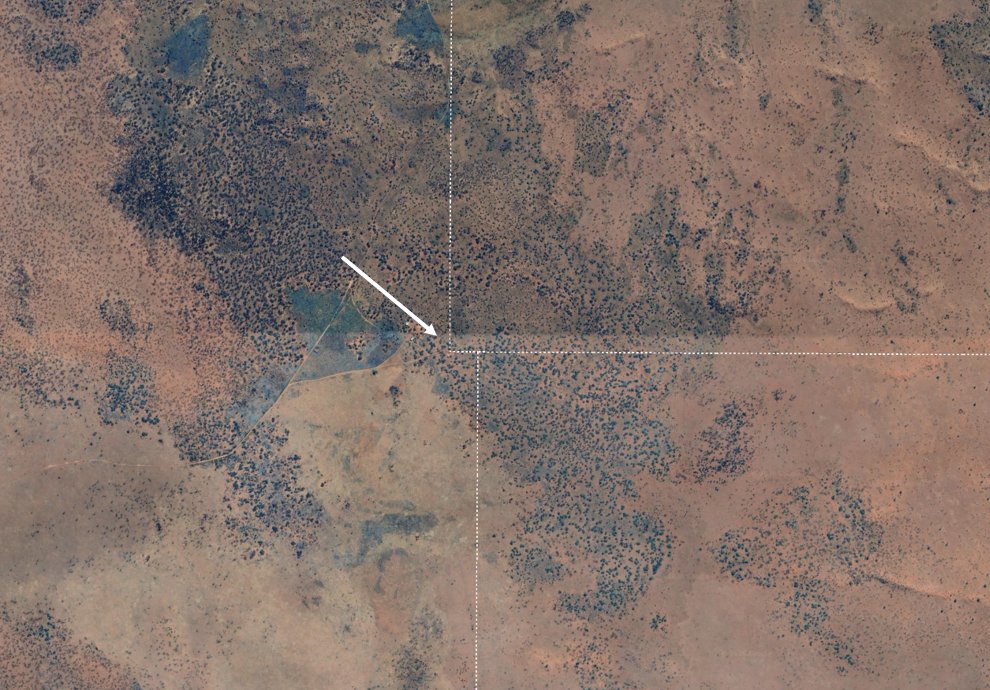
The Oklahoma Panhandle exists because Texas chose to preserve its status as a slave state.
Under the Missouri Compromise, slavery was banned in territories north of the 36°30′ parallel. When Texas joined the United States as a slave state in 1845, its northern border was set at that line. Although Texas claimed land farther north based on earlier Spanish and Mexican boundaries, keeping that territory would have created a conflict over slavery restrictions. As part of the Compromise of 1850, Texas surrendered the strip of land north of 36°30′—the area that would eventually become the Oklahoma Panhandle.
The cession left the region outside the borders of any organized state or territory. Since it belonged to neither Texas, Kansas, New Mexico, nor Colorado, it remained a patch of unorganized federal land.
For roughly four decades, from 1850 to 1890, the area was widely known as “No Man’s Land,” a place with no formal territorial government, limited law enforcement, and an uncertain legal status. It was eventually attached to Oklahoma Territory and became part of the state of Oklahoma when Oklahoma entered the Union in 1907.
This is the only known instance in the history of Major League Baseball in which a four-base error occurred in which the ball went over the fence, and it’s very possible it could happen again if the play tonight is appealed.
The fact that it would be the second time to happen in history, and both times the outfielder is Joe Adell, is unfathomable.
The only thing I don't love about the @Topps Now program is that while they tell a great story about *most* of the MLB season, pretty sure they leave out the, ah, bloopers and whatnot. And those are a really fun part of the season!
Jo Adell is a very nice young man who has worked hard on his defense and amazingly robbed three home runs on the same night earlier this season.
Unfortunately, he also pulled a Canseco.
People are calling Tom Holland arrogant and entitled for this, but he is absolutely right. The way Marvel has been making movies for the last several years is very bad.
Marvel has been shooting movies without scripts, shooting multiple versions of different drafts of screenplays by different writers and then stitching them together into Frankenstein movies that don’t make sense in response to focus group feedback. Executives have too much power and writers and directors have too little and therefore the movies lack purpose or vision.
This is how you get “The Marvels” or “Captain America: New World Order.” And it is perfectly justifiable for Holland, who is the face on the poster, to not want to be in a movie like that.
The process is bad, the movies are bad and the stars are more than justified in calling out the executives who are responsible. Nolan makes good movies and Marvel makes bad movies and Holland is completely reasonable and obviously correct to suggest that maybe Marvel should try making movies the way Christopher Nolan makes movies instead of the way Marvel has been making movies.
The oak woodlands that European settlers mistook for untouched wilderness were a landscape California's indigenous peoples had been shaping for thousands of years.
The acorn was the staple food across most of California. It fed many of the region's tribes, from the Karuk and Yurok in the north to the Kumeyaay in the south, and it turns up in archaeological sites stretching back at least 9,000 years.
The oaks were carefully tended, not just harvested. Across hundreds of distinct nations, people lit deliberate low fires beneath the trees, clearing brush, returning nutrients to the soil, knocking back the weevils and moth larvae that bore into the nuts, and keeping the groves open and bearing well. Which oaks thrived, and where, was partly a human achievement.
Then an 1850 California law outlawed the burning and the people who tended the land were forced off it. The groves grew denser, fuel accumulated, and the loss of cultural burning became one of several factors contributing to today's severe wildfires.
But it's coming back. Tribes across California are leading cultural burns again, on their own land and alongside the agencies that once banned the practice.
As North Fork Mono tribal chairman Ron Goode puts it, "Fire has spirit, this land has spirit, and when we're burning, they come alive."
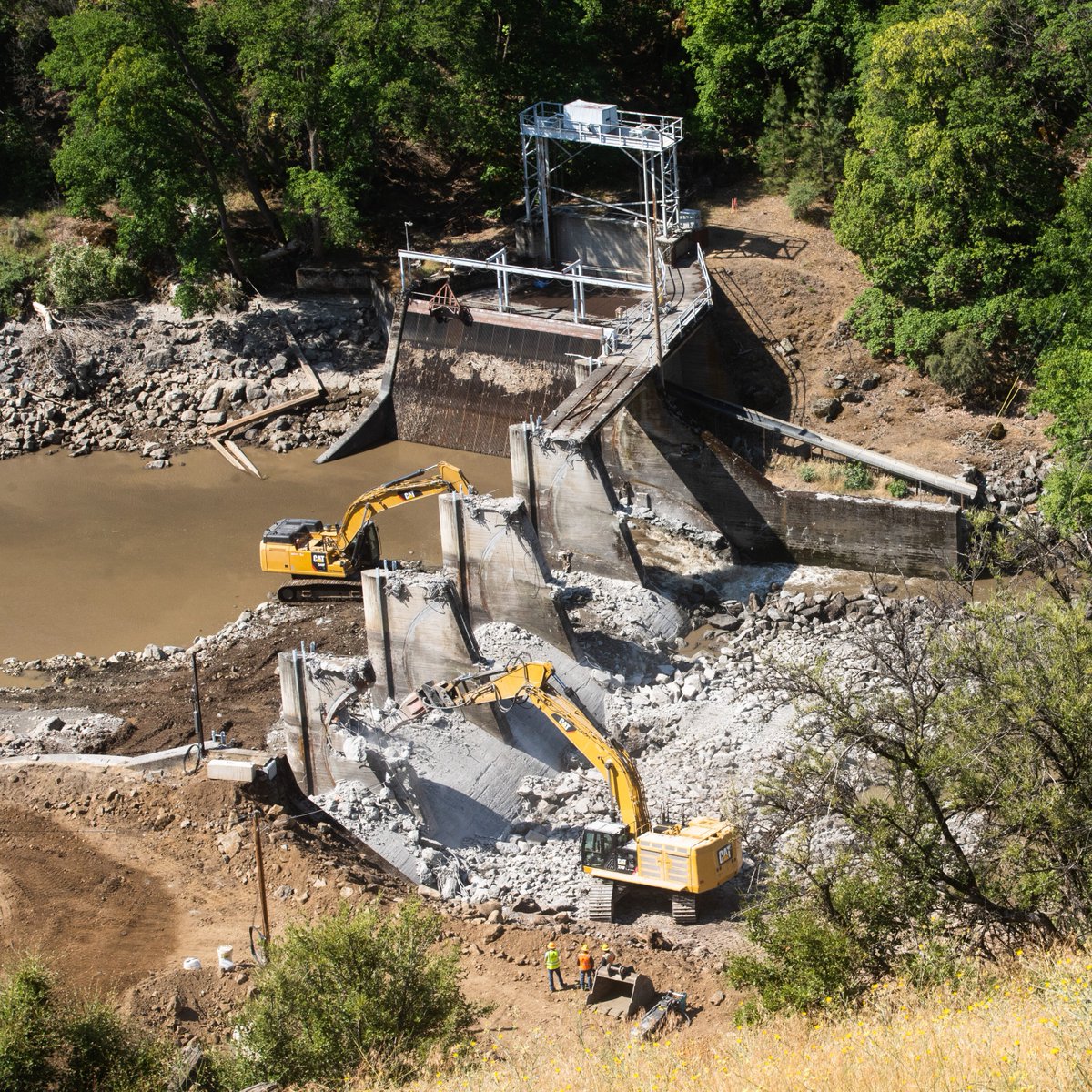
The United States has more than 90,000 dams on its rivers. Many of them no longer generate power, hold back floods, or serve a purpose at all. They just sit there, aging, holding the water back.
Take one out, and the ecological recovery can happen breathtakingly fast.
In 2024, the largest dam removal in American history finished on the Klamath River, where four dams came down along the Oregon-California line. Within days, Chinook salmon were pushing into water they hadn't reached in generations.
By the fall of 2025, they had climbed all the way into the upper basin, spawning in streams that had been sealed off for more than a hundred years.
Damon Goodman, a regional director for California Trout, put it plainly: the rivers "seem to come alive almost instantly after dam removal."
Maine's Penobscot tells the same story. After two dams came down, the river herring went from a few thousand fish a year into the millions, and with them came back the eagles, ospreys, and otters that live off the run.
A dam is one of the few environmental problems you can fix by subtraction. Take the wall away, and the river seems to remember what it was.
The childfree community really said "instead of making new people, what if we fully invested in the people already here?" and somehow society decided THAT was the weird option.