Since I’m going to be hearing this for the next 6 months as a Texas voter, let me answer the question:
“You would vote for an adulterer over James Talarico? That’s not very Christian.”
Here’s the truth: I would rather vote for almost anyone else who is going to at least advocate for conservative *policies* over a literal heretic who wears my faith like a skin suit, advocates for policies that harm children, endorses immorality and generally harm society.
Ken Paxton has personal baggage. I don’t deny that. But Talarico has plenty too — and he openly mocks God’s law and treats Jesus as a political mascot all while pushing a radical far-left agenda that would be a disaster for my state.
You see, I’m an adult. I do not expect those who are seeking political office to be my moral superiors or even trustworthy. They are tools to be used to do the least amount of damage via policy.
I wish more pastors and men who live godly lives were running. I really do. But the options we get are what they are.
Paxton supports secure borders, law enforcement, lower taxes, unleashing American energy, the Second Amendment, just to name a few.
Talarico supports unlimited abortion, trans-ing children, higher taxes, government-run “healthcare,” and is incredibly comfortable blaspheming the word of God.
I’m not voting for a priest. I’m voting for an imperfect person to represent my interests. That’s how it works.
You’re not going to guilt trip Texans into supporting a looney tunes candidate like Talarico. Paxton will win by 5+.
It’s about policy, not personality.
Hello @AOC, while you smiled in a hijab at a New York event, I was in Federal Court facing the 4th hitman hired by the Islamic Republic to assassinate me, for campaigning for Iranian women to have the same freedom you performed for a photo op. Will you come to court with me in August when I face the 5th hitman? Or does solidarity only work when it doesn't offend the Islamic regime?
You wore hijab voluntarily in New York. Women are killed in Iran for taking it off.
You are the very woman who, at every opportunity, protests against violence against women, decries gender segregation, and champions "inclusion." Yet here you stand, smiling and wearing a hijab, at an event in New York, in the heart of the West, where men and women are strictly separated. To me and millions of Iranian women, this does not look like a choice. It is no longer "My body, my choice," but rather "My body for votes."
They who claim to fight for women's self-determination in the name of feminism voluntarily embrace an ideology that mandates our women cover their hair simply because they are women. They enjoy the prosperity, freedom, and privileges of the Western world, where they may live as autonomous individuals , yet they simultaneously accept that other women should not be afforded the same rights.
#LetUsTalk
There were massive international protests over George Floyd and those police involved were severely punished with long prison sentences, yet the police responsible here did not even lose their jobs!
An incredibly unjust double-standard!
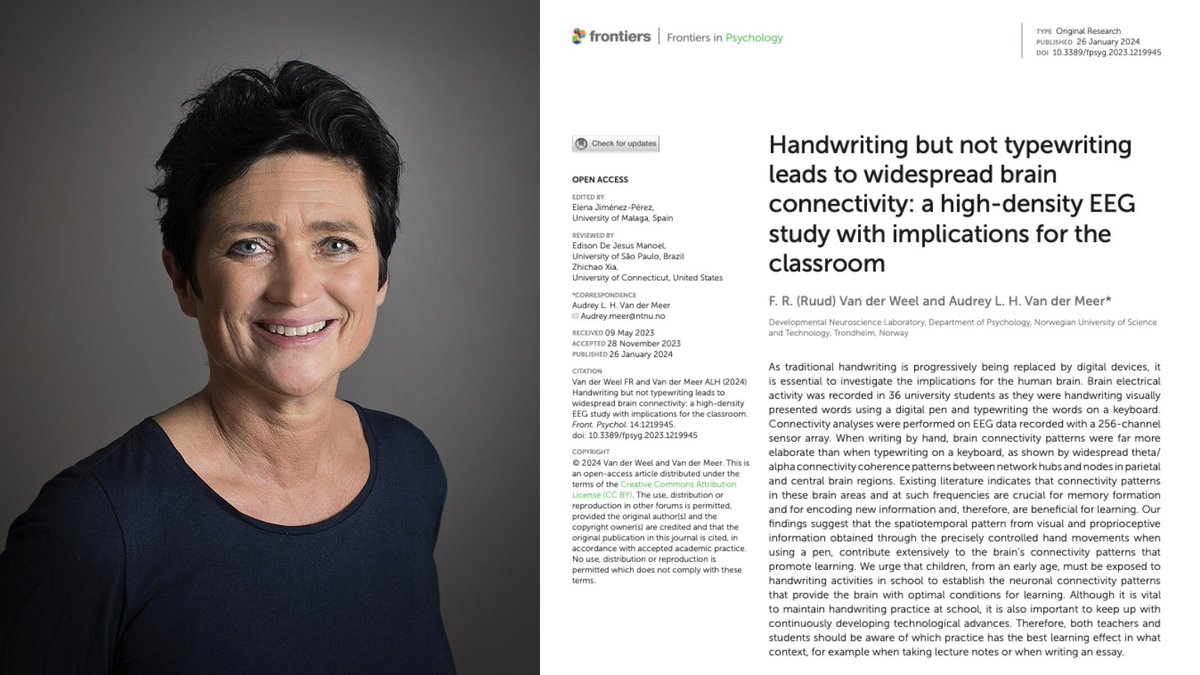
A Norwegian neuroscientist spent 20 years proving that the act of writing by hand changes the human brain in ways typing physically cannot, and almost nobody outside her field has read the paper.
Her name is Audrey van der Meer.
She runs a brain research lab in Trondheim, and the paper that closed the argument was published in 2024 in a journal called Frontiers in Psychology. The finding is brutal enough that it should have changed every classroom on Earth.
The experiment was simple. She recruited 36 university students and put each one in a cap with 256 sensors pressed against their scalp to record brain activity. Words flashed on a screen one at a time.
Sometimes the students wrote the word by hand on a touchscreen using a digital pen, and sometimes they typed the same word on a keyboard. Every neural response was recorded for the full five seconds the word stayed on screen.
Then her team looked at the part of the data most researchers had ignored for years, which is how different parts of the brain were communicating with each other during the task.
When the students wrote by hand, the brain lit up everywhere at once.
The regions responsible for memory, sensory integration, and the encoding of new information were all firing together in a coordinated pattern that spread across the entire cortex. The whole network was awake and connected.
When the same students typed the same word, that pattern collapsed almost completely.
Most of the brain went quiet, and the connections between regions that had been alive seconds earlier were nowhere to be found on the EEG.
Same word, same brain, same person, and two completely different neurological events.
The reason turned out to be something nobody had really paid attention to before her work. Writing by hand is not one motion but a sequence of thousands of tiny micro-movements coordinated with your eyes in real time, where each letter is a different shape that requires the brain to solve a slightly different spatial problem.
Your fingers, wrist, vision, and the parts of your brain that track position in space are all working together to produce one letter, then the next, then the next.
Typing throws all of that away. Every key on a keyboard requires the exact same finger motion regardless of which letter you are pressing, which means the brain has almost nothing to integrate and almost no problem to solve.
Van der Meer said it plainly in her interviews.
Pressing the same key with the same finger over and over does not stimulate the brain in any meaningful way, and she pointed out something that should scare every parent who handed their kid an iPad.
Children who learn to read and write on tablets often cannot tell letters like b and d apart, because they have never physically felt with their bodies what it takes to actually produce those letters on a page.
A decade before her, two researchers at Princeton ran the same fight using a completely different method and ended up at the same answer. Pam Mueller and Daniel Oppenheimer tested 327 students across three experiments, where half took notes on laptops with the internet disabled and half took notes by hand, before testing everyone on what they actually understood from the lectures they had watched.
The handwriting group won by a wide margin on every question that required real understanding rather than surface recall.
The reason was hiding in the transcripts of what the two groups had actually written down.
The laptop students typed almost word for word, capturing more total content but processing almost none of it as they went, while the handwriting students physically could not write fast enough to transcribe a lecture in real time, which forced them to listen carefully, decide what actually mattered, and put it in their own words on the page.
That single act of choosing what to keep was the learning itself, and the keyboard had quietly skipped the choosing and skipped the learning along with it.
Two studies. Two countries. Same answer.
Handwriting makes the brain work. Typing lets it coast.
Every note you have ever typed instead of written went into your brain through a thinner pipe. Every meeting, every book highlight, every idea you captured on your phone instead of on paper was processed at half depth.
You did not forget those things because your memory is bad. You forgot them because typing never woke the part of the brain that would have made them stick.
The fix is the thing your grandmother already knew.
Pick up a pen. Write the thing down. The slower road is the faster one.
-While walking home from a soccer match with his friends a white British young man is accosted by a Sikh immigrant. British young man starts recording with his phone.
-Sikh immigrant then stabs him four times with an 8 inch knife. He seeks no medical help for the British young man, but instead steals his phone and puts it in his pocket (the phone that contains the evidence of what happened).
-Sikh immigrant’s mother (also an immigrant) arrives on the scene and hides the murder weapon.
-Police arrive and the Sikh immigrant lies and says he was called a racist name and his turban was knocked off (video from the phone proves both of these claims were lies, though neither justifies stabbing someone).
-Police proceed to handcuff the white British boy as he bleeds out.
So the summary is because the Sikh immigrant lied and said he was called a racist name, the British police handcuffed and detained the dying victim.
What can you conclude from this but that the UK is not a safe place for white people?
This is the same UK that protested over the death of George Floyd. Yet do you see anyone in the streets over what the police did to this young man?