You can discover more about the project and learn about our activities and ambitions.
We look forward to connecting with researchers, industry representatives, and everyone who's interested in innovative and sustainable bio-based solutions.
🤝 Come meet us at the ROBUSTOO stand!
📍 𝐑𝐎𝐁𝐔𝐒𝐓𝐎𝐎 𝐢𝐬 𝐚𝐭 𝐈𝐅𝐈𝐁 𝐢𝐧 𝐑𝐨𝐦𝐞!
We are excited to be taking part in IFIB – the International Forum on Industrial Biotechnology and Bioeconomy.
If you are attending the event today or tomorrow, 𝐜𝐨𝐦𝐞 𝐚𝐧𝐝 𝐯𝐢𝐬𝐢𝐭 𝐭𝐡𝐞 𝐑𝐎𝐁𝐔𝐒𝐓𝐎𝐎 𝐬𝐭𝐚𝐧𝐝!
Biocatalysis is a practical option where selectivity, mild conditions, and lower solvent use matter. The challenge is industrial implementation: stability, scalability, and solid economics. That’s what #ROBUSTOO is working on!
📣The window for early movers is open.
Europe’s chemical industry is entering a tighter regulatory era. EU rules are restricting hazardous solvents, while CSRD is raising the bar for proving environmental performance.
R&D teams need greener alternatives that are also technically viable and scalable.
These solutions are being validated at pilot scale, with process efficiency, environmental impact and economic viability assessed through LCA and TEA. For companies exploring bio-based chemicals, polymers or adhesives, #ROBUSTOO is a project worth following.
Finding reliable suppliers for bio-based specialty chemicals remains a challenge. #ROBUSTOO is developing scalable enzymatic routes for oxygenated compounds, FDCA and lignin-derived aromatics, supporting sustainable sourcing without compromising performance.
Scaling biocatalysis isn't just about making enzymes work; it's about producing them reliably, at scale, and at a viable cost.
In ROBUSTOO, we're engineering microbial strains to boost enzyme production, helping make oxidative enzymes more accessible for industrial applications.
Alongside pilot-scale validation, we are also assessing the processes catalysed by UPO, laccases, and HMFOs through LCA and TEA, to determine whether these biocatalytic processes can realistically offer advantages in terms of environmental impact and cost.
♻️ Moving towards a circular and greener economy is clearly a priority, but in an industrial context, new technologies also need to make sense from a cost and scalability perspective.
For this reason, at #ROBUSTOO, we don’t focus solely on enzyme development.
We are addressing this aspect by developing engineered microbial strains to improve enzyme expression and production efficiency, thereby enabling access to novel oxidative enzymes in quantities that better align with industrial needs.
#Biomanufacturing#SyntheticBiology#Scaleup
In many cases, a key question in #industrialbiocatalysis is not only “does the reaction work?”, but “can we run it consistently at a larger scale?”
Even when enzymes are robust and efficient, another bottleneck often emerges in producing them at scale, at a viable cost.
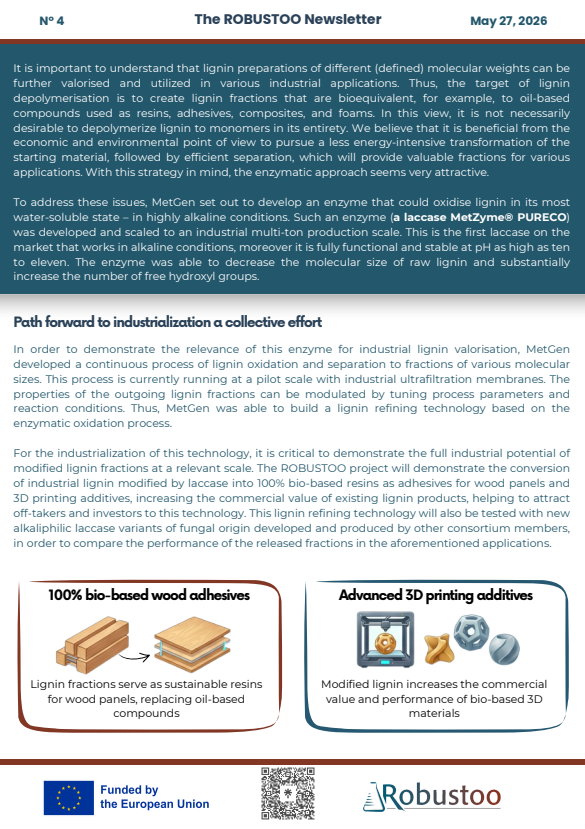
📩 The 4th ROBUSTOO project newsletter is out now!
In this edition, we explore one of the biggest opportunities in the biorefinery sector: lignin valorisation.
👉You can find the PDF version of the newsletter on our website: https://t.co/AiWU4SxpGG
We are focused on using UPOs to produce key chemical compounds difficult to obtain through conventional synthesis. Our goal is to unlock new pathways for industrial production of fine chemicals and intermediates and improve scalability and efficiency of enzyme-driven processes.
Unspecific Peroxygenase (UPO) is opening new doors in fine and intermediate chemical production.
This enzyme has the unique ability to catalyse a plethora of oxyfunctionalization reactions, triggered by hydrogen peroxide as the main oxygen donor and the final electron acceptor.
From pharmaceuticals to the chemical industry, enzymes are revolutionizing numerous sectors, contributing to circular economy models and industrial #sustainability.
However, challenges remain when it comes to enzyme stability and industrial scalability.
#ROBUSTOOproject#enzyme