The loudest voices stoking fears about AI dangers have made tremendous headway in the past two weeks. AI technology has not taken some unexpected, dangerous turn, but the hype around it — propelled by what appears to be a well orchestrated PR campaign — has drummed up considerable fear. I worry that it represents a setback for our field.
I have written frequently that fears of AI are overhyped. AI’s capabilities can be uncannily human-like and unpredictable, and it’s rational to worry when people who are directly involved express concerns. But I see the problems as a sign of the engineering work that ahead, rather than insurmountable barriers or the sky falling. AI technology continues to advance — which is a good thing! — but technical advances, poorly understood by the public, give those who seek to generate hype repeated opportunities to do so.
First, I don’t see any step up in the risk of human extinction from AI compared to a few months ago. The theories about this remain the same fantastical, science fiction scenarios as a few months ago. The biggest change in AI risk is its cybersecurity capabilities — a topic which we should take seriously — but this, too, will not lead to the end of the world.
The most notable recent event leading to increased fear was when an OpenAI team deployed an agent swarm that hacked into Hugging Face. Much of the popular press contained significant hype. For example, some publications reported that a swarm of 1,200 agents carried out the attack. While this was technically accurate, as I write this, I have about 1,300 processes running on my laptop. Yes, the ability to get large swarms of agents to work in parallel on a task is a significant technical advance, And, in computing, many processes run at the same time. So this shouldn’t be seen as some magical capability.
Additionally, OpenAI’s buggy sandboxing and monitoring processes were key to enabling this incident. Fixing these bugs and putting in place improved monitoring would be appropriate fixes, not pausing AI. There are many well known ways to attack software systems. The main advantage of AI agents is that they are relentless. They will tirelessly try many tactics — and have the patience to chain vulnerabilities together — that previously would have taken an infeasible amount of human effort. But in the long term, I believe the advantage will lie with defenders (because they have more information with which to identify bugs, which they can fix), but the cyber-threat landscape has changed significantly. There are still bottlenecks to identifying and exploiting a vulnerability. AI agents still have to try a lot of things to see what works, and taking these actions takes time and might be detected by defenders. This is why, even though it is now easy to obtain versions of leading open weight models that have had their guardrails removed or weakened, so they will not refuse to try to execute cyber attacks, the world has not ended.
I am also concerned about the anthropomorphization of AI in a lot of reporting, where LLMs and agents are unnecessarily treated as if they were people. If I wield a hammer, miss a nail, and accidentally dent the wall, it’s not the fault of the hammer. The problem lies in how I used the hammer. Similarly, if I prompt an agent and it hacks into someone else’s system, the responsibility lies with me, not the agent.
Of course, we want to build systems that are as safe and predictable as possible. (For example, an unsafe hammer would be one whose head randomly flies off under normal use.) Today’s agentic systems are not predictable, but I see no reason why, by applying sound engineering practices, we won’t be able to make them extremely safe to use. One new element in the forecasts of AI-enabled doom is AI companies disclaiming responsibility for their own products. “I didn’t do it; my out-of-control agent did!” There’s a balance to be struck between the responsibility of the tool maker and the tool user, but when something goes wrong, let’s hold the people building and/or using the hammer responsible, rather than the hammer. (By the way, if you’re worried about AI bioweapon risk, David Bellamy has a great post on why this, too, is overhyped. Briefly, the bottleneck in building a bioweapon is not intelligence, but lab work and manufacturing.)
Pausing AI progress will create much more harm than benefit. First, our adversaries will certainly not slow down. Second, engineering requires discovering problems empirically so we can fix them. If we pause AI by a decade, we will also delay finding and implementing safety engineering fixes by about the same duration.
Of course, the incentive to stoke fears — for regulatory capture, to garner attention, or to make one’s technology seem more powerful — remains the same as before. Disclaiming responsibility is a new one. Taking a hard technical look at the actual risks however, I see little factual basis for the degree of fear that’s been stoked up. We still have hard research and engineering work ahead to improve AI safety, but the beneficial applications continue to vastly outweigh the risks, and we should keep building.
[Original text (with links): https://t.co/jni2tWazAH ]
Grok 4.7 just built a GTA-style open-world game from a single prompt in Grok Build
You can walk around, drive cars, enter vehicles and explore an entire city
It looks insane, and I had way too much fun playing it 😂
In just the last 90 days:
1. Grok 4.3 — barely top 10. “xAI is dead beyond compute leases.”
2. Grok 4.5 — massive comeback. “Maybe a chance. But Grok will never catch up to the frontier.”
3. Grok 4.6 — they’re frontier. “Still not top 3.”
4. Grok 4.7 — now top 3 in frontier coding, while being much cheaper & faster.
5. Grok 4.8 next month.....
The model machine is just starting up.
Grok will be the workhorse of the upcoming agentic era.
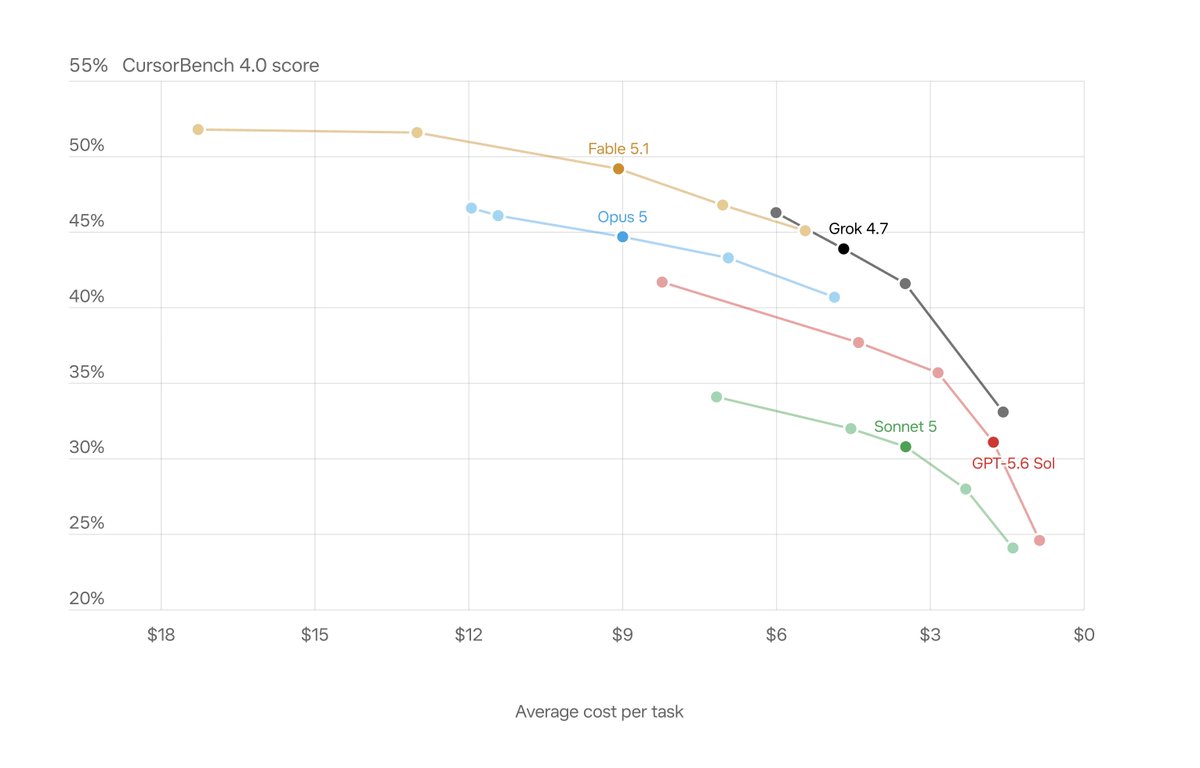
Grok 4.7 is behind only Anthropic models on AA-Briefcase, ranking just behind Opus 5 at ~50% of its Cost per Task
Grok 4.7’s improvements over Grok 4.6 are clear in AA-Briefcase-Lite, our public due diligence scenario where models are tasked with building market models and target assessment decks. Grok 4.7 gains significantly in Analytical Quality Elo (1698 → 1994) with a slight regression in Presentation Elo (1531 → 1499).
API cost to produce example decks: Grok 4.7 (xhigh) ~$8 vs. Grok 4.6 (xhigh) ~$4.40
grok 4.7 is here, and its our best model so far!
try it out in cursor, grok build, api or anywhere you get your tokens! curious to hear what you think
here's grok 4.6 vs 4.7 building age of empires ii
Grok 4.7 has landed. 🚀
Congrats to @SpaceXAI on its most capable model yet for coding and knowledge work.
Proud to support the team with NVIDIA accelerated computing.
Excited to bring 4.7 to you all!
Numerics aside, it's incredibly capable in Grok Build/Cursor. We spent a lot of hours on the harness, iterating with some of the greatest engineers in the world.
Also, the fast mode has INSANE tps. Happy Grok Building :) Lmk what you think!
Grok 4.7 places @SpaceXAI as third, after Anthropic & OpenAI, for agentic coding.
When factoring in that Grok is significantly faster & lower cost, it’s a great choice for your everyday workhorse.
Grok 4.7 scores 46 on the Artificial Analysis Intelligence Index to bring SpaceXAI into the top 4 AI labs. Coding Agent Index performance has also improved, overtaking GPT-5.6 Sol
Grok 4.7 scores +2 points over Grok 4.6 on the Intelligence Index, with strong performance on agentic knowledge work tasks. We evaluated the new model at xhigh reasoning effort.
Congratulations to @SpaceXAI and @ElonMusk on the release!
Key takeaways:
➤ Grok 4.7 joins the frontier of agentic knowledge work: Grok 4.7 gains +111 Elo over Grok 4.6 (high) on AA-Briefcase, our private benchmark for long-horizon agentic knowledge work, scoring 1657 Elo and placing it alongside Claude Opus 5 and Claude Fable 5.1 at the frontier. On GDPval-AA, it scores 1695 Elo, +90 ahead of Grok 4.6 (high).
➤ A leap in coding agent performance: Grok 4.7 (xhigh) with Grok Build scores 56 on the Artificial Analysis Coding Agent Index, up +9 points from Grok 4.6 (xhigh). Among models in their native harnesses, Grok 4.7 + Grok Build now ranks 4th, behind only Claude Fable 5.1, GPT-6 Astra, and Claude Opus 5.
➤ Incremental performance changes elsewhere: Outside of agentic knowledge work, Grok 4.7 broadly matches Grok 4.6 (high) on the other Intelligence Index tasks. It improves on Terminal-Bench 4.0 (+4.5 percentage points) and GDP.pdf (+3.0 p.p.), with regressions on AA-LCR (-3.7 p.p.) and AutomationBench-AA (-1.1 p.p.).
➤ High token use across tasks: Grok 4.7's gains come with higher token usage. Grok 4.7 (xhigh) uses approximately 81k output tokens per Intelligence Index task, compared with 36k for Grok 4.6 (high) and 27k for GPT-6 Astra (max) - 125% and 196% more, respectively.
Other model details:
➤ Context window of 500k tokens, unchanged from Grok 4.6
➤ Pricing of $2/$6 per 1M input/output tokens with cache hits discounted to $0.50 per 1M tokens, matching Grok 4.6
➤ Configurable reasoning effort spans low to xhigh. Our evaluation uses xhigh.
Just a reminder that GLM 5.3 Flash, DeepSeek V4.1 Flash, Qwen 3.8 Next Flash, and even Qwen 3.8 27B are all outperforming (in both intelligence and capabilities) every model that was considered "frontier intelligence" in Xmas 2025 (just 10 months ago)
Opensource AI is on fire
Last week, @X sued several people who abused Creator Revenue Sharing by operating a coordinated network of accounts, posting inauthentic content to manipulate engagement, and using multiple bank accounts to hide their scheme.
We do not tolerate fraudulent behavior on X -- and will act forcefully to protect our platform and the earnings of genuine creators.
You can read our lawsuit here: https://t.co/EKHFX06nSY
Happy 420!
The time is NOW to legalize #marijuana!
While our legislators spend time packing pork in stimulus bills I hope they eliminate the ban on federal banking & legalize #cannabis in order to increase:
💼 Jobs
💰 Tax Revenue
🏡 Real Estate Values
Mahalo,
#PotDaddy💚