The American Association of University Professors called the University of Nebraska-Lincoln's push to gain readmission to the AAU into question following last year's program and position eliminations.
📞 ☎️ Off the REQUEST LINE 📞 ☎️ 📼
The callers have the SHRINE BOWL on their minds this week. How about 1980, they said!
Start with the rosters, and then read about the dramatic finish (perhaps the greatest in Shrine Bowl history?)
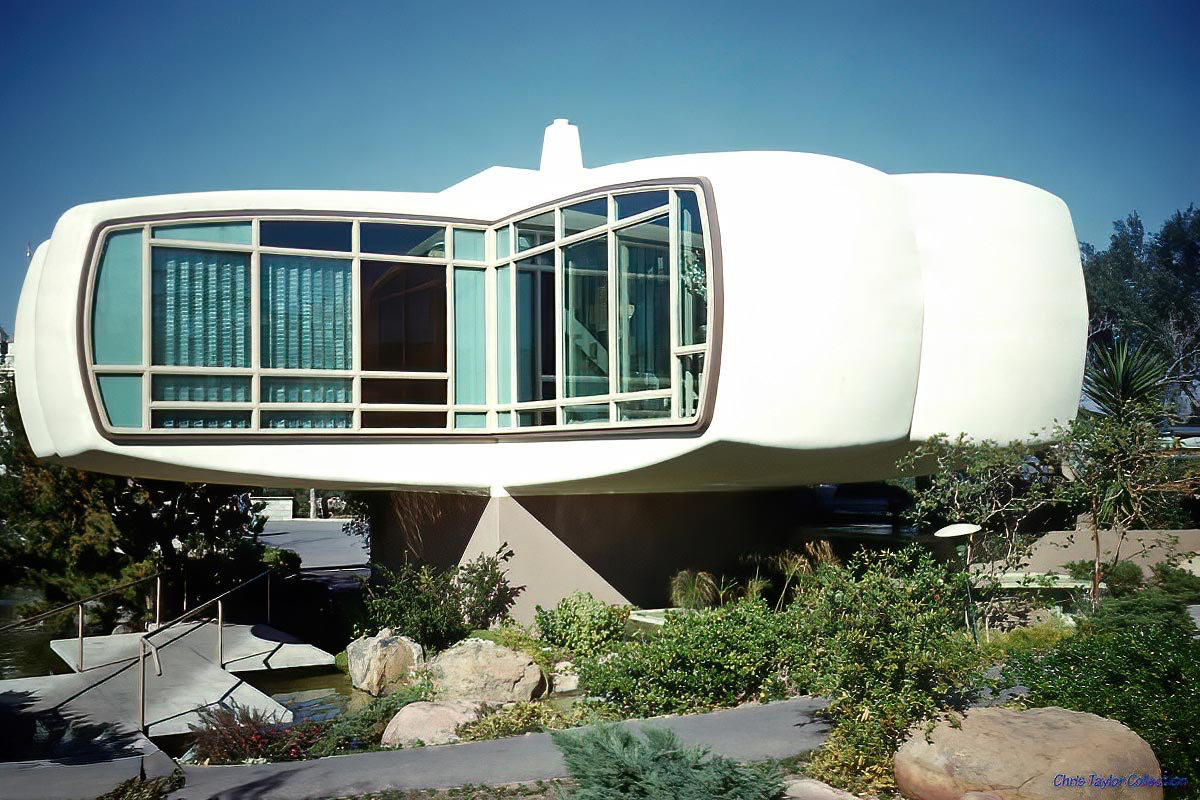
Disneyland’s Monsanto House of the Future stood in Tomorrowland from 1957 to 1967, offering guests a glimpse of what suburban living might look like in 1986. Developed through a collaboration between Monsanto, MIT architects and engineers, and Disney, the experimental house was constructed largely from fiberglass-reinforced plastic, a radical idea at a time when plastics were still relatively uncommon as structural building materials.
Inside, the House of the Future was filled with space-age conveniences. Its “Atoms for Living Kitchen” featured an early microwave oven, push-button appliances, specialized refrigerated storage compartments, and an ultrasonic dishwasher built into the kitchen island. Instead of conventional water jets, the dishwasher demonstrated the possibility of using high-frequency sound waves to help clean plastic dishes. While microwave ovens eventually became household standards, ultrasonic dishwashing never caught on as a mainstream home appliance.
The bathrooms were created with the involvement of industrial designer Henry Dreyfuss and featured molded plastic fixtures and built-in electrical conveniences. Among the futuristic touches was an electric toothbrush with a cord that retracted into the wall. The master bathroom even incorporated closed-circuit television that allowed residents to see visitors at the front door, an early vision of technology similar to today's video doorbells and home-monitoring systems.
Perhaps the greatest demonstration of the house’s plastic construction came when Disneyland tried to remove it in 1967. Demolition reportedly took about two weeks because the fiberglass-reinforced structure proved far tougher than expected. Wrecking balls reportedly bounced off portions of the shell, forcing workers to cut, pry, and crush the structure into smaller sections for removal.
The Earth is in a protracted ice age, and average global temperatures are around 15°C, still far lower than the long-term historical average of 18°C to 26°C.
The world is just too cold to be facing a crisis of global warming. Polar ice sheets are almost entirely isolated from warmer tropical waters, and any significant glacial ice loss is likely to last thousands of years, potentially raising sea levels by only a few millimeters a year.
Any protracted warming or carbon dioxide rise is more likely to benefit plant growth, improved living conditions, and higher food production. This has already been identified in NASA satellite studies.
Predicted extreme temperature rise scenarios—such as warming reaching up to 5°C by 2050—have been increasingly set aside in recent years by climate modeling cohorts and United Nations assessments as support fades for extreme high-emissions scenarios in favor of more realistic baselines.
The evidence of our ice age world is sitting there like a sudden winter snowdrift. Ten percent of the world's land area is still under glacial ice, which covers 15 million square kilometers (5.8 million square miles)—roughly a third of its peak extent during the Last Glacial Maximum (26,000 to 19,000 years ago).
The Antarctic ice sheet is the largest and thickest ice formation on Earth, reaching up to 4.8 kilometers (about 3 miles) deep. It holds 90% of the world's ice by volume and accounts for around 85% of total global glacial ice cover, spanning roughly 14 million square kilometers (5.4 million square miles)—8.3% of the world's land surface.
The Late Cenozoic Ice Age has not ended, having lasted for 34 million years, triggered by the glaciation of Antarctica, orbital anomalies (Milankovitch cycles), and tectonic shifts that isolated the Antarctic continent as Australia and South America drifted northward.
Human civilisation has risen almost entirely during the benevolently warm Holocene interglacial period, which has lasted for 11,700 years. The alternating cycles of glacial and interglacial periods have been taking place continually for 2.58 million years. These are very long-standing geological cycles, driven by orbital shifts (known as Milankovitch cycles).
However, the oceans are the Earth's greatest and most abundant physical feature visible from space. Oceans cover three quarters (72%) of the globe to an average depth of 2.3 miles, while forests cover 31% and deserts 33%. Most of the rest of the world is still wilderness.
Furthermore, the oceans contain 86% of the surface carbon reservoir and 91% of all retained heat energy; by contrast, the atmosphere holds a mere 1 to 2% of each.
For four decades, public debate has been dominated by fear and guilt, centered on claims of a looming climate crisis caused by us. The UN has led this campaign, which is unrelated to its mandated purpose of resolving international conflicts.
Much of the scientific basis for the campaign was based on worst-case computer model scenarios and forecasts of soaring world temperatures. The intensity of this campaign has progressively been diminishing.
Quite intelligent move on the Hippos part.
He knows the gators won't mess with him, so he leads his attackers straight to the pit.
Maybe it's their deal with one another. Bring us food, we leave you all alone... 💪
The central and eastern U.S. are about to go from summer to fall in a matter of days...
The end of this never-ending heat dome is near! By Tuesday, a powerful push of cooler air will send high temperatures plummeting across the Plains and East Coast compared to what you are feeling today.
The most dramatic cooldowns will target the central Plains and Mid-Atlantic. Kansas City and Omaha could see highs plunge 24–25 degrees, while Washington, D.C., could see temperatures over 20 degrees lower than what they are today.
The chill won't stop there, with much of the East Coast cooling by 12-16 degrees, including New York City and Charlotte.
Meanwhile, the Intermountain West will be taking the opposite path. Places like Boise could see a significant warmup by the time we get into Tuesday!
Tracking a river #flood along the Nishnabotna River near Hamburg, Iowa after multiple rounds of heavy convective rainfall. Note the trees, logs and other debris floating in the flood. Unless more rainfall arrives, this should crest above minor flood stage.
An old meteorologist once said, "You can predict the winter based on the 'Wooly Worms'. The more black they have, the harsher the winter. The more brown, the milder the winter will be." Just found the first Wooly Worm today. Not saying he's right, but we sure hope he is! 🤞🤞
Most attended games at Wrigley Field:
1. Cubs vs. Dodgers, 1947 (Jackie Robinson’s first game in Chicago): 46,572
2. Nebraska volleyball vs. Missouri, 2026: 43,067