Forget Nero. Forget Caligula.
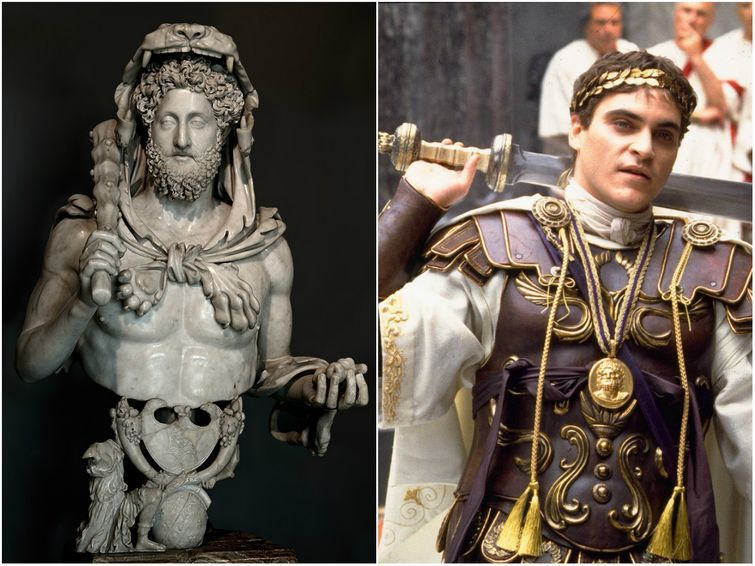
The worst Roman emperor in history was a 19 year old who thought he was the reincarnation of Hercules. If you saw the movie Gladiator, you know him as Joaquin Phoenix's character. His real name was Commodus, and the reason his story is so dark is that his father was Marcus Aurelius, the philosopher king who wrote the Meditations.
When Marcus died in 180 AD, Commodus inherited the most powerful empire the world had ever seen. He immediately abandoned his father's wars on the German frontier, made a humiliating peace, and rode back to Rome to play.
He fought in the Colosseum 735 times. He won every match, because his opponents fought him with wooden swords while he used a real one. The Senate was forced to pay him a million sesterces every time he stepped into the arena.
He once gathered men who had lost their feet to accident or disease, dressed them from the knees down as serpentine giants, handed them sponges to throw at him as "rocks," and clubbed them to death in front of the Roman public for sport.
On another day, he decapitated an ostrich in the arena, walked up to the senators in the front row, and held the bloody head up at them with a smile. The historian Cassius Dio was sitting there that day. He writes that the senators chewed on the laurel leaves from their crowns to hide their hysterical, terrified laughter, because they understood the head was a promise.
He renamed the city of Rome itself "Colonia Commodiana." Colony of Commodus.
He renamed all twelve months of the year after his own twelve titles.
He declared himself a living god, dressed publicly in a lion skin, carried a wooden club, and demanded to be addressed as Hercules, son of Zeus.
His own sister Lucilla tried to have him assassinated. He survived and had her executed. His wife Crispina was exiled to an island and quietly killed. His chamberlain Cleander began openly selling senate seats and consulships for cash. In one year, twenty five different men were appointed consul.
On New Year's Eve, 192 AD, his mistress Marcia found her own name on his execution list for the next morning. She poisoned his wine. He vomited it up. So she sent in his personal wrestling coach, a man named Narcissus, who strangled him to death in his bath.
The very next year, the imperial throne of Rome was literally auctioned off to the highest bidder by the Praetorian Guard. Five different men claimed the title of emperor in twelve months. Civil war never really stopped after that.
Edward Gibbon, who wrote the definitive history of Rome's collapse, opens his entire 3000 page book with the death of Marcus Aurelius and the rise of his son.
The Roman Empire would limp on for another 284 years in the west before it finally fell.
But the Pax Romana, the longest stretch of peace and prosperity the ancient world had ever known, died on the German frontier with Marcus Aurelius.
His son made sure of it.
Jane Fonda pays tribute to her former husband, Ted Turner:
“He swept into my life, a gloriously handsome, deeply romantic, swashbuckling pirate and I’ve never been the same,” Fonda wrote on Instagram. “He needed me. No one had ever let me know they needed me, and this wasn’t your average human being that needed me, this was the creator of CNN, and Turner Classic Movies, who had won the America’s Cup as the world’s greatest sailor. He had a big life, a brilliant mind and a soaring sense of humor."
“He could also take care of me. That was new as well. To be needed and cared for simultaneously is transformative. Ted Turner helped me believe in myself. He gave me confidence. I think I did the same for him, but that’s what women are raised to do. Men like Ted aren’t supposed to express need and vulnerability. That was Ted’s greatest strength, I believe."
https://t.co/gcHcWQabGs
Swiss Guards are sworn in at the Vatican annually on May 6th.
It occurs today to honor the 147 guards who died defending Pope Clement VII during the 1527 Sack of Rome.
Of Egypt, however, I shall make my report at length, because it has wonders more in number than any other land, and works too it has to show as much as any land, which are beyond expression great.
Herodotus wrote this in the mid-5th century BC as an introduction to his lengthy description of Egypt.