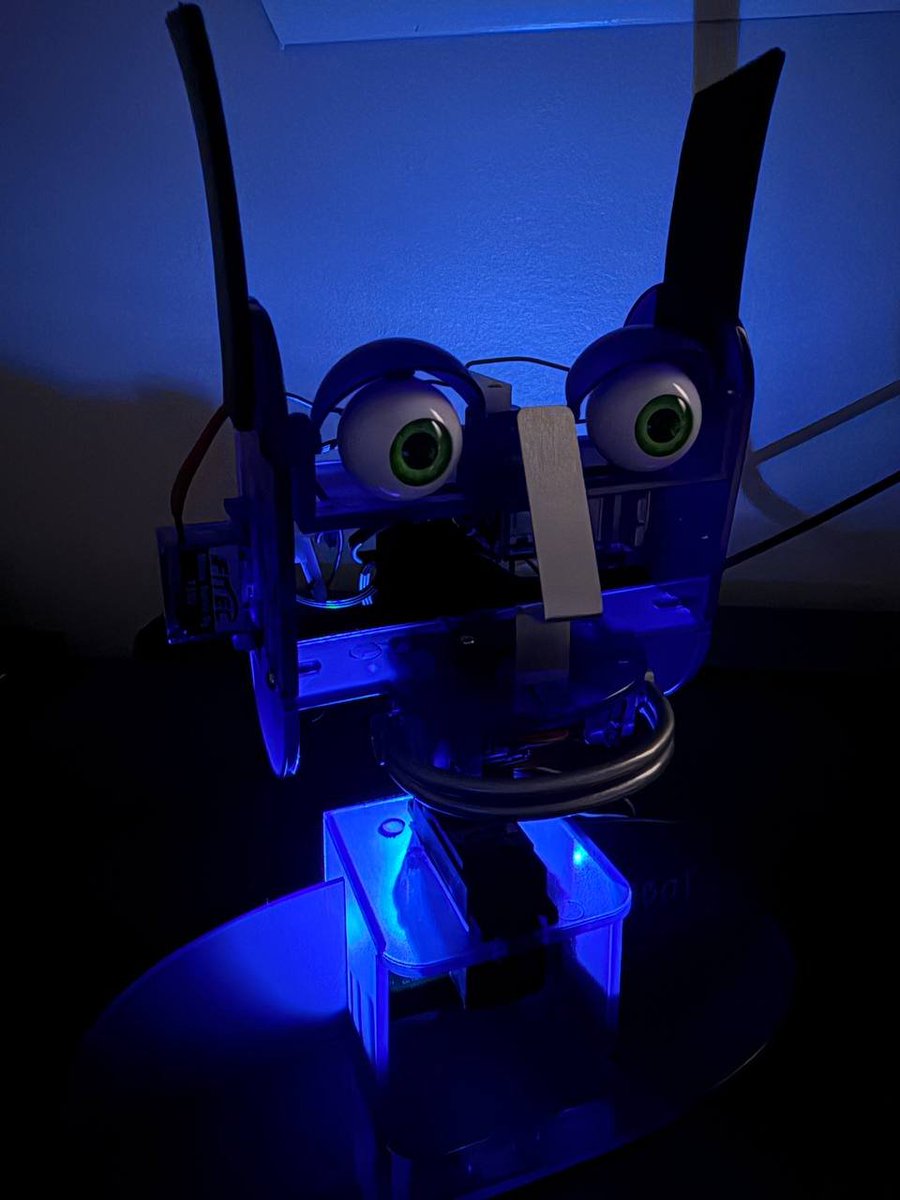
I’m not 100% sure this will work yet.
In theory, I should be able to map outputs from HYBRID001’s nervous system to the Ohbot’s motors and feed sensor input back into the system, which would effectively give it a physical body.
Whether it actually behaves the way I expect is another question xD
Found an old Ohbot I haven’t used in years and I think I’ve found a much better use for it.
I’m going to try giving HYBRID001 a physical body.
The idea is to map outputs from the hybrid nervous system directly to the Ohbot’s motors, so instead of only watching neural activity on a screen we can actually see those signals produce physical movement.
Then start feeding real sensor input back into the system.
Very early experiment but this could get interesting pretty quickly.
One of the experiments I’m most interested in running next is a proper side-by-side comparison of the worm, the fly and HYBRID001.
Same stimulus, same environment, same conditions then just watch how each system responds.
The part I really care about is whether the hybrid starts producing responses or neural patterns that you don’t see in either parent system on its own.
If that happens consistently across repeated runs, that’s where 001 gets genuinely interesting.
I downloaded the $001 / HYBRID001 demo video directly and had AI analyze the entire thing instead of watching a few seconds and making assumptions.
The AI analyzed roughly 70 seconds of footage, checking the continuity of the terminal, the simulation process, spike counts, worm/fly activity, bridge activity, and how the raster patterns changed across different trials.
The conclusion was pretty clear: there are no obvious signs that this is an AI-generated or deepfake video.
The terminal output remains consistent throughout the recording. Different trials produce changing values, activity levels, and raster patterns. There are none of the typical text distortions, broken characters, or continuity errors you often see in generative AI videos.
So there is a high probability that an actual program is running here, rather than this simply being a fake AI-generated video.
But the AI pointed out something much more important:
A real running program ≠ proof that the entire research is real.
The video only shows us the output. It cannot prove whether those numbers are genuinely being calculated by the neural simulation underneath, or whether some of them are hard-coded or randomly generated.
So after analyzing the video with AI, this is where I stand:
AI-generated/fake video: low probability.
Terminal/program actually running: high probability.
A real neural simulation exists behind it: reasonably likely.
All scientific results and the scale claimed by HYBRID001: cannot be verified from this video alone.
The next step is simple.
Audit the GitHub and find the exact source code responsible for this simulation. If the spike counts, bridge activity, and other results shown in the video can be traced back to actual model calculations rather than hard-coded or randomly generated outputs, that would be much stronger evidence.
For now, I don’t see enough evidence to call the $001 dev’s video fake.
The FOMO is already over. Now let the code and time prove the rest.
The holy grail for robotics is being able to generalize: doing work in unseen places
We rented 30 homes in the Bay Area and are doing tasks without any new training
This is a look at the compute pipeline running behind HYBRID001.
You’re seeing the neural activity being processed through the simulation rather than just the visual layer on the site spikes, active neurons, bridge activity and the state changes happening as the system runs.
Yeah, this is something I realised after putting HYBRID001 on the site.
Right now you mostly just get to watch the neural circuit running, which is cool, but it doesn’t really show what I’m actually testing.
So I’m going to start recording the experiments and posting the results here too, so people can actually see what changes, what works, and what we learn from each run.
Paper 4 is about scale.
What happens when we stop treating HYBRID001 as a fixed system and start increasing the number of neurons, expanding the connectome subsets, adding more bridge neurons, and running the simulation at higher fidelity?
More compute lets us simulate more of the underlying biology at once and test whether a larger, denser hybrid produces behaviours or neural dynamics that simply do not appear at smaller scales.
That is why scaling the system matters. It is not just about making HYBRID001 bigger it is about seeing whether increased biological complexity produces genuinely new emergent properties.
Here is the hybrid001 website where you can watch some of these experiments with 001 happen in real time
there is also some other info about the project here
https://t.co/5nUd2gBVKW
Also, for anyone new here (HYBRID001 picked up a lot of attention overnight lol)
These are the current papers I’ve put together documenting the research, results and findings from the project so far.
As new data comes in, the papers will keep being updated and expanded.
paper 1:
https://t.co/GCOcUEu45n
paper 2:
https://t.co/WxfFYt3lAb
paper 3:
https://t.co/3OOCcDYCiE
Also, for anyone new here (HYBRID001 picked up a lot of attention overnight lol)
These are the current papers I’ve put together documenting the research, results and findings from the project so far.
As new data comes in, the papers will keep being updated and expanded.
paper 1:
https://t.co/GCOcUEu45n
paper 2:
https://t.co/WxfFYt3lAb
paper 3:
https://t.co/3OOCcDYCiE
Since this tweet $001 has generated around $5000 in funding for my project (not expected xD)
So here's what i plan to do with the money:
- cloud compute for running longer simulations and experiments
- hosting, databases and storage for research data
- maintaining public datasets, code and documentation so other people can reproduce the work
- improving the HYBRID001 site and live visualisations
Part of the funding will also go toward turning the current HYBRID001 codebase into a proper reusable framework, so other people can plug in their own neural models, run experiments, compare results and build on the research without having to recreate everything from scratch.
Since this tweet $001 has generated around $5000 in funding for my project (not expected xD)
So here's what i plan to do with the money:
- cloud compute for running longer simulations and experiments
- hosting, databases and storage for research data
- maintaining public datasets, code and documentation so other people can reproduce the work
- improving the HYBRID001 site and live visualisations
Part of the funding will also go toward turning the current HYBRID001 codebase into a proper reusable framework, so other people can plug in their own neural models, run experiments, compare results and build on the research without having to recreate everything from scratch.
@joshua_pau6119 This is the only token for hybrid001
i made it since i heard about the fees you can earn just from people trading your token instead of having to actually sell to get some kind of funding
0xcfe55dc432292074166227f6aef152259f679ab1
The neural research behind HYBRID001 is built using work from @OpenWorm and Google’s fruit fly connectomics research.
Here is the papers:
https://t.co/9OhzlFa9QY
https://t.co/VQqIQ3qKhE
Not everything I work on is meant to be public. I use GitHub for a mix of public projects, private experiments, unfinished work and repos I share with friends when we’re building or testing things together.
Some projects get published, some stay private, and some never get finished at all.
The interesting part isn’t just getting both systems to run.
It’s watching what happens between them.
How the neurons influence each other, whether new pathways start forming, whether behaviour changes over time, and whether the combined system produces patterns that weren’t present in either one individually.
Just pushed the HYBRID001 research another step forward.
The paper is now being submitted across more established research channels, with the aim of getting the work in front of people working in computational neuroscience, computational biology and artificial life.
Every new result we collect from HYBRID001 will continue to feed back into the paper as the research develops.
These are the places we have requested to publish our paper:
https://t.co/8NI0XPd1il
https://t.co/cZnMdQoYXl
https://t.co/wHdlDrIpzB