Did you know that if you wait 30 minutes after the market open to take a trade, you have a 70% higher chance of making profit in the market?
Start making more by doing less.
The more you know 💫
A trading present for you. 🎁
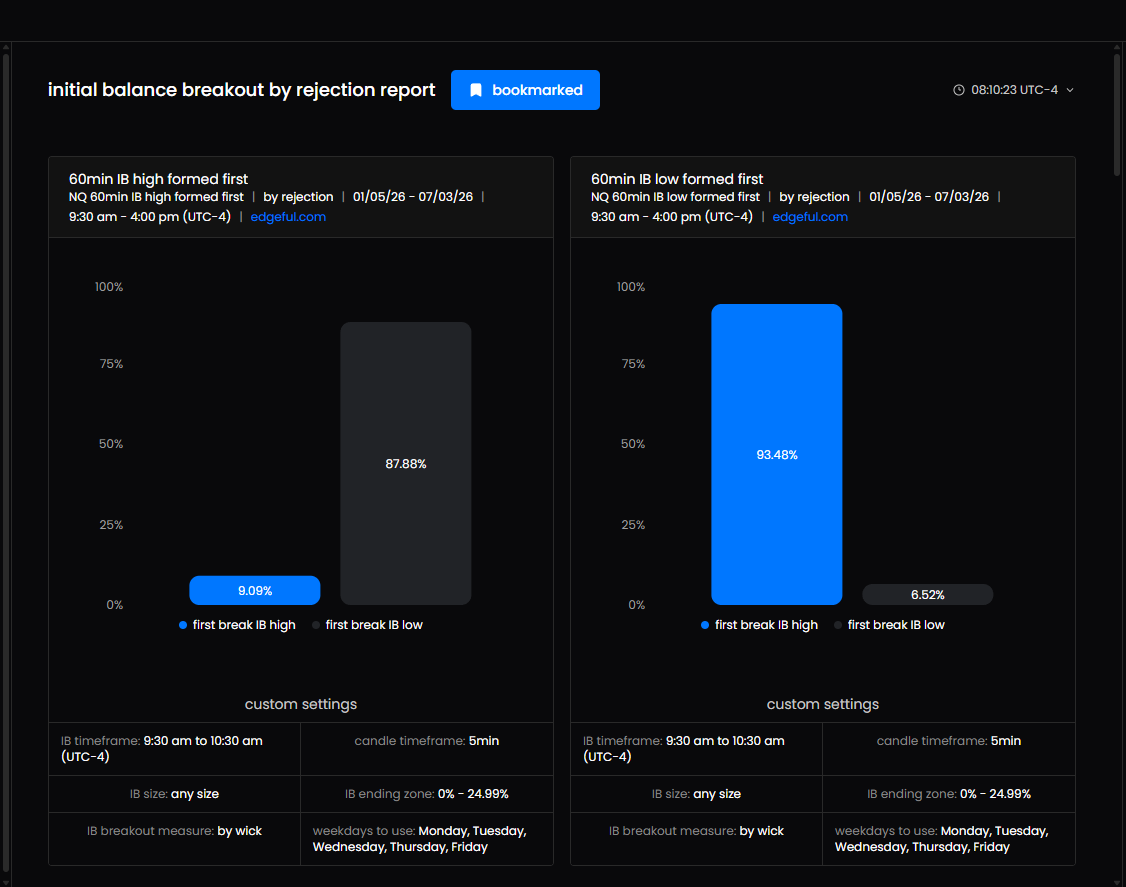
93% of the time something happens with NQ. 😍
If the low of the initial balance formed first, and then the high,
AND if the price closes within 25% of the top of the IB range,
then
93% of the time the high broke first!
Happy 4th of July! 🥳 💰
@edgeful #proudpartner
https://t.co/nGh4DScNal
Most traders don't quit because they can't read the chart
They quit because they can't handle the crushing disappointment and self-hate
Knowing everything a profitable trader knows and still doing the opposite
Ruining a perfect trade when all you had to do was nothing
Doing everything you said you'd do and turning it to ashes because something inside you wouldn't let it be that simple
No boss giving you orders. No rulebook to follow
Just you and a screen that somehow exposes every wound you'd take to the grave.
When you are trading well, that's the time when you should be very hard on yourself- develop a plan to fix the holes in your trading.
When you are struggling, that's the time to show yourself some grace.
Trading is not for everyone. True.
It's for insanely mad people. Because who else would choose a profession like this.
You lose money.
Then spend more money to learn how not to lose money.
Then lose more money applying what you learned.
And then convince yourself that you're "close."
You stare at charts for hours. You spend weekends studying markets. You celebrate a breakeven month like it's a major achievement.
And after all that...
You still can't wait for Monday morning. 🤦🤷
It's for people who clearly have a very unusual relationship with pain.
The great lie is that society is divided between rich and poor.
The great truth, as David Friedberg puts it, is makers vs takers.
Makers build, create, and deliver real value: houses, software, art, businesses, and everything that moves civilization forward.
Takers watch, criticize, analyze, and politic. They push the lie that the rich hoard unfairly so the poor must seize it… all while positioning themselves to rule the chaos.
As @friedberg tells his kids: “At the end of the day, if you made something and someone else valued it, you were a maker. That was an amazing achievement. That is a great day.”
Takers thrive on division. Makers drive progress.
Time to choose your side.
【How Traders Who Always Break Their Rules Become Unable To Break Them】
As you watch the price on the chart move closer to your stop loss line, the hand gripping your mouse starts to sweat a little.
You feel like you should widen the stop just a little.
The moment an unrealized profit appears, your finger moves to the take profit button.
At that moment, somewhere in your head, you hear a voice saying, "I did it again."
You broke your rules again.
After you close the screen, you think this.
My willpower was weak again.
If I could endure more, focus more, and control my emotions better, I should be able to follow the rules next time.
But that way of thinking is already wrong.
You do not break your rules because your willpower is weak.
You break them because, inside you, the win or loss in front of you still feels more important than following the rule.
■ Traders Who Break Rules Are Trying To Avoid Losses
Most traders do not want to break their rules.
In fact, they seriously want to follow them.
And yet, when an unrealized loss grows, they delay the stop loss.
When they see a small profit, they take profit too early because they do not want to lose it.
When the entry condition appears, they cannot click because the previous loss is still in their mind.
Or they enter outside their rules because they do not want to miss the chance.
All of these are actions trying to make the single trade in front of them better.
In other words, you are not ignoring your rules.
You are treating the loss in front of you as something too bad.
In that state, following the rules will always feel painful.
Because one part of you wants to follow the rules, while another part of you is saying, "I do not want to lose this one trade."
As long as those two things collide, your live trading will always shake.
■ Traders Who Cannot Break Rules Have Changed The Direction Of Their Emotions
So how do you become unable to break your rules?
The answer is to build, with your own hands, the belief that following your rules leads to success more than the win or loss in front of you.
You test across a large sample size.
You see wins, losses, losing streaks, and drawdowns again and again with your own hands.
You understand what remains as the total of wins and losses when you repeat the same condition.
And by practicing it again and again with your own hands, you turn that understanding into belief.
Once you reach that point, the direction of your emotions changes.
Before, you hated losing.
So you broke your rules to avoid losses.
But when your belief changes, deviating from the rules starts to feel worse.
More than the stop loss itself, delaying the stop loss creates strong disgust.
More than losing, contaminating the sample becomes something you cannot accept.
At that point, you are not enduring in order to follow the rules.
Breaking the rules itself becomes unacceptable inside you.
■ "I Know Rules Matter, But I Still Cannot Follow Them"
Many people say this.
"I know rules matter in my head, but when I actually trade, I still cannot follow them."
No.
You do not know it yet.
You only know it as words.
If you truly knew it, your actions would change.
If you truly believed it, the direction of your emotions would change too.
If you had truly passed through a large sample size with your own hands, you would not start doubting the entire system because of one trade in front of you.
Knowledge loses easily to fear during live trading.
Understanding from only looking at data is still weak.
Agreement from listening to someone else explain it is still not yours.
Belief cannot be borrowed.
Belief can only be built with your own hands.
That is why traders who cannot follow their rules do not need stronger words.
They do not need more motivation.
They need to pass through rule based wins, rule based losses, and rule based losing streaks again and again with their own hands.
■ Do Not Try To Follow Rules. Build A State Where You Cannot Break Them
If you want to become someone who follows rules, look at the foundation of your belief before blaming your live self.
Have you truly tested those rules across a large sample size?
Do you know how those rules lose?
Have you experienced the losing streaks produced by those rules again and again with your own hands?
Do you know, not as words but as experience, what remains after repeating those rules?
If this foundation is weak, following rules will become a battle every time.
But once this foundation is complete, everything changes.
You stop trying to protect the win or loss in front of you.
What you protect becomes the rule, the sample, and the consistency.
At that point, not breaking your rules is no longer effort.
Breaking your rules becomes the unnatural thing.
There is only one way for traders who always break their rules to become unable to break them.
Go far enough that you can believe, with your own hands, that following your rules brings you closer to success than the win or loss in front of you.
When you reach that point, you will no longer break your rules to avoid losses.
You will start avoiding the act of breaking your rules itself.
📚 Content for serious traders
https://t.co/tMFssKR6Oz
Thank you for reading.
giveaway time :))
giving away 5 lucid 50k DIRECT funded accounts - no eval, straight to funded. you just trade!!
to enter:
- follow me + @TradingLucid
- like + repost
- reply "in"
winners in 5 days 🤝
I spent over two decades as a full time futures trader and scalper, and I learned your edge isn’t just your strategy. It’s your focus.
It’s the amount of hyperfocus it takes every single day. Blocking everything out, slowing your heart rate down, staying calm, believing in your homework, executing at a high level. Trading has to be your number one focus each day. So if you’re learning to become a successful trader, here are three things you may be focusing on that are working against you.
First, other people’s money. Stop looking at how much everyone else is making. That’s the number one thing you have to look away from. I was around thousands of traders on the floor and I barely remember us talking about money. It was private. The goal was to build a life. It felt blue collar. Today everyone talks about what they make, trying to prove someone wrong about the market. It’s a different place, and a lot harder for a new trader to block the noise out.
Second, the access. Overnight used to just be overnight, where you managed a position if you had one. Set time to start, set time to break, set time to come back. We traded mornings, skipped midday, came back for the close. Now the access never stops, and it’s spread everyone’s focus too thin to stay locked in.
Third, understanding the market environment. We move between environments at a very rapid rate. We go from trending higher with no signs of a pullback, buy the dip and hold on, straight into sell off mode. Trying to guess what those days will be like going into them is very difficult. You have to stay open minded and understand how quickly the tape can change. Last Friday was the perfect example. A market runs higher a lot further than most thought, then unravels all at once. It’s the same psychology we see in traders. They stay in their own trend for only so long, then unravel all at once. If you’re not focused, or you’re clinging too hard to one market environment as you move into the next, you aren’t allowing things to be what they are. You’re fighting them for what they were.
So here’s the simple part. Slow everything down. Survive a game where you pay your bills and stay in long enough to make a living. There will be moments this business really pays you, and you won’t choose them. They choose you. The rest is grinding, surviving, enjoying the process. Arguing with people on social media is a time waster, and the people who do it are usually unhappy in their own lives. Spend your time wisely.
Focus is the whole game. Protect it like your account depends on it, because it does.
Enjoy your life. Have fun. This is the greatest business in the world if you let it be. And it’ll be the worst, and destroy your life, if you let it.
Cheers, DELI
- years of failure.
- years of poor sleep.
- years of debt.
- years of losing money.
- years of being mocked.
- years of stress.
- years of social isolation.
- years of watching charts for 10 hours a day.
And they still call you ''lucky''.
Dude, this 5-minute clip will change your life.
Everyone I know benefited massively from the exercise that Mark Douglas is teaching in this clip.
Watch it.
I'm begging you.
You don't need to be confident to trade. You need to be willing to be wrong.
I spent years trying to build confidence. Affirmations before the session. 'I am a profitable trader.' 'I can handle the next loss.' 'I trust my system.' I'd say them out loud in my room like a man trying to convince himself the water isn't cold before jumping in.
Then I'd take a loss and the affirmation would dissolve in seconds. Like it was never there. Because telling yourself you can handle a loss means nothing when you still secretly believe that stop was proof you did a bad job.
Confidence isn't the foundation. It's the byproduct. You can't build it before the trade. It builds itself after hundreds of trades where you showed up without it and survived anyway.
What I actually needed wasn't confidence. It was flexibility. The ability to look at a winning trade and admit I didn't predict the outcome. It just went my way this time. The ability to look at a losing trade and know it wasn't a mistake. It was a quality setup that didn't work because quality setups don't always work.
That flexibility broke everything I thought I knew.
Because if my winning trade wasn't a prediction, then my analysis doesn't cause the win. And if my losing trade wasn't a mistake, then there's nothing to fix. And if there's nothing to fix, then the thing I've been doing for years, adding indicators, stacking confluences, searching for the 90% win rate concept, was never going to get me there. I was solving a problem that didn't exist.
The greatest thing a trader can learn to do is enter a trade and genuinely know there's nothing left to do. The indicators didn't predict the outcome. They pointed me to a quality trade. What happens after the entry was never mine.
Viewing a loss as a bad thing means you think there's a problem to solve. Viewing a win as proof of skill means you think you caused the outcome. Both are the same illusion from different angles. And both keep you chasing something the market was never designed to give you: certainty.
The day I stopped trying to be confident and started practicing being wrong was the day the charts got quiet. Not because the market changed. Because I stopped needing it to confirm who I am.
Flexibility of mind isn't a technique. It's what's left when you finally stop pretending you know what's going to happen next.
I chose trading because:
• I hate talking to people.
• I hate saying ''YES'' when I want to say ''NO''.
• I hate having my life controlled by some loser.
• I hate not having enough money.
• I hate not having enough time.
• I hate waking up early.
I only live once, ok?
The biggest game changer for me was realizing the most powerful edge is sitting on hands. Its the unplanned, impulse trades that don't correlate to any setup that generate losses. I plan exactly where I am going to enter & have 1 setup that I look for there. Otherwise, no trading
Jensen Huang, CEO of Nvidia, is telling you where to invest in 2026.
He has personally directed Nvidia's capital into 8 specific companies for a combined total of over $45 BILLION.
This is where the most important company in the AI economy is putting its money.
Here’s the full list:
OpenAI: $30 billion
The largest commitment of the 8. Nvidia is funding the buildout of OpenAI's compute infrastructure from the inside. OpenAI is also Nvidia's single largest customer.
GLW Corning: $3.2 billion
Optical glass and fiber to physically connect AI clusters. You cannot move data between millions of GPUs without it.
IREN: $2.1 billion
AI cloud provider with one of the deepest power positions in North America.
MRVL Marvell: $2 billion
Custom networking chips that move data between GPUs at massive scale.
LITE Lumentum: $2 billion
Lasers and optical components for the fiber backbone of every AI data center.
COHR Coherent: $2 billion
Fiber optic transceivers that connect GPU clusters inside data centers.
CRWV CoreWeave: $2 billion
GPU-as-a-service provider. Nvidia's largest cloud customer outside the hyperscalers.
NBIS Nebius: $2 billion
AI cloud infrastructure company. Quietly building hyperscale GPU capacity for the AI labs.
Whatever Nvidia is buying is where the money is going next.
At The Assembly, we’re a team of 8 with one goal: help you find the right stocks early.
Turn notifications on so you don’t miss our alerts. This is VERY important.
If you’re not following us yet, you will regret it later.