Been working with @nestframework for 3-4 years and always loved how its modules and CLI make the tedious work easier and safer. But lately they've completely upped their game with official AI, MCP, observability and reliability modules. It finally feels like a complete platform.
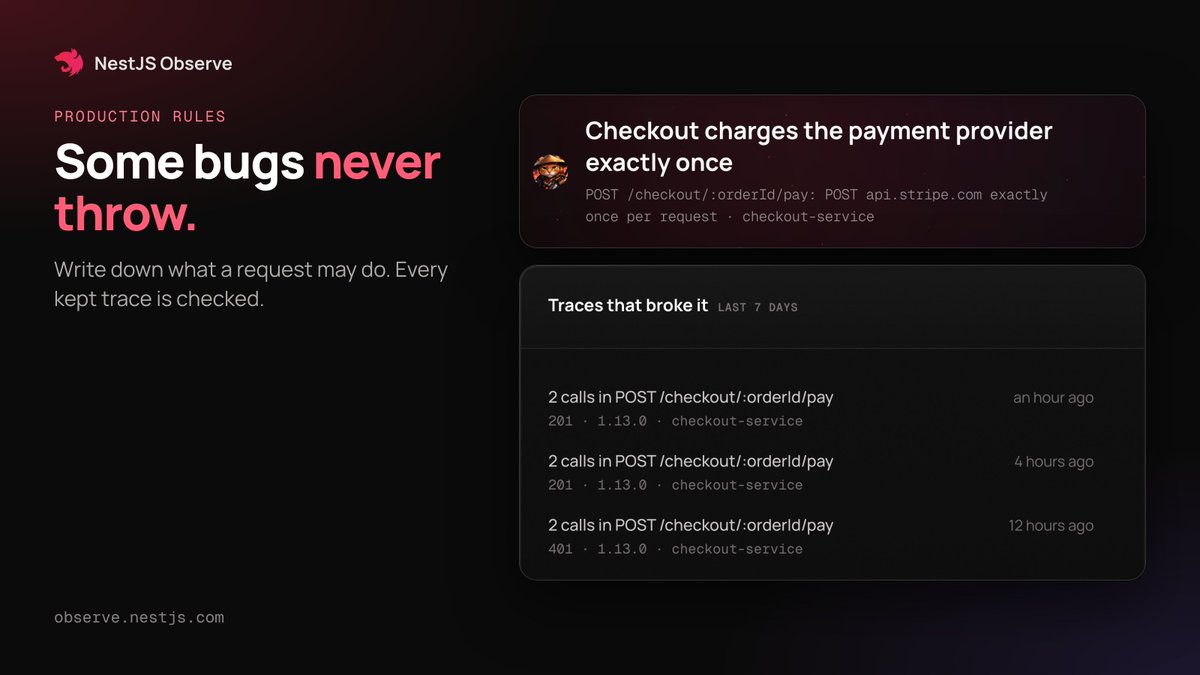
📣 Announcing Production Rules in NestJS Observe: catch the bugs that never throw 🧷
A retry that charges a card twice, a query run once per row. Write down what a request may do - "checkout calls Stripe exactly once" - and every kept trace is checked against it.
Announcing @nestjs/mail 📬
Lightweight, zero dependencies, long awaited. Typed mail classes, auto-escaped templates, SMTP/Resend/Postmark/SendGrid/SES transports, outbox support, and delivery events you can track as custom metrics in NestJS Observe.
https://t.co/NRN19X1Rpa
DeepSeek Harness shows that the model is only part of the equation. The harness shapes how it works.
Open-source models and customizable harnesses could be a more durable long-term path, giving developers more choice and control.
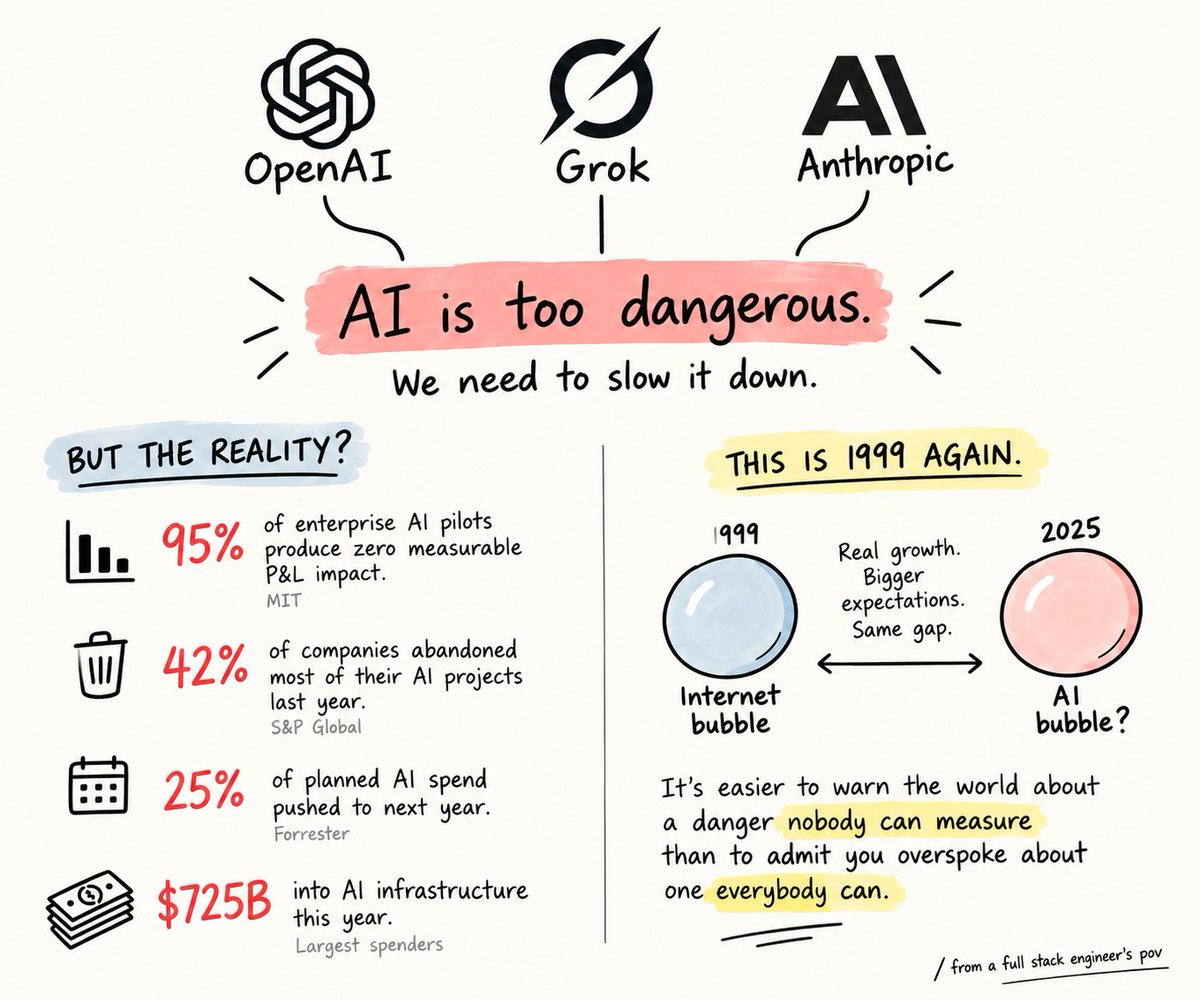
Three CEOs agree AI is too dangerous to build fast. I think they're propping up a bubble.
MIT: 95% of enterprise AI pilots show zero P&L impact. Against $725B in infrastructure this year.
Easier to warn of a risk nobody can measure than admit you oversold one everybody can.
Windows idled at 6 GB. Switched to Linux, but my Lua window manager config was 4 years stale.
Pointed Claude Code at it. Never had to relearn Lua. Desktop now idles at 1 GB and I can run everything at once.
The real unlock isn't writing code. It's the work you keep postponing.
Chunking for RAG: prepending the heading path works. Running an LLM over each chunk for context works too, and costs a call per chunk at ingest.
voyage-context-4 handles it inside the embedding model. One pass over the document, one vector per chunk, retrieval context included.
A heading path tells you where a chunk sits. Not what it says.
"It fell 12% year over year" is unfindable. The subject is a pronoun, and pronouns embed to nothing.
Contextualized chunking prepends generated context before embedding. @AnthropicAI measured 35% fewer misses.
Chunk size is not the lever you think it is.
Flatten a PDF, DOCX, PPTX or HTML page into markdown and every boundary the document had is gone.
Token count is all that's left to split on.Parse into a document tree first. Docling gives you headings, tables and lists as objects.
Number one mistake people make when building a RAG system: they convert any doc or webpage to markdown and chunk it by token size, ignoring the structure of the document.
Respect the structure. Don't split a paragraph across chunks, and if you must, carry context into both.
6 months of building production apps with Claude Code.
The lesson: you cannot outsource judgment.
I design the architecture. Claude scaffolds it.
I define the flows. Claude implements them.
Claude writes the CRUD. I test it.
Every time I skipped a step, I paid for it later.
Indian telecom Reliance is sabotaging access to Telegram for millions of users OUTSIDE India (including the UAE) via a rogue method called BGP hijacking.
The sabotage seems intentional, as Reliance has ignored multiple reports.
This may be part of a competitive war, as Reliance is partially owned by Meta — the company behind WhatsApp.
Network operators are advised to reject unauthorized BGP announcements from Reliance (AS18101) to prevent route hijacks and ensure stable Internet access for their users.
Such abuse of global Internet routing is alarming. I wouldn’t be surprised if Reliance/WhatsApp were also behind the recent lobbying effort to ban Telegram in India.