#ViÑADELMAR#ÚLTIMOMINUTO
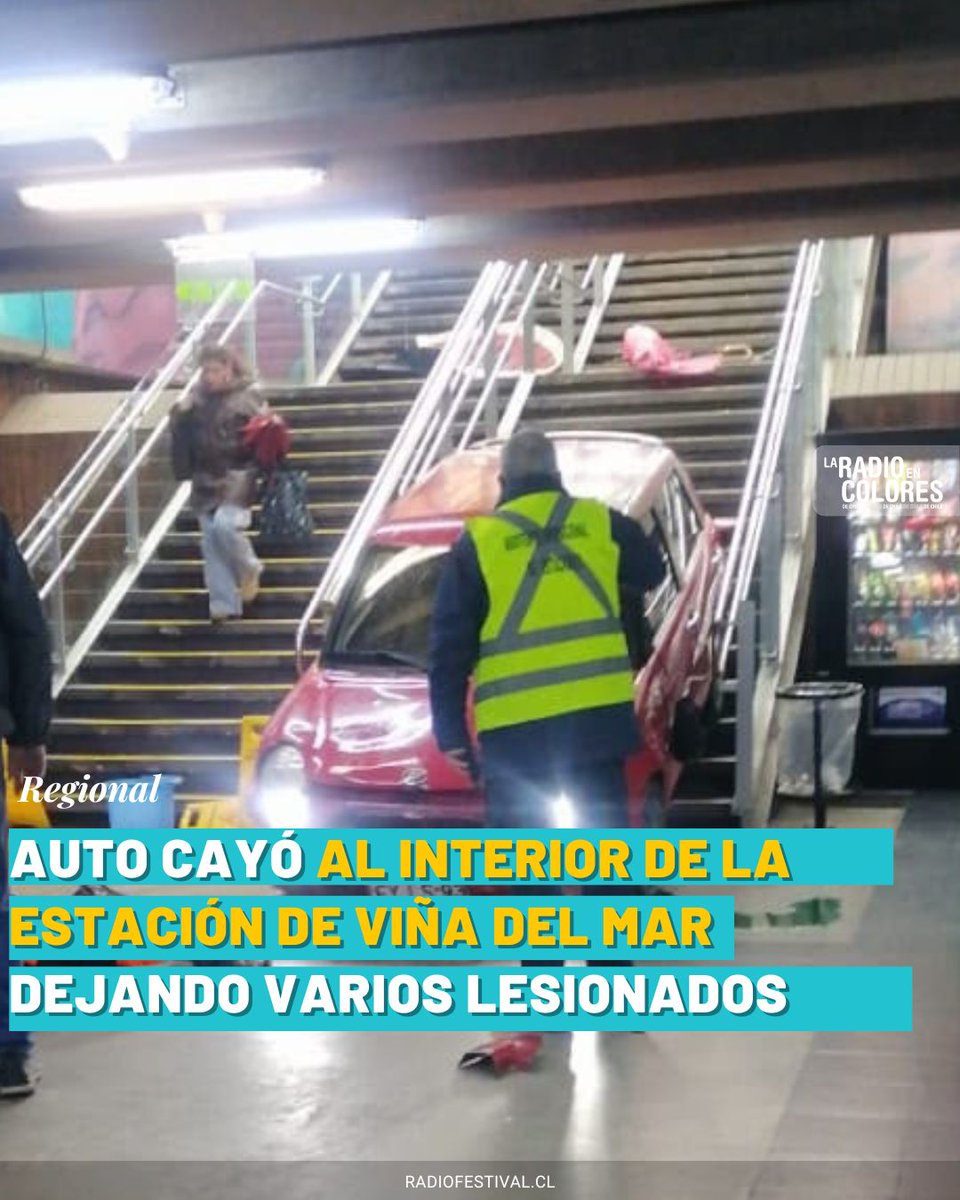
AHORA AMPLIACIÓN| Desbarrancamiento de vehículo en estación del metro EFE en Viña del Mar deja 1 fallecido y 4 lesionados, el accidente se registró en calle Álvarez con Sucre, en el lugar se mantiene un amplio operativo de los equipos de emergencias.
PRELIMINAR: 1 persona fallecida y 4 lesionados deja el grave accidente ocurrido esta tarde cuando un automóvil cayó al interior de estación #ViñadelMar de EFE Valparaiso
🔴 #SENAPREDInforma
¡ATENCIÓN! Por peligro de aluvión #SENAPRED solicita evacuar sector Población Argentina en la comuna de #Quilpué, Región de Valparaíso.
Para reforzar la evacuación en terreno por parte de los organismos técnicos, #SENAPRED activó mensajería #SAE.
RECUERDA actuar con calma y acatar las indicaciones de la autoridad y de los equipos de respuesta. Durante la evacuación, no olvides considerar a tu mascota y sus necesidades.
Más información en https://t.co/Vea77AemGK
The Myth of “Love Learning”
People often ask me how to get better at chess. My answer is almost the opposite of what people expect.
You don’t have to love learning.
In fact, if you wait until you love the process, you’ll probably never become very good.
We romanticize improvement. We imagine great players waking up excited to study endgames, analyze losses, or memorize opening lines. Sometimes that’s true. Most of the time it isn’t.
Improvement is often boring.
The difference between an amateur and a professional isn’t that the professional enjoys every minute. It’s that they keep going when they don’t.
People say children are fearless learners. I’m not so sure.
Children quit things constantly. Piano. Swimming. Languages. Football. Chess. They usually continue only because someone else insists they do. Parents. Teachers. Coaches.
Discipline often comes before passion, not after.
The same is true for adults.
We tell people to “follow your curiosity.” That’s wonderful advice if curiosity happens to last. Usually it doesn’t.
Every meaningful skill has a point where curiosity runs out and routine takes over.
That’s where improvement actually begins.
Chess certainly did not always feel like play to me.
There were tournaments where the last thing I wanted to do after six hours of defending a miserable endgame was analyze another five hours.
There were openings I studied not because they fascinated me, but because my opponents forced me to.
There were positions I analyzed simply because they were objectively important.
Not because they were fun.
Because they needed to be done.
People often criticize schools for asking the wrong questions.
But there’s another side to that story.
If everyone only studied the questions they found interesting, most people would develop huge blind spots.
Sometimes someone else knows what you need to learn before you do.
Nobody is naturally curious about tax law before becoming an accountant. Or anatomy before becoming a surgeon. Or rook endings before losing enough of them.
External structure isn’t always the enemy of learning.
Often it’s the bridge that gets you to the point where genuine curiosity develops.
The biggest obstacle isn’t fear of looking stupid.
It’s our addiction to doing only what feels rewarding today.
Modern life gives us endless opportunities to switch the moment something becomes difficult.
A new opening.
A new productivity system.
A new app.
A new hobby.
Very few people simply keep doing the same useful thing for years.
That’s the superpower.
So when people ask how to improve at chess, I don’t tell them to fall in love with learning.
Love helps.
Curiosity helps.
Being willing to fail helps.
But none of those are reliable.
Build habits that survive the days when none of those feelings are there.
Because mastery isn’t built on motivation.
It’s built on showing up after motivation has left the room.
One thing I’ve noticed after more than two decades of professional chess is that almost everyone dramatically underestimates how much preparation has changed.
People still imagine opening prep as memorizing a few lines from a book. That world is long gone.
Today it’s databases with millions of games, engines stronger than any human has ever been, neural networks evaluating positions that used to be considered equal, cloud computing, custom scripts, opening trees, novelties hidden 25 moves deep, and increasingly AI helping organize all of it.
But here’s the funny part.
The biggest difference between the very top players isn’t usually who has the strongest engine. We all have access to incredibly strong engines.
It’s knowing what to ask.
You can spend six hours analyzing a position and learn almost nothing, or ask the right questions and discover an idea in twenty minutes that completely changes your understanding.
Over the years I’ve also realized that preparation isn’t really about finding “the best move.”
It’s about finding positions where:
you understand what’s going on,
your opponent probably doesn’t,
and the practical decisions are difficult.
That’s why sometimes you’ll see a super-GM voluntarily enter a position that’s objectively only equal—or even slightly worse. If it’s easier to play for one side, the engine evaluation isn’t the whole story.
Another misconception is that preparation ends once the game starts.
The first novelty is often just the beginning. After that you’re relying on pattern recognition, intuition built from thousands of hours of analysis, psychology, time management, and occasionally just stubbornness.
Chess has become both more scientific and more human at the same time.
The computers keep getting stronger, but understanding which positions fit you is still something no engine can optimize perfectly.
At least not yet.
I would like to dedicate this win to @GmNaroditsky. It was one of his favourite tournaments. We have played endless bullets and hyperbullets, which definitely contributed to my growth as a player.
🇦🇷 Faustino Oro speaking to ChessBase India after becoming the 2nd-youngest GM in history:
“I am very happy with the tournament and, of course, with achieving my final GM norm. A year or two ago, maybe I could have imagined this, but when I started playing, I could not have imagined it even in the best scenario.
Obviously, I have talent, but talent alone is not enough. You can become a good player with talent, but you won’t become world champion only with talent. There is a lot of work behind it. I train every day for five or six hours, sometimes in different ways. I work very hard because, as I said, with talent alone you will not get far.
I just try to play my best chess and enjoy it, which I think is the most important thing. Because if you don’t enjoy it, why do you play?
I need to keep playing and keep improving. The next goal is 2600.”
After deep reflection, I have taken the difficult decision to withdraw from the FIDE Women’s Candidates Tournament.
No event, no matter how important, can come before personal safety and well-being. Despite the assurances provided, I do not feel fully secure under the current circumstances.
This is a painful but necessary decision, and I stand by it.
Informamos a nuestros clientes de los sectores 22 Norte, 19 Norte, 20 Norte, 21 Norte y 23 Norte; en la comuna de #ViñadelMar, la interrupción del suministro eléctrico. Nuestro personal de emergencia ya está informado.
@AdrianAdriasola@visionpaischile Supongo que, pedagógicamente, parte la clase con un ejemplo simple a modo de recordatorio y con un tono lúdico, haciendo alusión a Star Wars. Luego, en los 60 o 65 minutos restantes de la clase, se tocan temas nuevos y de nivel universidad.
Acá está el segundo audio donde se describe como en el ataque estadounidense contra el chavismo, estos destrozaron todos los aviones tanto rusos como los F16 además de los sistemas aereos.
Además cuenta el tamaño de las inversiones de los americanos en Venezuela.