AI didn't write this, but would it matter if it did?
Let’s get one thing out of the way: I work with AI. I write about it. I edit books about it. I understand the mechanics—not the math (that still terrifies me)—but the systems, the processes, and the biases baked in by the people building and using it.
It’s not magic. It’s just tech.
But lately, I've seen a curious trend: people being accused of using AI because their work “feels too clean,” or “reads too formulaically,” or my favorite—“just sounds AI-ish.” As if humans haven’t been writing predictably since we first figured out how to end every hero’s journey with a dramatic final act and a fade to black.
Yes, people use AI to write. And yes, sometimes it’s lazy. But sometimes it’s just a tool. Like spellcheck. Or a thesaurus. Or your favorite rubber duck who just sits there, patiently listening as you explain your code until, somehow, that beautiful mess of spaghetti finally makes sense.
The bigger irony is that most of these AI models were trained on us—our blog posts, our tweets, our fanfic, our very human quirks and styles, and syntactic stumbles.
So when someone says, “This sounds like AI,” they’re responding to a style we humans made familiar long before the machines copied it.
I’ve worked as a writer, editor, developer, and technologist for the past couple of decades. I got my start back in the FidoNet days. (Ask your parents.) I’ve seen tools come and go, from hand-coding HTML in a text editor to generating responsive sites with a click. Each time, the same fears arise: Is this the end of creativity? And the answer, every time, is no.
Creativity doesn’t die. It adapts. It mutates. It occasionally disguises itself as something it’s not. But it never stops.
So if you’re worried that AI is ruining creativity, take a breath. Creativity isn’t a format. It’s a force. It can’t be replicated—not really—because it includes the one thing models still don’t understand... Intention. Subtext. Sarcasm.
And for the record: AI didn’t write this post. But if it had, I’d at least make it cite my resume and tell it to stop using em dashes—because apparently, the thing I’ve been doing my whole career is now considered taboo.
Imagine that.
Wishing you had a ticket to @rubyconf? Maybe we can help.
Honeybadger is giving away a free conference ticket to RubyConf in Chicago on Nov 13 – 15, 2024.
See the replies for how to enter. 👀
#RubyConf#RubyConf2024@rubycentralorg
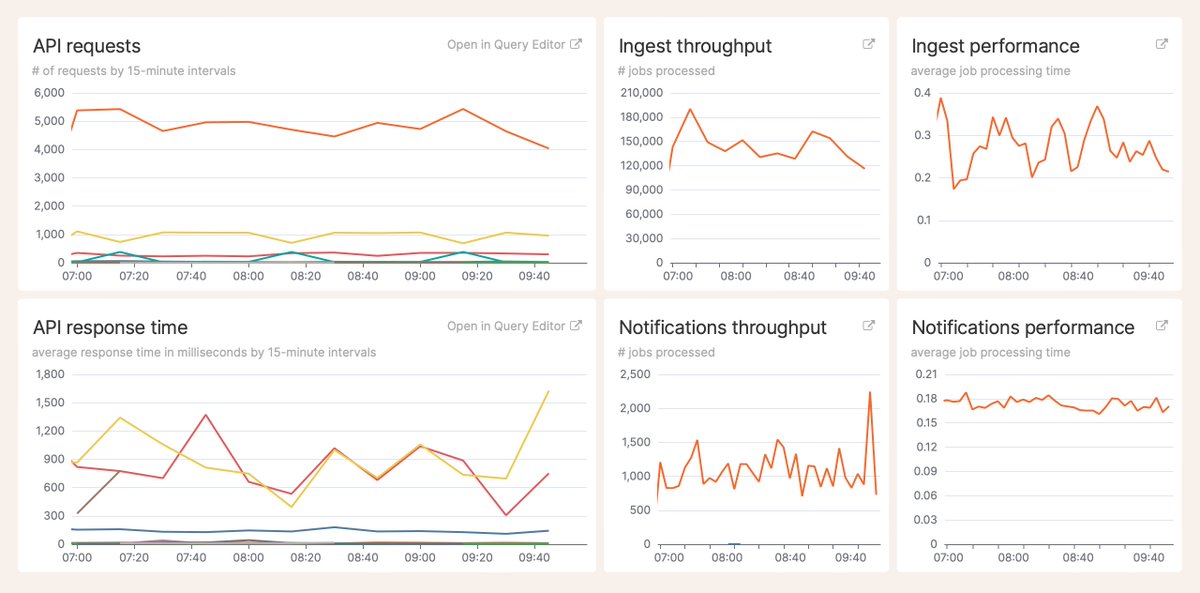
Honeybadger’s logging and observability features allow you to query your application events to troubleshoot production issues and get to the root cause. Today, we’re turning it up a notch with a new performance monitoring integration for @laravelphp! 🚀 🧵
Join Honeybadger cofounder @stympy as he uses Honeybadger Insights to debug a slow controller action in Rails using our new "hands-free mode" contextual menu to construct BadgerQL queries. 📈🔥
We launched Honeybadger Insights as a general-purpose tool in your monitoring toolkit; you could use it for many different things, but how you used it was up to you. Today, we're introducing two new features that make it much easier to get started. 🚀🧵
This was a great read. It also emphasizes one of the issues I have with AI code assistants. AI can be a useful tool, but could lead developers to be complacent with complexity instead of striving for simplicity. More of my thoughts here on my post: https://t.co/IY1geu45tJ
This morning I read @eugeneyan's article on simplicity https://t.co/gKxc2fT7Dg. My entire role is about finding simple solutions for complex problems. In the long term, I've found it is always the better choice.
Quick blog post on how to track deployments in @honeybadgerapp with @kamal post-deploy hooks. Super simple but still ended up writing 600 words just so I don't forget next time ;) https://t.co/2DJZp3elGV #rails#deployment
You've deployed your Rails app with Kamal, but now what? How do you know what's happening under the hood?
You can tail your logs on the server (otherwise known as hard mode), but there's a better way: ship them off-site with Vector!
Great read from our very own @roelbondoc 🔗👇
We designed Honeybadger Insights around wide events. What are wide events, and how can you use them to gain insight into your applications?
https://t.co/xeaXpqdwfH
🚀 JUST LAUNCHED:
Honeybadger now supports structured event logging, data visualizations, and custom dashboards.
It's the logging tool you always wanted and the observability tool you didn't know you needed.
Introducing Honeybadger Insights. 🧵👇
Building your Rails app is only half the battle. The other half is deploying it. Kamal makes it easy to deploy a Rails app without a PhD in infrastructure and operations!
Learn how with this article from our very own @roelbondoc
https://t.co/oSIwnwMiaI
#RubyOnRails#Kamal
“Most, if not all, of my projects start off with similar architecture. Usually they involve a combination of a Docker container with a Ruby on Rails application.” https://t.co/S4Ad6S4OxP