@saltMariaa Alcaraz often acts like a complete bully during games, it's obvious. If he doesn't act that way for you, I'm happy for you. Have a good life.
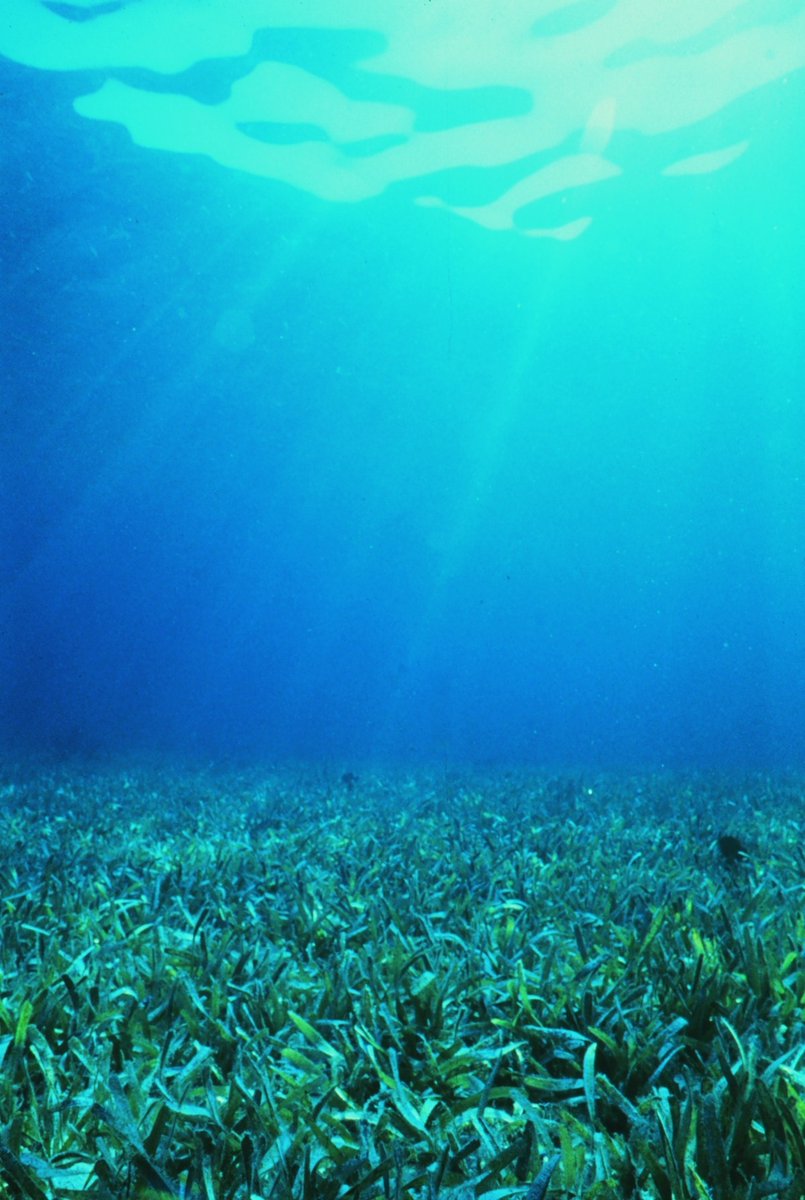
Seagrass - Let There be Light!
Seagrass is:
A stabilizer.
A filter.
A nursery.
A pantry.
👉 Learn more about why seagrass is one of the most important habitats in Florida Keys National Marine Sanctuary: https://t.co/kJSjVdACiJ
Photo: Paige Gill
🤩As the Queens arrive in Barnsley, Hatshepsut takes the lift in our new blog 'The Arrival of the Queens of Egypt' at: https://t.co/ulyHqjihDO
#CleoandtheQueens
We know more about planets around other stars than we do about our own Solar System's backyard. Only one mission has ever explored the Kuiper belt — and what it found was anything but empty.
Read more in our March issue of The Planetary Report: https://t.co/R7q5sM0zyq
Along the ridge of Peru’s remote Serpent Mountain, an enigmatic mile-long formation has given archaeologists plenty to puzzle over. But surprising new theories about the “Band of Holes” have emerged. Check out archaeologists’ drone videos!
https://t.co/1w5KcIM95i
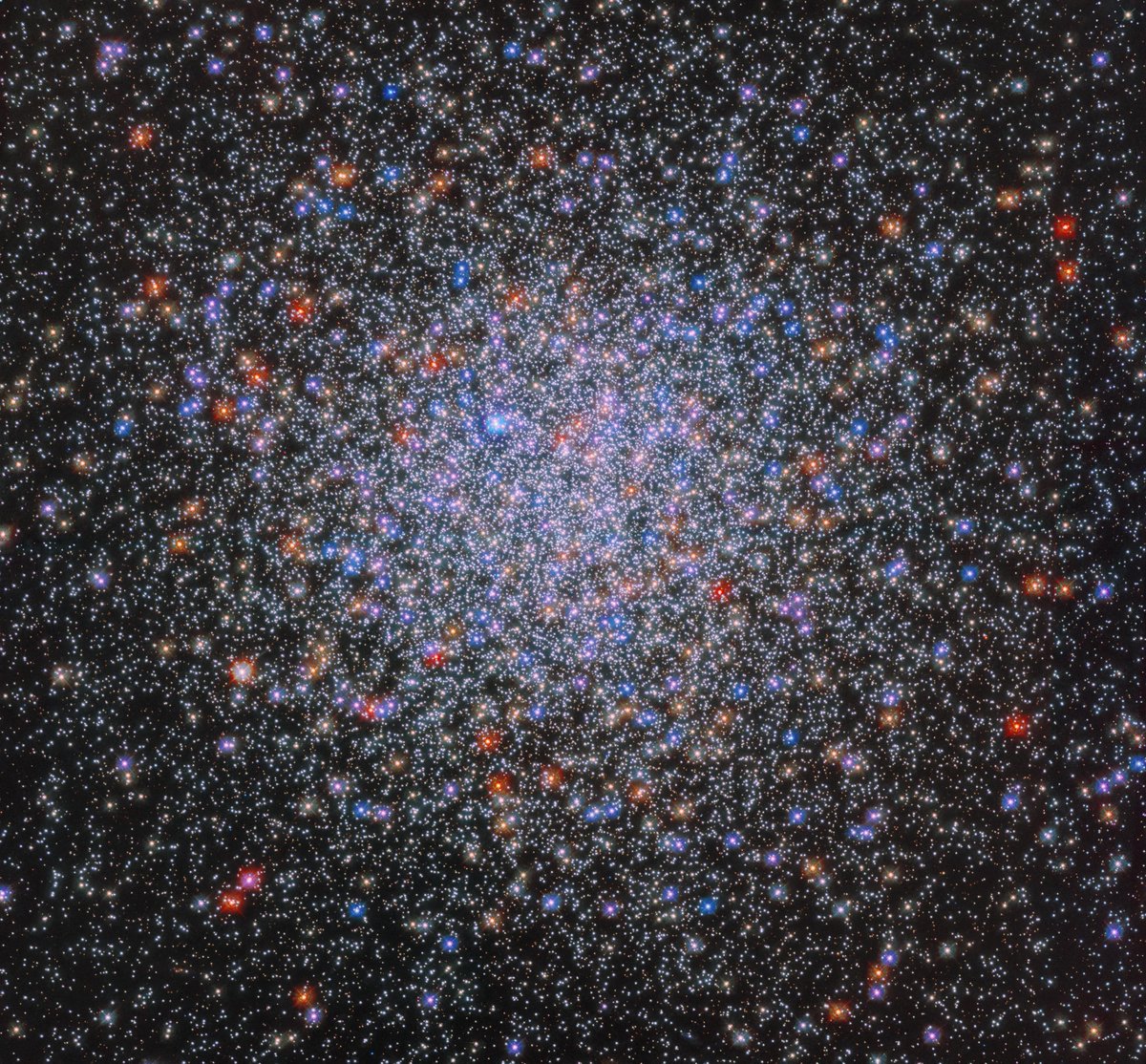
We'd rate Messier 5 five stars.
Though it certainly contains a lot more of them: over 100,000!
This new image showcases the star cluster in ultraviolet light, a capability unique to Hubble: https://t.co/yOPk8rXOOq
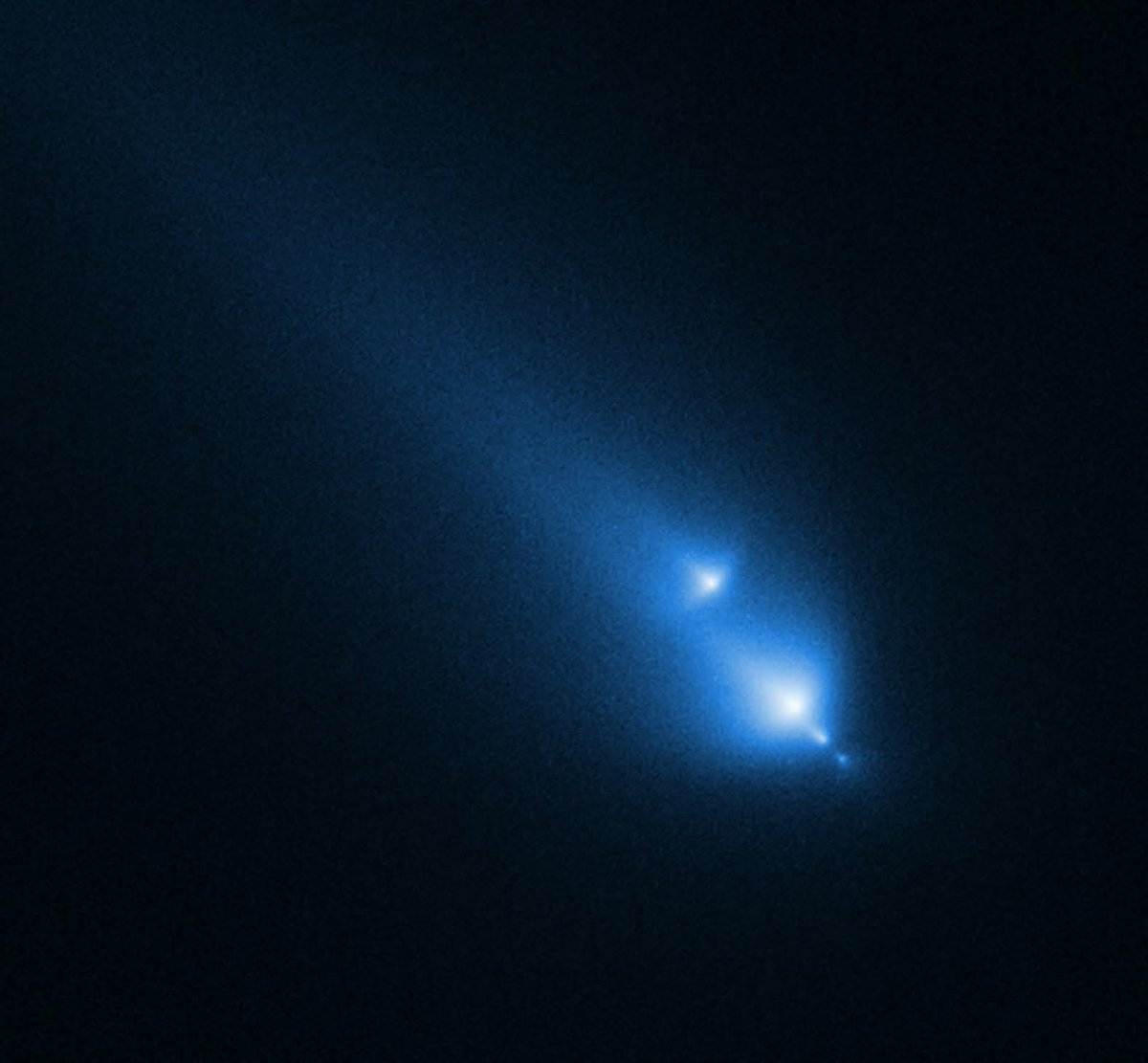
Hubble Space Telescope Captures Rare Cosmic Spectacle: Comet C/2025 K1 (ATLAS) Breaks Apart LiveMarch 19, 2026IMAGE DESCRIPTION: A striking Hubble image shows several bright, fuzzy, blue-streaked fragments aligned diagonally from upper left to lower right, capturing the dramatic breakup of comet C/2025 K1 (ATLAS).
Credits: NASA, ESA, Dennis Bodewits (Auburn University); Image Processing: Joseph DePasquale (STScI)In an incredible stroke of cosmic luck, NASA's Hubble Space Telescope has captured a comet in the very act of disintegrating—a fleeting event so rare that the odds of witnessing it in real time are astronomically low.The comet in question, officially designated C/2025 K1 (ATLAS) (and casually called K1 to distinguish it from the unrelated interstellar visitor 3I/ATLAS), was never meant to be the star of the show. Hubble's observations were originally planned for a different target, but technical issues forced the team to switch to this alternative. As Hubble pointed its powerful eye at K1 in early November 2025—just after the comet's close solar flyby on October 8—it began fragmenting right before the telescope's "eyes."Over three consecutive days (November 8, 9, and 10, 2025), Hubble's Space Telescope Imaging Spectrograph (STIS) recorded the progressive disintegration. The images reveal the comet splitting into at least four distinct pieces (some reports suggest up to five), each surrounded by its own glowing coma of gas and dust—the fuzzy halo that forms as a comet's ices vaporize.This marks a scientific first: Hubble has never before observed a comet so early in the fragmentation process. Ground-based telescopes could only detect blurry blobs, but Hubble's sharp resolution clearly separated the individual fragments, offering unprecedented detail into how comet nuclei weaken and shatter under solar heating, outgassing, and gravitational stresses.“Sometimes the best science happens by accident,” said co-investigator John Noonan, a research professor in the Department of Physics at Auburn University. “This comet got observed because our original comet was not viewable due to some new technical constraints after we won our proposal. We had to find a new target—and right when we observed it, it happened to break apart, which is the slimmest of slim chances.”Noonan himself was stunned when reviewing the data: “While I was taking an initial look at the images the day after Hubble took them, I saw that there were four comets in those images when we only proposed to look at one.”The findings, published in the journal Icarus, highlight how fragile these ancient icy bodies can be after enduring intense solar heating during perihelion (closest approach to the Sun). K1, discovered earlier in 2025 by the ATLAS survey, had survived its solar encounter initially but soon succumbed to the stresses, beginning to crumble about eight days before Hubble's https://t.co/fTTWCJMHBX fading and receding from the Sun—currently located in the constellation Pisces, roughly 400 million km from Earth—the fragmented comet is unlikely to ever return to the inner solar system. Its remnants are drifting outward, a testament to the violent, unpredictable lives of these "dirty snowballs" from the distant Oort Cloud.This serendipitous capture not only provides valuable insights into comet evolution and breakup mechanisms but also reminds us that even in the precision of planned space science, the universe sometimes delivers its most dramatic moments unannounced.
@Tennis_Ita Ma basta aiuti ad Alcaraz! Una SETTIMANA fa (non 10 ANNI fa) Fonseca era dalla parte di Sinner e nessuno ha detto niente. A Miami gioca dalla parte di Alcaraz ed è venuto fuori un caso. Caso strano oggi Fonseca viene spostato sul centrale e giocherà 24 ore dopo!
@marni__4x@capitanfooturo@paolobertolucci Pathetic comment, the usual senseless nonsense. From what you write and how you write it, you're a bully just like your friend. Long live good manners and those who have received and/or understood them.
DIVE DEEP BEHIND THE #SCIENCE AND THE #SHARKS 🦈
Unlock the full Chapter 42 and explore the entire #Sharkives collection with Shark Tracker+ on the #OCEARCH Global Shark Tracker app.
Support the sharks. Unlock the story.
➡️ https://t.co/EGD2GX0H19