Created a local variant of Whispr Flow last week since I wanted to have control about my data and it even saves me subscription fees.
I agree with @AlexFinn that more and more people will move to local models due to:
- Data privacy concerns
- Rising API fees from OpenAI and Anthropic
You are going to be able to run Fable 5 locally on your desk
In 2 years Apple will be coming out with Mac Studios with 1.5TB of memory
With just 300gb of memory you can run Opus 4.8 level intelligence
Think of what you can do with 5x that
You need to be preparing for this now
Start getting familiar with local AI technology
Go to your Hermes/OpenClaw and use this prompt:
“I am brand new to local AI and want to get familiar. Look at the computer you are currently on. Understand the specs. Then go on Huggingface and find the best models I can run on it. Then, walk me through how these models work, how they will run locally, and use cases I can do with them. After walking me through all of that so I’m educated, you can then load it onto this computer and build an interface so I can use them”
In 2 years EVERYONE on Earth will have a local model running on their desk
The people who start preparing now will be WAY ahead of everyone else
16% left of Fable 5 usage for the next 5 days. What should be the main thing that I should try with the tokens that I have left?
Already:
- Reviewed and cleaned all my code
- Cloned a software tool where I would otherwise pay for -> I run it locally now (big win!)
- Made a complete training program to upgrade my skills. Including exercises, tests, and interviews by Claude
Would be great if they could actually reset the weekly Fable 5 limit as well.
A lot of people have been trying to squeeze in as much work as possible before the original cut off and have (almost) reached their weekly Fable 5 limit, myself included :/
Our internal data shows Claude is accelerating AI development—a possible path to recursive self-improvement, or AI autonomously building a more capable successor.
It’s happening faster than we thought, and the implications deserve greater attention. https://t.co/OVVPJO7VQx
Looks like OpenAI and Anthropic are starting a battle on price and tokens....
> very good for developers
> let's see what it will do to the rest of the industry....
codex is the best AI coding product and we want to make it easy to try.
for the next 30 days, we are giving companies that want to try switching over two months of free codex usage.
Heads up: there's currently a typosquatting package on npm pretending to be related to Supabase:
𝗌𝗎𝗉𝖺𝖻𝖺𝗌𝖾-𝗃𝖺𝗏𝖺𝗌𝖼𝗋𝗂𝗉𝗍
This is not an official Supabase package.
Always verify package names before installing dependencies, especially when using AI/codegen tools that may hallucinate package names.
Official packages are published under the @𝗌𝗎𝗉𝖺𝖻𝖺𝗌𝖾/* 𝗌𝖼𝗈𝗉𝖾.
We're actively working to get this package taken down.
@supabase Vibe coding seems to get riskier by the day.
Yesterday: TanStack hijack. Today: fake Supabase package on npm.
Your AI won't warn you. My defence strategy: never install a package under 7 days old
Will start to incorporate speech to speech integration today for the first time in my app and will try Grok since it got the best result!
> will share my experience after testing later today
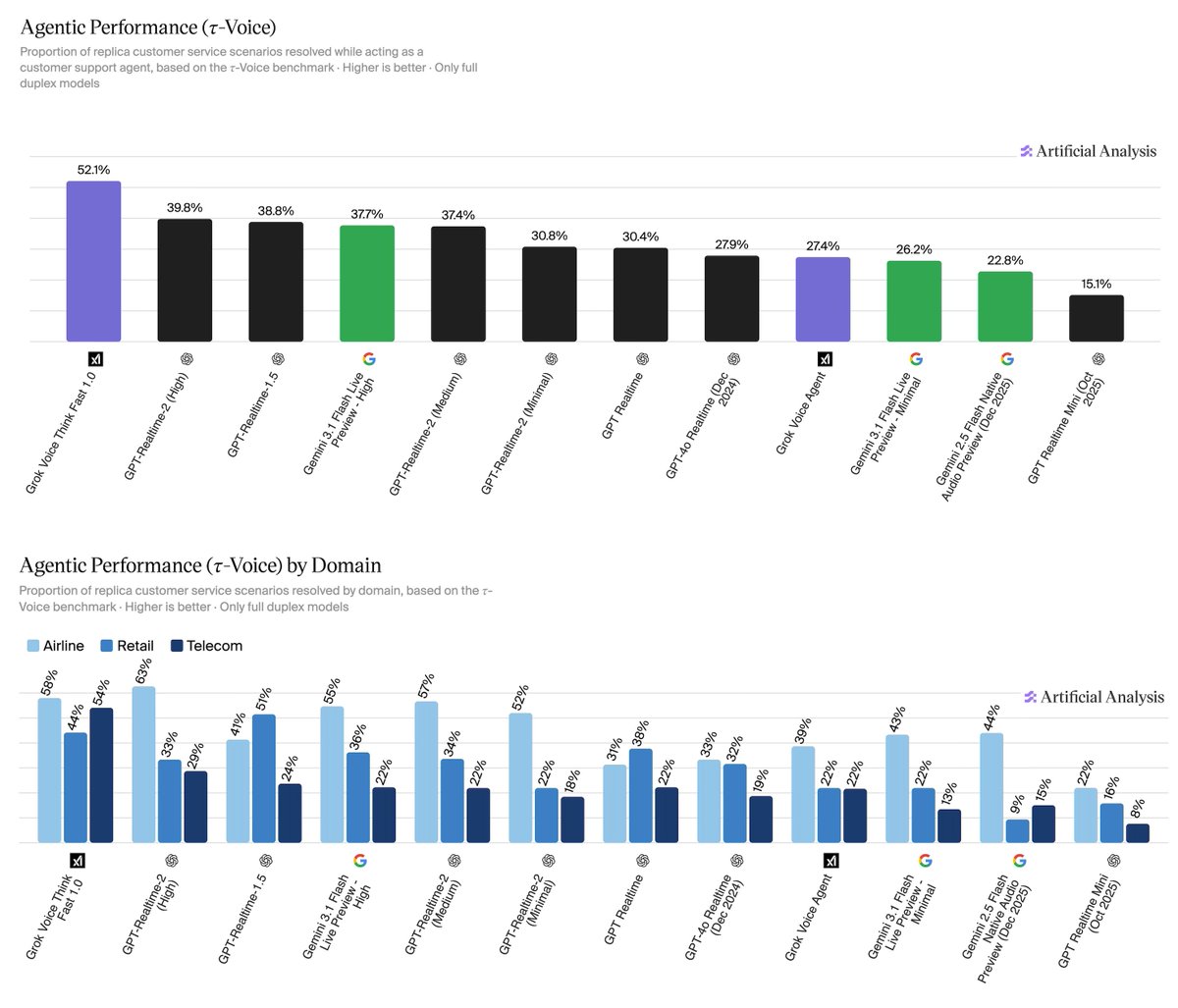
Announcing agentic performance benchmarking for Speech to Speech models on Artificial Analysis. We use 𝜏-Voice to measure tool calling and customer interaction voice agent capabilities in realistic customer service scenarios
Even the strongest Speech to Speech (S2S) models today resolve only about half of realistic customer service scenarios end-to-end - a meaningful gap relative to frontier text-based agents on the same tasks. Voice channels introduce significant complexity: challenging accents, background noise, and packet loss, all while requiring fast responses, consistency across long multi-turn conversations, and reliable tool use. Performance also varies considerably by audio condition: in clean audio some models perform notably better, but realistic conditions continue to pose a challenge. Conversation duration also varies meaningfully across models, with implications for both customer experience and operational cost.
About 𝜏-Voice:
Our Agentic Performance benchmark is based on 𝜏-Voice (Ray, Dhandhania, Barres & Narasimhan, 2026), which extends 𝜏²-bench into the voice modality to evaluate S2S models on realistic customer service tasks. It measures multi-turn instruction following, support of a simulated customer through a complete interaction, and tool use against simulated customer service systems. The simulated user combines an LLM-driven decision model with realistic audio synthesis: diverse accents, background noise, and packet loss modelled on real network conditions.
This complements our Big Bench Audio benchmark measuring intelligence and Conversational Dynamics (Full Duplex Bench subset) benchmark measuring conversational naturalness. Scores are the average of three independent pass@1 trials. We evaluate under realistic audio conditions using the 𝜏²-bench base task split across three domains:
➤ Airline (50 scenarios): e.g., changing a flight, rebooking under policy constraints
➤ Retail (114 scenarios): e.g., disputing a charge, processing a return
➤ Telecom (114 scenarios): e.g., resolving a billing issue, troubleshooting a service problem
Task success is determined by deterministic checks against expected actions and final database state, consistent with the 𝜏²-bench evaluator.
Key results:
xAI's Grok Voice Think Fast 1.0 is the clear leader at 52.1%, averaging 5.6 minutes per conversation, the second-longest overall. OpenAI's GPT-Realtime-2 (High) (39.8%, 3.0 min) and GPT-Realtime-1.5 (38.8%, 4.8 min) follow, with Gemini 3.1 Flash Live Preview - High close behind at 37.7% (3.8 min).
Speech to Speech is a fast evolving modality and we expect movement in rankings as we continue to add new models with these capabilities, and model robustness improves.
Congratulations @xAI@elonmusk! See below for further detail ⬇️
SECURITY ADVISORY — TanStack npm packages
A supply-chain compromise affecting 42 @tanstack/* packages (84 versions total) was published to npm earlier today at approximately 19:20 and 19:26 UTC. Two malicious versions per package.
Status: ACTIVE — packages are deprecated, npm security engaged, publish path being shut down.
Severity: HIGH — payload exfiltrates AWS, GCP, Kubernetes, and Vault credentials, GitHub tokens, .npmrc contents, and SSH keys.
If you installed any @tanstack/* package between 19:20 and 19:30 UTC today, treat the host as potentially compromised:
• Rotate cloud, GitHub, and SSH credentials immediately
• Audit cloud audit logs for the last several hours
• Pin to a prior known-good version and reinstall from a clean lockfile
Detection — the malicious manifest contains:
"optionalDependencies": {
"@tanstack/setup": "github:tanstack/router#79ac49ee..."
}
Any version with this entry is compromised. The payload is delivered via a git-resolved optionalDependency whose prepare script runs router_init.js (~2.3 MB, smuggled into each tarball at the package root).
Unpublish is blocked by npm policy for most affected packages due to existing third-party dependents. All 84 versions are being deprecated with a SECURITY warning, and npm security has been engaged to pull tarballs at the registry level.
Full technical breakdown, complete package and version list, and rolling status updates:
https://t.co/Zy8qG7PA9f
Credit to the security researcher for responsible disclosure.
After years as a consultant, I quit my job to go all in on AI.
The pace of AI development hit me hard. There is a massive opportunity for non-tech people right now to actually build real things. And let's be honest, consulting jobs will not exist in their current form much longer anyway.
No fixed plan; I will figure it out by building and learning something new every single day.
Will be documenting my learnings and sharing my achievements along the way! Happy to connect :D