In 2002, after his stock fell 90%, the CEO of Sun Microsystems said the most honest thing a CEO has ever said about a valuation.
At 10 times revenue, to pay you back in ten years, I'd have to give you 100% of revenue as a dividend. Every year. For a decade.
Zero cost of goods. Zero expenses. Zero taxes. Zero R&D. Just hand you every dollar that comes in.
"Do you realize how ridiculous those assumptions are? What were you thinking?"
That was one company. A cautionary tale everyone nodded at and promptly forgot.
Today, 51% of the S&P 500 trades above 10 times revenue.
Different decade. Same math.
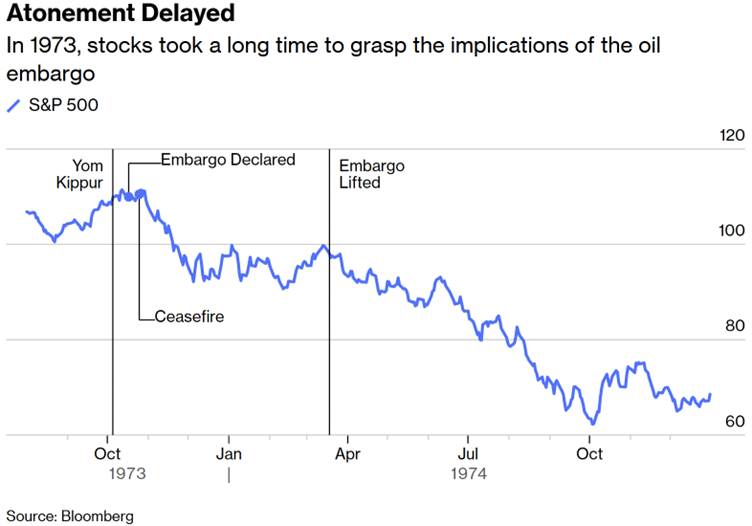
Given "Schroedinger's ceasefire" and "Schroedinger's Hormuz re-opening", thought this was a potentially instructive chart from @johnauthers, via @Bloomberg.
#HistoryRhymes
Iran's 10 points and US' 15 points are totally irreconcilable. So three possibilities (and guessed probability):
1) US capitulated (1% ?)
2) Iran capitulated (14%?)
3) Way around Trump's deadline, no change, kick the can for a few days (85% ?)
This is Iran's highest authority statement on the ceasefire agreement reported by CNN and now confirmed to be true - just read through it and feel free to take your own conclusions on the matter
Kharg Island is being directly targeted now - Fair to expect the next Iran’s retaliation will be against an even more strategic target than Al Jubail.
Meanwhile, traders and asset managers 👇🏻
It’s clear Iran isn’t bluffing. When they vow to retaliate, they deliver. Saudi Arabia’s Jubail, one of the largest industrial complexes in the world, went up in flames overnight.
Please pay attention to the FRP (Fire Radiative Power) values in the table. FRP represents the thermal energy released from a specific point in megawatts.
The numbers 40 and 125 appear several times. Even the largest normal flare stacks in a typical petrochemical complex usually fluctuate between 10 and 20 MW.
The concentrated detection of values exceeding 40 MW suggests a heat source far more powerful than anything found in a standard operating environment. In particular, 125 MW is simply impossible to explain away as a typical industrial flare stack.
These are figures you only see when massive refinery tanks are fully engulfed in flames or during the sustained, ultra-high-temperature fires following a major explosion.
Currently specific zones within the Jubail industrial complex can be viewed as being engulfed in flames so intense that satellites are flagging them as abnormal.
Of course Saudi will control the narrative. You’ll likely see Reuters quoting them today saying something like, "Intercepted drone debris fell, but operations are normal, so don't worry."
#oott #iran
That’s in line with my base case: neither the Saudis nor UAE will negotiate with Iran’s regime. Full stop.
Their barrels come back either through a clean reopening, via physical bypass pipelines or force. Nothing in between.
Until then, the market is structurally short 5mbpd of supplies of these two countries at the minimum and the real spare capacity buffer the system had pre-war.
The market thinks this Iran shock is smaller than the April 2025 tariff tantrum
I think they’ve got it backwards
Tariffs were words. Words you can walk back. That’s the entire TACO trade. Trump takes out his big stick, markets puke, he rolls it back, markets exhale and everyone buys the dip
Bombs…yeah, you can’t roll them back
Yes, I get the bull case. Hormuz has been “about to close” since 1980 and never has. Shale, the SPR and Saudi spare capacity make the oil complex less fragile than it was in ’73. Iran has more to lose from closure than we do
All true. All priced.
Here’s what isn’t priced: you don’t need Hormuz to actually close. You just need the tail risk to fatten. Insurance, freight, tanker rerouting, refinery margins. The shock reverberates through the supply chain long before a single ship gets hit
And the Fed can’t cut into an energy shock without lighting inflation expectations on fire. So they sit on their hands while growth rolls over
Words you can take back. Killing people, dropping bombs on infrastructure…you can’t take that back. And you have no control over the other guy’s next move
Market pricing this like it’s a headline, not a regime change. I hope the market’s right
I actually wrote this back on March 18th to explain things to my Korean friends, but I'm posting it here on X as well since so many ppl still seem to get it wrong.
Global Total Crude Inventory = Commercial MOI + Commercial Available Inventory + Surplus crude + SPR
The world looks like it’s overflowing with oil, but prices don’t wait for all 2 billion barrels of global inventory to vanish before they spike. Every single time oil crossed $100/bbl, it was the same story.
Take the US as the prime example. Right now, US commercial crude inventory is sitting around 440 million barrels, but that number physically cannot drop below 280–300 million.
You might say, "What the hell are you talking about? Just draw it down, you idiot lol." But let’s look a bit closer.
That "Commercial MOI" I mentioned stands for Minimum Operating Inventory. This isn't oil sitting in a refinery tank or a hub ready to be used instantly.
MOI is the volume physically locked in the system you cannot pull out. It’s the baseline required just to keep the entire US oil system running.
Here are the main components:
1) Linefill: This is the oil filling the entire pipeline network across the US. bc of the "push from one end to get out the other" structure, about 110–120 million barrels must stay in the pipes at all times.
2) Tank Bottoms: This is the volume at the very bottom of storage tanks that pumps literally can’t reach. Estimated at around 80–90 million barrels.
3) In-transit & Working Stock: The minimum volume sitting on tankers, barges, or waiting at refineries to be blended and fed into the units. Without this base feed, the refinery simply stops.
Just combining Linefill and Tank Bottoms (Unavailable Stocks) gives you ~200 million barrels. Add the Working Stock needed for operational flexibility, and ~300 million barrels becomes the actual hard floor.
I used the US as an example, but you probably get the point by now. The "Global Total Onshore Inventory" figure includes all that MOI—Linefill, Tank Bottoms, etc.
Since it’s global, we don't have the exact numbers, but this MOI accounts for 60-70% of the total figure. Minimum Working Stock is another 20-25%.
Most of those 2.3 billion barrels are scattered across tens of thousands of kilometers of pipelines and the bottoms of thousands of storage tanks.
The vast majority is essential just to keep the system alive; it’s physically impossible to gather it all in one place and dump it onto the market.
Therefore the actual available crude—the delta actually moves prices and balances—is much smaller than ppl think. That’s why the oil market sees massive price swings even over a quarterly shift of just 1mb/d.
Think of the "buffer" I mentioned as cash on hand for immediate liquidity. The rest of those 2.3 billion barrels? That’s like your factory equipment.
No matter how much equipment you have, if you run out of cash, you go bankrupt. The oil market is the same; once that tiny sliver of available crude vanishes, the system hits a crisis and faces desperate bidding.
Right now, we are in the phase of burning through the "excess cash" in the corporate account. And we're doing it very fast. Next we'll start dipping into personal savings.
But like most business owners, there isn't actually much cash in the personal account. It’ll run dry in no time.
Now imagine if you knew as long as you kept the factory running, you could eventually pay off the debt and fix the cash flow—but right now you don’t have a single cent of available cash. What happens?
To keep the factory from going under, you’d do anything to scrape together cash for the electric bill and payroll. You’d sell your kid’s iPhone or even put your wife on the street—you’d do anything desperate to get that cash.
Once we hit that stage, prices go absolutely vertical. Bottom line: when the buffer is gone, you have to start withdrawing all available commercial inventory. The pace will be lightning fast.
Even the ppl who were sitting on the sidelines hoping for the war to end will start bidding desperately bc they need oil 'right now'. I’m not just acting calm or pretending I’m okay with this taking a long time.
Even if you believe a long position is the way to go, there’s a specific process and setup must be cleared for the environment to force prices up. And it won't take that long.
Until then I expect vol to be absolutely violent in both directions.
#oott #com
Here’s the paradox I’m thinking of.
When commodity traders or analysts fire off countless warnings, most ppl bash them for exaggerating everything just to get some attention for once.
But that’s not it. They’re just doing their jobs. In fact by doing what they do, they actually help keep us from slamming into a brick wall.
When everyone knows a disaster is waiting at the end and it becomes the consensus, stakeholders and ppl with good intentions will put in the effort to stop it before we get there.
The louder the warnings ring out and the more ppl get on board, the more hands will reach out to try and slow things down—or even stop them entirely.
If we actually end up avoiding the disaster, all you’ll hear is, "See? Those oil traders were just full of crap," but hey what can you do? lol
I can't speak for everyone, but even most oil bulls—excluding the traders who are all in on the prompt—don't actually want to see prices spike too aggressively.
Since many of them own energy stocks, they’d prefer to sit in the sweet spot for a long time, and they know prices nobody ever imagined will only trigger a massive backlash.
But as the "nothing’s gonna happen" chant gets louder and prices stall making ppl think "this is manageable," the incentive to actually solve the root of the conflict just fades away.
Don't dismiss or mock the warning voices so lightly. The more those voices are muffled the more dangerous it gets. Once we actually hit the wall, it’ll be too late to regret it.
That’s the paradox.
#oott #iran
We were so innocent once:
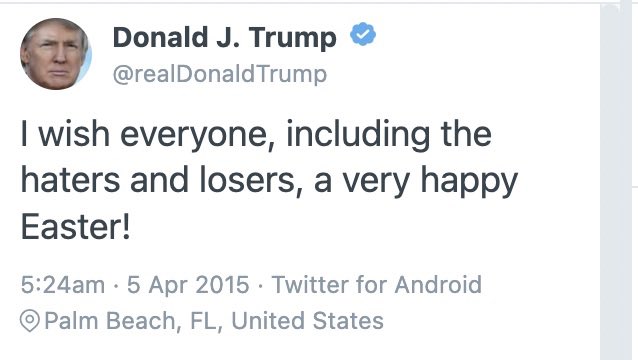
Trump Easter message, 2015: I wish everyone, including the haters and losers, a very happy Easter!
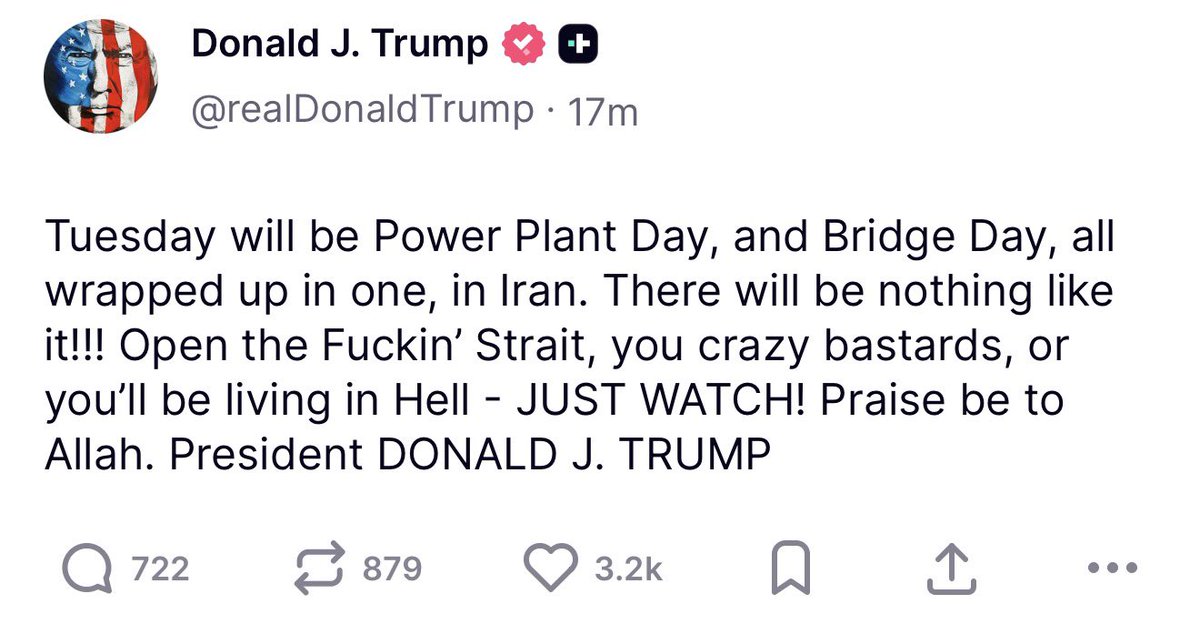
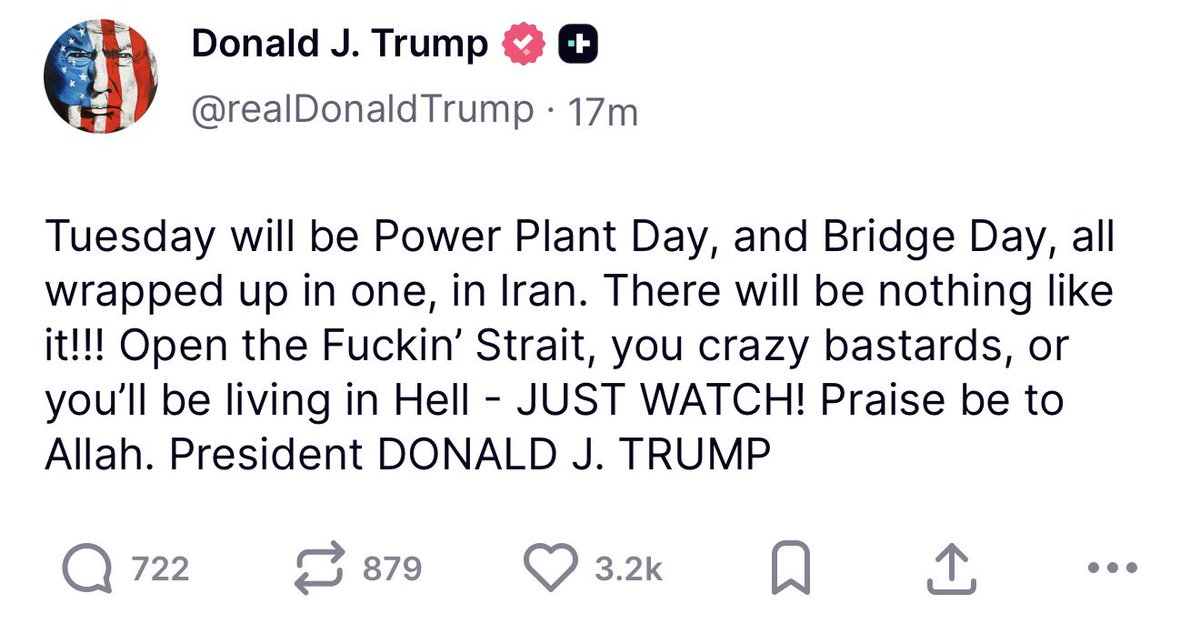
Easter Sunday, 2026: Open the Fuckin’ Strait, you crazy bastards, or you’ll be living in Hell … Praise be to Allah
Some get hopeful on the Iraq crude exception news. Don’t. This is the fog of war. Nothing less and as explained below.
Same story with the “free passage of 20 Pakistani tankers”. A fleet Pakistan doesn’t posses, on voyages that will likely never happen.
What matters is not a one-off negotiated transit, a ballast move, or a PR “deal” with a few crooks and kickbacks.
What matters is when OECD+China commercial decision-makers, the big boys, the people who actually move 90% of global cargo and 98% of global GDP, deem the Strait safe again for normal traffic. Roughly 150 vessels per day, bidirectional, across crude, products, LNG, chemicals, dry bulk, the lot.
Until that threshold is met, nothing is fixed. Don’t even expect the CCP to cut short-term “deals”. They won’t. They think long term. The UAE & Saudis? They think in generations and will not negotiate with terrorists. Not happening.
Yes, the rate of change matters. But the signal has to carry institutional weight. Bilateral agreements are possible. But they will require time and brains to be fleshed out. Think the Government of Japan confirming a durable arrangement with Iran, backed by the buy side and actual logistics on the ground.
But for such a massive diversion from 75 years of Pax Americana to be agreed by the big boys, we will require a LOT more economic pain than 4 weeks of $100+ oil and three flights cancelled in Timbuktu. Are u kidding me? We need a good old fashioned and painful recession. A hard landing.
Treating thin Iraq exception headlines in the middle of a dicy U.S. rescue missions, military strikes, and a presidential deadline as a possible market inflection point is amateur hour.
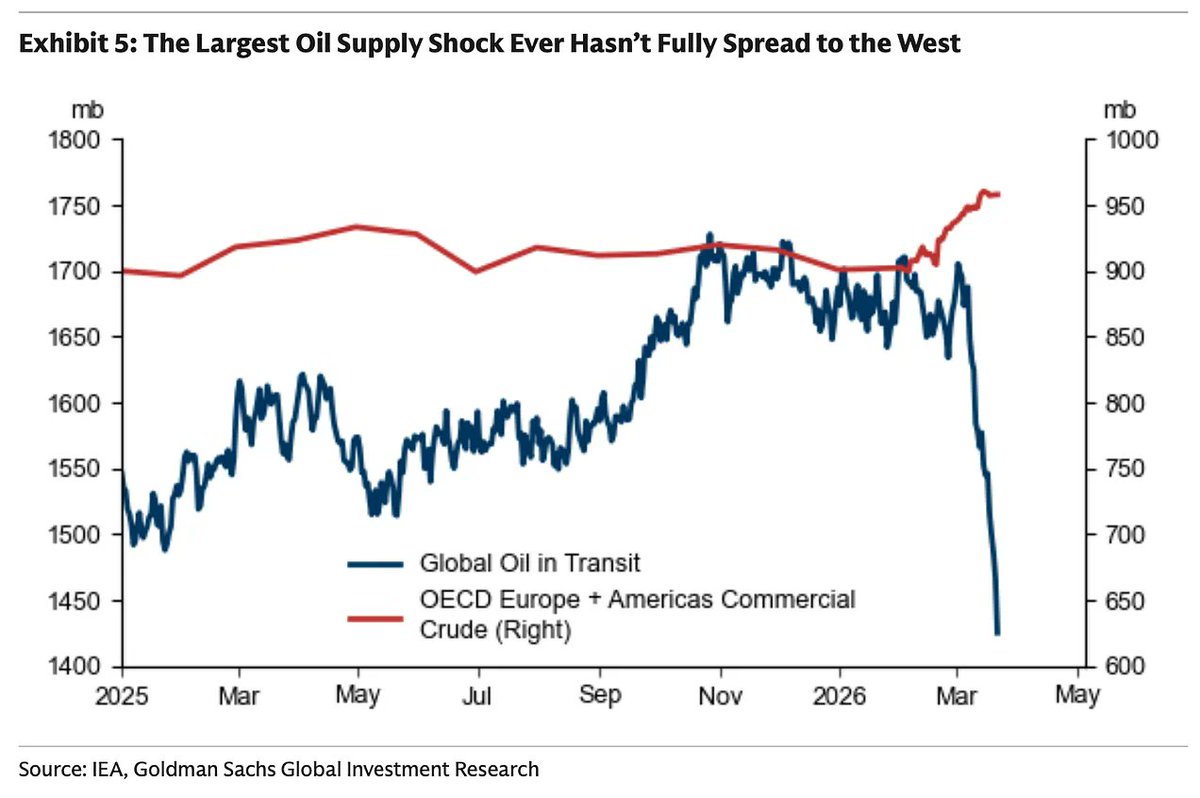
The oil shock has yet to arrive in the west.
Blue line = Global Oil in Transit (left axis, Drops from 1.7B barrels to 1.4): This tracks the total volume of crude physically sailing on tankers globally.
It rose steadily through 2025, then in March 2026, there is a cliff-edge collapse of roughly ~300 mb, as empty tankers cannot be reloaded.
Red line = OECD Europe + Americas Commercial Crude (right axis, 0.95B barrels): This tracks commercial crude inventories held by Western buyers. Despite the tanker collapse, this line has barely moved — when it finally does, the physical shock will have arrived.
@hkuppy Yep worked well for me, one side of the string around a block/stone, the other directly around the tree, they don't mind it at all. You can get creative. I have an avocado tree that looks like an octopus. I started 3 years ago, lived in Zurich before that. So still learning too.