@MaraLui56385486@LatinXChem The disadvantages are.
-We cannot strictly control the size and morphology of the particles.
-There are aggregation effects.
-Uniform size distribution is not obtained.
@MaraLui56385486@LatinXChem 3-No sophisticated equipment or long reaction times are required.
4-Since the sample is dispersible in water, it can be used in various applications.
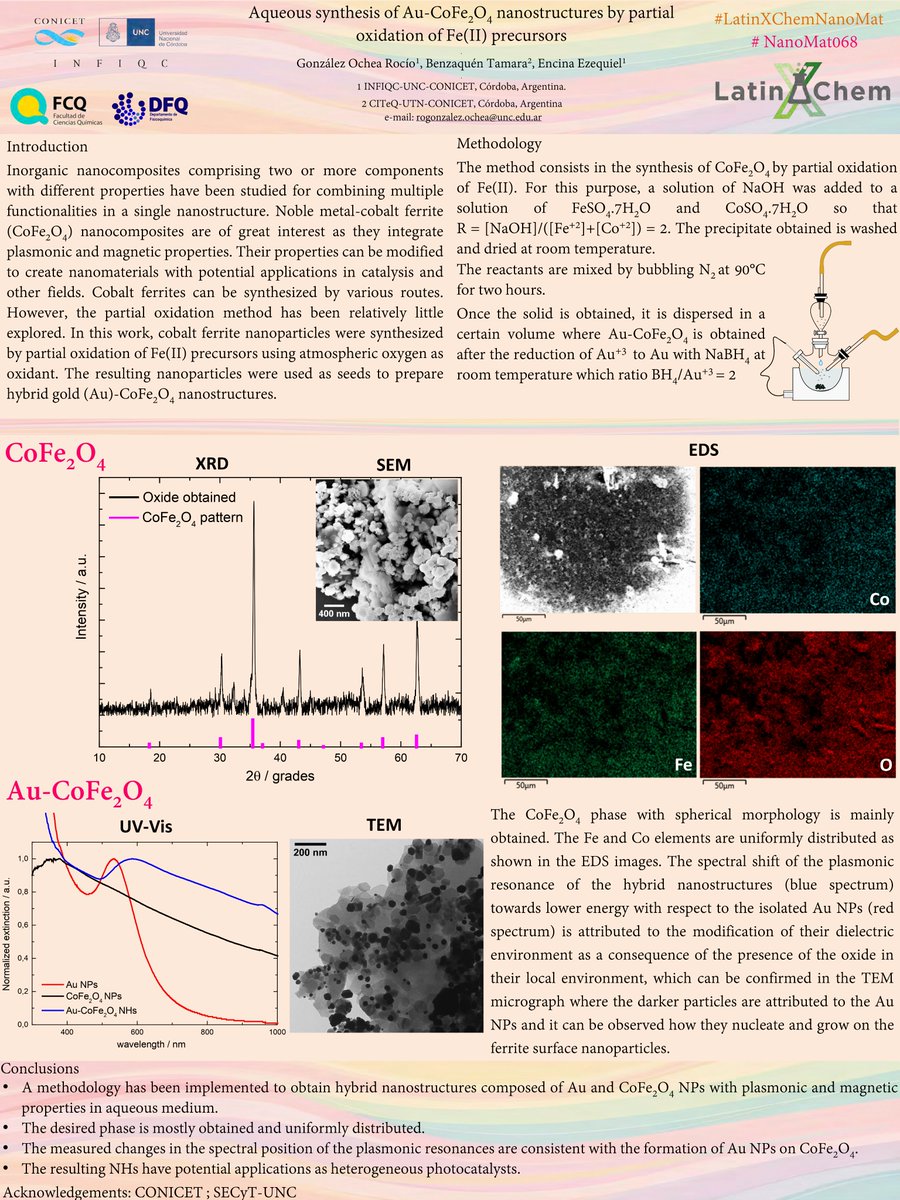
@MaraLui56385486@LatinXChem Hi! Good question! We are in this process but the results obtained indicate that the reported method provides a new, simple, inexpensive, and scalable way to prepare bicomponent nanocomposites with plasmonic and magnetic properties, broadening the set of available methodologies.
@olgaliir@LatinXChem Regarding the other question, the diffraction peaks that do not match the CoFe2O4 pattern could be attributed to an oxidised oxyhydroxide.
@olgaliir@LatinXChem Hi ! thank you for your question! Once the solid is obtained, 0.1 g is dispersed in 50 ml of water to give a mother solution of 2000 ppm. From this dispersion, 2.5 ml is taken and mixed with 1 ml of 0.0254 M HAuCl4 and 0.5 ml of 0.1 M NaBH4 to give a final volume of 100 ml.
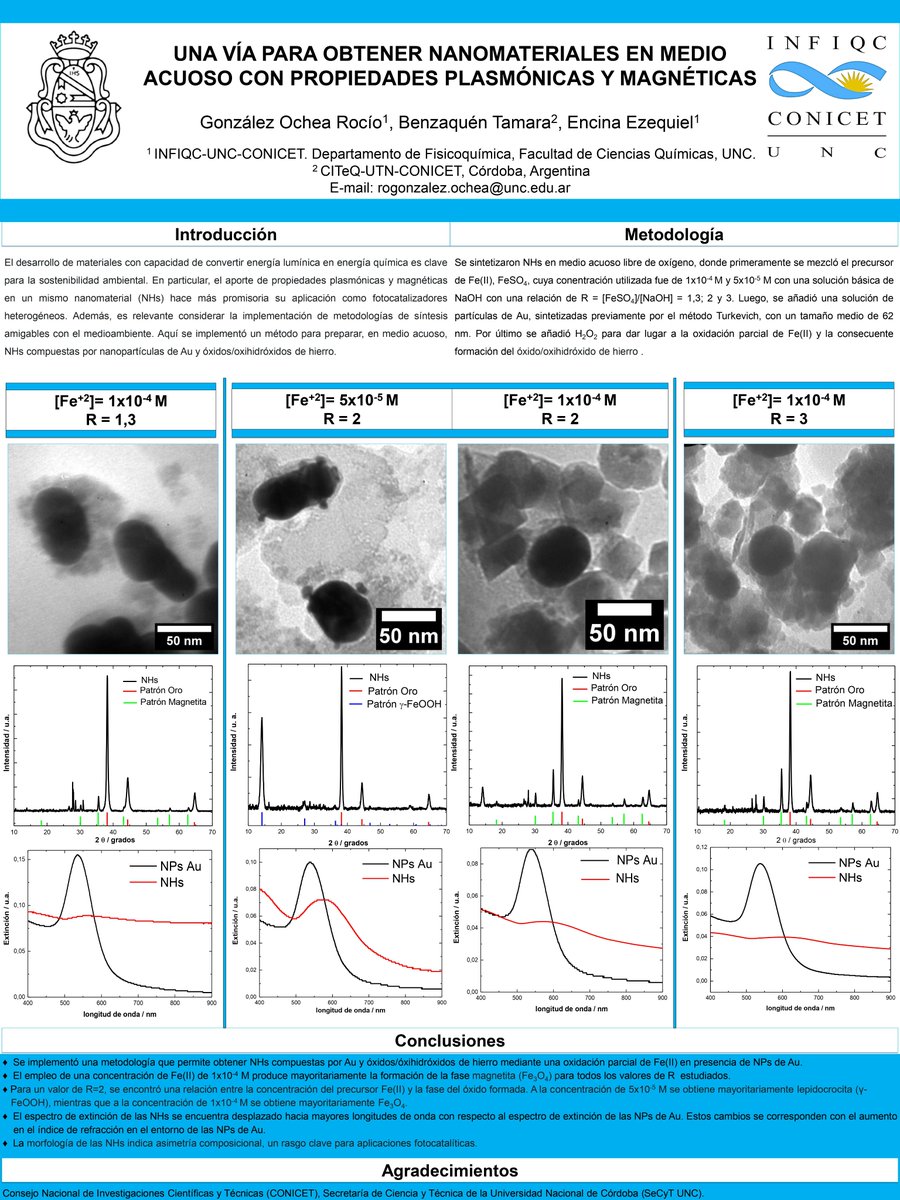
@piketin@LatinXChem La resonancia plasmónica se encuentra en torno a los 540 nm. Creemos que esto va a permitir una buena transferencia hacia el óxido de hierro debido a que existe solapamiento espectral entre ambos como se puede ver en el siguiente espectro de extinción. Gracias por sus preguntas!!
Implementamos una vía acuosa para obtener nanomateriales con propiedades plasmónicas y magnéticas.
Alguien ha podido sintetizar magnetita a muy bajas concentraciones y en medio acuoso?⚗️
Gracias @LatinXChem por permitirme participar!🇦🇷🇦🇷
#LatinXChem22#LXChemNanoMat#NanoMat136
@piketin@LatinXChem Esto ocurre a partir de la transferencia de energía desde la nanopartícula de oro hacia el semiconductor en el cual se genera una separación de par electrón-hueco donde estas cargas interaccionan con el medio acuoso y así se generan las especies químicas reactivas mencionadas..
@piketin@LatinXChem Muchas gracias Diego! Realizaremos fotocatálisis heterogénea como proceso avanzado de oxidación basado en la generación de especies químicas altamente reactivas, como radical hidroxilo y anión superóxido. Esto ocurre...