When the vikings first arrived in Iceland in 9th Century CE, they discovered a coarse yet manageable new world ripe for the picking, uninhabited but for a few Gaelic monks on the southern coast. This strange, rugged land was worthy of conquering and survival over their scandinavian homeland stricken with civil strife and running short on arable land. That force of adventure, strength and resourefulness in a new land cultivated Iceland’s ancient survivalist architecture.
It was and still is a vast territory with dramatic rising glacial ranges from moonscape fields that run into coastal beaches of black sand and a land of no native timber. Where necessity became and still is the mother of invention. Homes were constructed of turf and drift wood that would wash upon the shores as well as from the endless supply of lava stones abound in the fields. Stone constrution also proved functionally sensible in this frequent earthquake prone environment, as homes could then “easily” be cobbled back together.
These buildings still exist at the ancient homestead of Keldur in Iceland’s southeastern region. This last remaining and fully intact early settlement farmstead can be found mentioned in Sagas from 12th Century CE. Traditionally a clan would head the farm with extended family living and working on site. Originally all living in the long house, there is evidence to think that a sudden and drastic climate change caused the move to smaller residential spaces to be built and long houses to be divided up to make easier to heat. Additions and improvements at Keldur had been made over the centuries, but the original main hearth room still bears the dirt floors and ancient timbers with fascinating hints of traditional communal living. A tunnel discovered in 1930’s runs from the main hearth room to the nearby small river and was thought to be for defensive purposes. Inside smaller spaces were formed originally for cooking and food storage and a connecting string of smaller turf structures served as various work and storage spaces such as a smithy, a mill, and livestock corral. Newest addition from early 19th Century remains near intact from it’s former glory, furnished with beautiful and simplistic folk furnishings and the silence combined with the spirits of those who still long remain at Keldur.
The last owner, whos family had farmed Keldur for almost two Centuries, knew of its great importance to Icelandic heritage and over the years had collected much history on the site. In 1942, he sold Keldur and his extensive collection to the National Museum of Iceland who continue to care for and manage this amazing historic site.
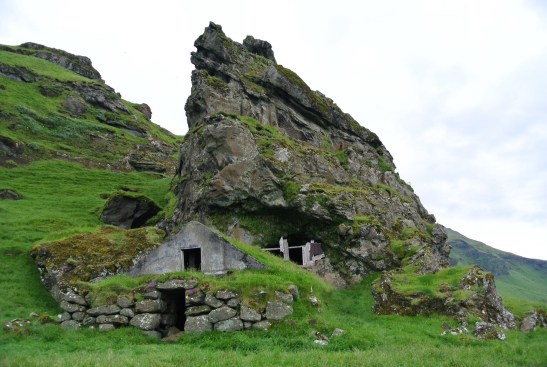
Upwards of 200 of these man-made caves with wooden or cobbled facades are scattered about 90 farms in the region used over the centuries for storing hay,corralling livestock, smithy’s and even for trade. Forty one of these caves are now protected sites, but many still in use today. We stopped roadside on HWY 1 at Rútshellir, and explored this t-shaped ‘building’. The front entrance to the turf structure is a feeding area for sheep, then stepping up into the cave (approx 6’ft tall and 10 ft wide) where they take shelter. Walking up the left side exterior is an entrance to another connecting cave space much smaller and where a smithy had a shop for many years. Yet another example of Iceland’s people understanding and using Mother Nature to their benefit through their ancient survivalist architecture.
#archaeohistories
The Great Migration: How the Foundations of the English-Speaking World Were Laid
Ever wonder why we speak English and not a Roman or Celtic tongue? The answer lies in a chaotic, transformative period between the 5th and 7th centuries. When the Roman Empire’s grip on Britain slipped, a vacuum was left behind—one that was filled by the bold seafaring tribes of Northern Europe: the Angles, Saxons, and Jutes.
This wasn't just a military invasion; it was a total cultural reset. From the shores of modern-day Denmark and Northern Germany, these tribes crossed the treacherous North Sea to seek new land, eventually pushing the native Britons to the fringes and creating the "Heptarchy"—the seven kingdoms that would one day become England.
Whether you're a history buff or just curious about where our modern traditions and language began, this map tracks the very first steps of the journey that would eventually reach the shores of America centuries later.
The Foundations of a New World: The Anglo-Saxon Migration (449–600 CE)
To understand the United States today—its laws, its literature, and its primary language—one must look back nearly 1,600 years to the foggy coastlines of the North Sea. The migration of the Germanic tribes to the British Isles is perhaps one of the most consequential movements of people in Western history. It was a period marked by the collapse of an old superpower, the arrival of opportunistic warriors, and the slow, grinding birth of a new identity. This is the story of how Britain became "England" and how the seeds of the English-speaking world were first planted.
In 410 CE, the Roman Empire was crumbling. Under pressure from "barbarian" tribes closer to home, the Emperor Honorius sent a letter to the cities of Britain, famously telling them to "look to their own defenses." For nearly four centuries, Rome had provided a professional military, legal infrastructure, and a sense of global connectivity. When the legions left, they took the stability with them.
Britain was left vulnerable. To the north, the Picts and Scots began raiding deeper into the lowlands. According to the monk-historian Bede, a British leader named Vortigern made a fateful decision:
The invited Germanic mercenaries from the mainland to help defend his lands. He offered them territory in exchange for protection. It was an invitation that changed the course of history forever. Once the first wave of warriors realized how fertile and poorly defended the island was, the trickle of mercenaries turned into a flood of settlers.
As shown in map, the migration was primarily driven by three distinct groups, each bringing their own dialects and customs. Hailing from the region of Angeln (modern-day Schleswig-Holstein in Germany), they were perhaps the most numerous. They settled in the north and east, founding the kingdoms of Northumbria, Mercia, and East Anglia. It is from this tribe that names "England" (Engla-lond) and "English" (Englisc) are derived.
Coming from the sprawling plains of Northern Germany, the Saxons were fierce warriors and prolific settlers. They moved into the south and west of Britain, establishing Wessex (West Saxons), Sussex (South Saxons), and Essex (East Saxons). Their legacy survived in the title of the "Anglo-Saxon" people and heavily influenced the legal and social structures of the early English state.
The smallest of the three main groups, the Jutes traveled from the Jutland peninsula (modern Denmark). They settled in Kent and the Isle of Wight. Though fewer in number, they maintained a distinct cultural identity for generations, and the Kingdom of Kent became a vital gateway for the reintroduction of Christianity to the island later on.
#archaeohistories