Elon Musk literally sat down for a 45-minute talk with Y Combinator that explains how to build world-changing companies better than any business school on earth. This is the advice he gave a room full of young founders:
1. Don't try to build something great. Try to build something useful.
Everyone obsesses over greatness. Musk says that's the wrong target. "I didn't originally think I would build something great. I wanted to try to build something useful. I didn't think I would build anything particularly great. Seemed unlikely, but I wanted to at least try." Aim for useful first. Greatness, if it comes, is a byproduct.
2. When you can't get in the front door, build your own door.
Before Musk started his first company, he tried to get a job at Netscape. "I sent my resume into Netscape and nobody responded. I tried hanging out in the lobby to see if I could bump into someone, but I was too shy to talk to anyone. So I'm like, this is ridiculous, I'll just write software myself." He didn't set out to be a founder. He became one because no one would hire him.
3. He slept in the office and showered at the YMCA.
The origin of his first company was not glamorous. "We couldn't even afford a place to stay. The office was 500 bucks a month, so we just slept in the office and showered at the YMCA." He couldn't afford proper internet either, so he drilled a hole through the office floor and ran a cable to the internet provider downstairs. That was the founder of the future richest man on earth.
4. Keep the chips on the table.
When Musk sold his first company, he received a $20 million cheque. His bank balance went from $10,000 to $20 million overnight. Most people would have stopped. He put almost all of it straight back into his next company. "I kept the chips on the table." He did the same thing decades later, over and over. He hates money sitting idle. Money is fuel for the next mission.
5. Start with the mission, then work backwards to make it a business.
Musk didn't start SpaceX to make money. He went on the NASA website to find out when humans were going to Mars, and there was no plan. So he decided to build one. "There had been no prior example of a rocket startup succeeding. A small chance of success is better than no chance of success." The mission came first. The business model came later.
6. He started SpaceX expecting to fail.
He is brutally honest about the odds. "SpaceX started in mid-2002 expecting to fail. Probably 90% chance of failing. When recruiting people, I said, we're probably going to die, but small chance we might not die." The first three launches failed. The fourth one worked with no money left. "If the fourth launch hadn't worked, it would have been curtains. We made it by the skin of our teeth."
7. Break every problem down to physics.
This is the core of how Musk thinks. "First principles means break things down to the fundamental elements that are most likely to be true, then reason up from there, as opposed to reasoning by analogy." His example is rockets. Everyone priced them based on what old rockets cost. Musk asked what a rocket is actually made of, priced the raw metals, and found the materials were only 1-2% of the historical price. The rest was inefficiency he could attack.
8. When told something takes 24 months, break it down and do it in six.
Last year xAI needed a giant computer to train its AI. Suppliers said it would take 18 to 24 months. "It's like, well, we need to get that done in six months or we won't be competitive." So he broke it into parts. Needed a building, so he found an old factory. Needed power, so he rented generators. Needed cooling, so he rented a quarter of America's mobile cooling capacity. He slept in the data centre and ran cabling himself. It got done.
9. Watch your ego-to-ability ratio.
Musk's single sharpest piece of advice for young founders is about staying honest with yourself. "A major failure mode is when your ego-to-ability ratio gets too high. Then you break the feedback loop to reality." Keep the ego small, internalise responsibility for everything, and stay ruthlessly connected to what's actually true. "You want to close the loop on reality hard. That's a super big deal."
10. Chase work, not glory.
His closing philosophy ties it all together. "It's so hard to be useful. The area under the curve of total utility is how useful you've been to your fellow human beings times how many people. If you aspire to do true work, your probability of success is much higher. Don't aspire to glory, aspire to work."
He was ridiculed for years. The press called him "internet guy attempting to build a rocket company." He agreed it sounded absurd. He did it anyway, because a small chance of doing something useful beat no chance at all.
Here's the thing though....
Musk became the most followed founder alive because everything he does happens in public. The launches, the failures, the talks like this one. The companies made him powerful. The personal brand made his every word travel around the world before he finishes saying it.
We build massive distribution and grow personal brands on X and beyond without our clients lifting a finger.
If you're a founder or VC looking for that kind of exposure, book a call below.
We average 1.5M views a week.
https://t.co/UoXuYlkBQq
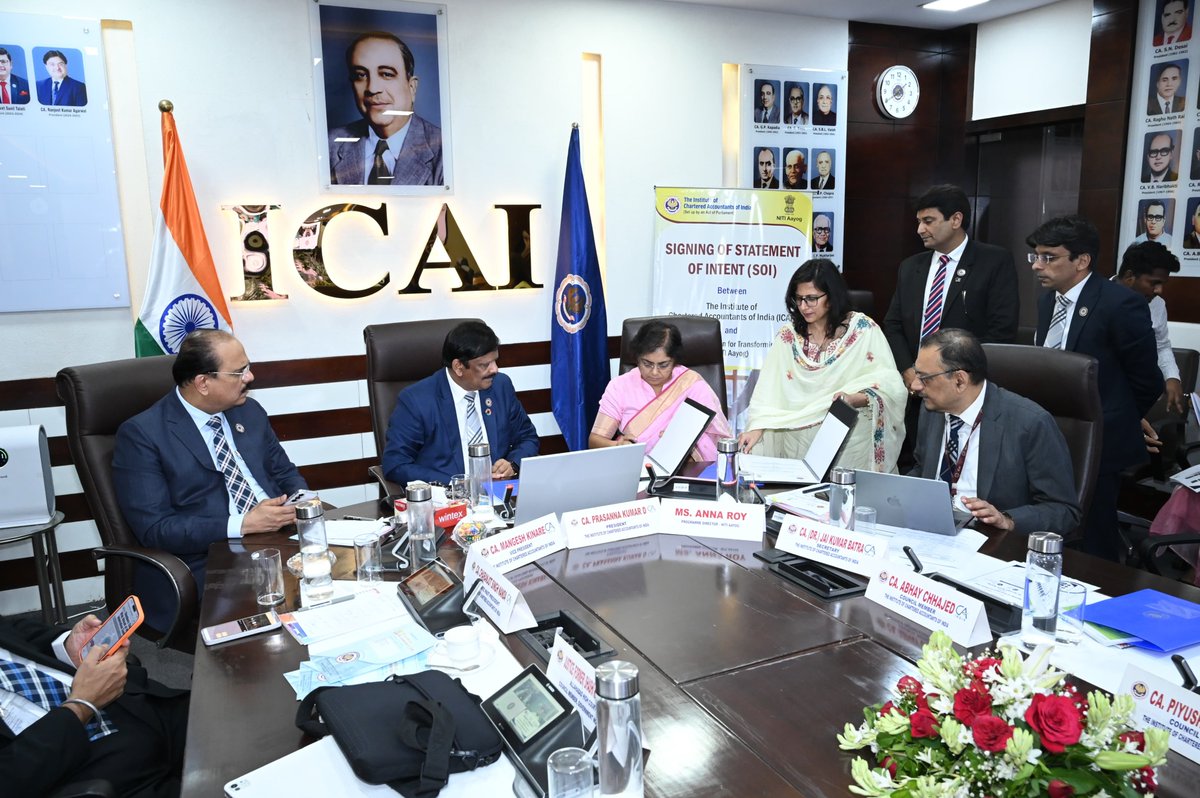
On the occasion of the 78th Chartered Accountants' Day on 1 July 2026, a significant milestone was marked with the signing of a Statement of Intent (SoI) between NITI Aayog and the Institute of Chartered Accountants of India (ICAI), reaffirming their continued collaboration under the Women Entrepreneurship Platform (WEP).
The occasion underscored the shared commitment of both institutions to fostering a vibrant entrepreneurial ecosystem and driving inclusive, sustainable economic growth.
The Statement of Intent builds on the strong partnership cultivated over the years and reinforces a common vision of empowering women entrepreneurs through capacity building, financial literacy, governance support, regulatory awareness, and professional mentorship.
#WomenEntrepreneurship #WomenLedDevelopment
@PMOIndia@narendramodi@Rao_InderjitS@MIB_India@PIB_India@DDNewslive@ashoklahiribjp@wep_community
Finally a reel for my CA community, about time 😎!
Happy Chartered Accountants day 🤗
Becoming a CA at 21 meant no time to enjoy my college life but what passion we all had, what memories ! It defined my work ethic, made me a more structured & analytical thinker which has helped me in all aspects of my life. It reminds me of the quote “ the highest reward for a man’s toil is not what he gets for it but also what he becomes by it”
This July 1st is soo special..
For the past few years,on every CA Day
There was one wish that when will I be celebrate this day as a Chartered Accountant.
Today that wish has finally come true☺️
Celebrating CA Day as a Chartered Accountant for first Time ✨
#CA#CADay#ICAI
Greetings on National Chartered Accountants Day to my fellow Chartered Accountants.
Today, we celebrate our profession, which demands commitment, dedication, integrity & excellence. Each one of you continues to play a vital role in strengthening India's financial system, fostering transparency & driving the nation's economic growth.
On this day, let us reaffirm our commitment to upholding the highest standards of professionalism & ethics to contribute to India's growth journey.
Clearing CA Final was great, but getting a top US Investment Bank interview off-campus is where the real game started.
Here is what I did🧵👇
#icai#caresults#castudents
How Rakesh Jhunjhunwala’s CA education helped him reach Rs. 20 Crores net-worth in 1989:
“My education and knowledge of Law helped me in understand the Madhu Dandavate budget.”
“People were saying that V.P. Singh government will levy tax on private education. Now, education is a state subject. You’ll have to amend the constitution.”
“So government wouldn’t do this only for Rs. 30 crore additional revenue. I knew although V.P. Singh was a rajput, he wouldn’t give a budget which will hurt industry.”
“Everybody was so bearish before budget but it turned out to be a pathbreaking one and Ramesh next day my net-worth was Rs. 20 Crores.”
The Institute of Chartered Accountants of India (ICAI) is assisting Tirumala Tirupati Devasthanams ( TTD) — the trust that manages the iconic Tirupati Balaji Temple — to strengthen its accounting and record-keeping system for donations and contributions received from devotees.
ICAI President Prasanna Kumar D stated that TTD already has a strong accounting and auditing mechanism but approached ICAI to improve it further and take it to the next level.
#ICAI is preparing a model framework for the accounting of donations and contributions received by TTD.
The same framework can also be voluntarily adopted by other religious and charitable bodies if they wish.
#TTD manages the operations and finances of the Tirupati Balaji Temple and other sub-shrines in Andhra Pradesh. It has approved a budget of ₹5,456 crore for the current fiscal year.
@maveinlux Bro how can post this type of bull shit post (uncle) you don't even the law and how to interpret and just bluffing in twitter don't make you matured person
Better register for Sep 26 CA exams and write exams clear and ready to prefix
Don't bullshit here
@maveinlux
The prefix CA is not randomly added .
It is amended through the amendment to section 7 of chartered accountants act 1949.
Started using only after both Rajya and Loksabha passed the amendment bill in 2002
MoU Signed by Professional Institutes: ICAI, ICSI, ICoAI and IIT Madras
A significant milestone towards the launch of the #CorporateMitra Scheme.
The Professional Institutes i.e, ICAI, ICSI & ICoAI along with IIT Madras have joined hands through a collaborative framework supported by the Ministry of Corporate Affairs to build a cadre of Corporate Mitras to support MSMEs in regulatory compliance and business growth.
#CorporateMitra #EaseOfDoingBusiness #MSME #ViksitBharat #DigitalLearning #SkillDevelopment