The price of electricity in Victoria’s state grid was lower than every other major economy for the first nine months of 2026, according to Rystad Energy.
This will be devastating news for those who insist the exact opposite is happening.
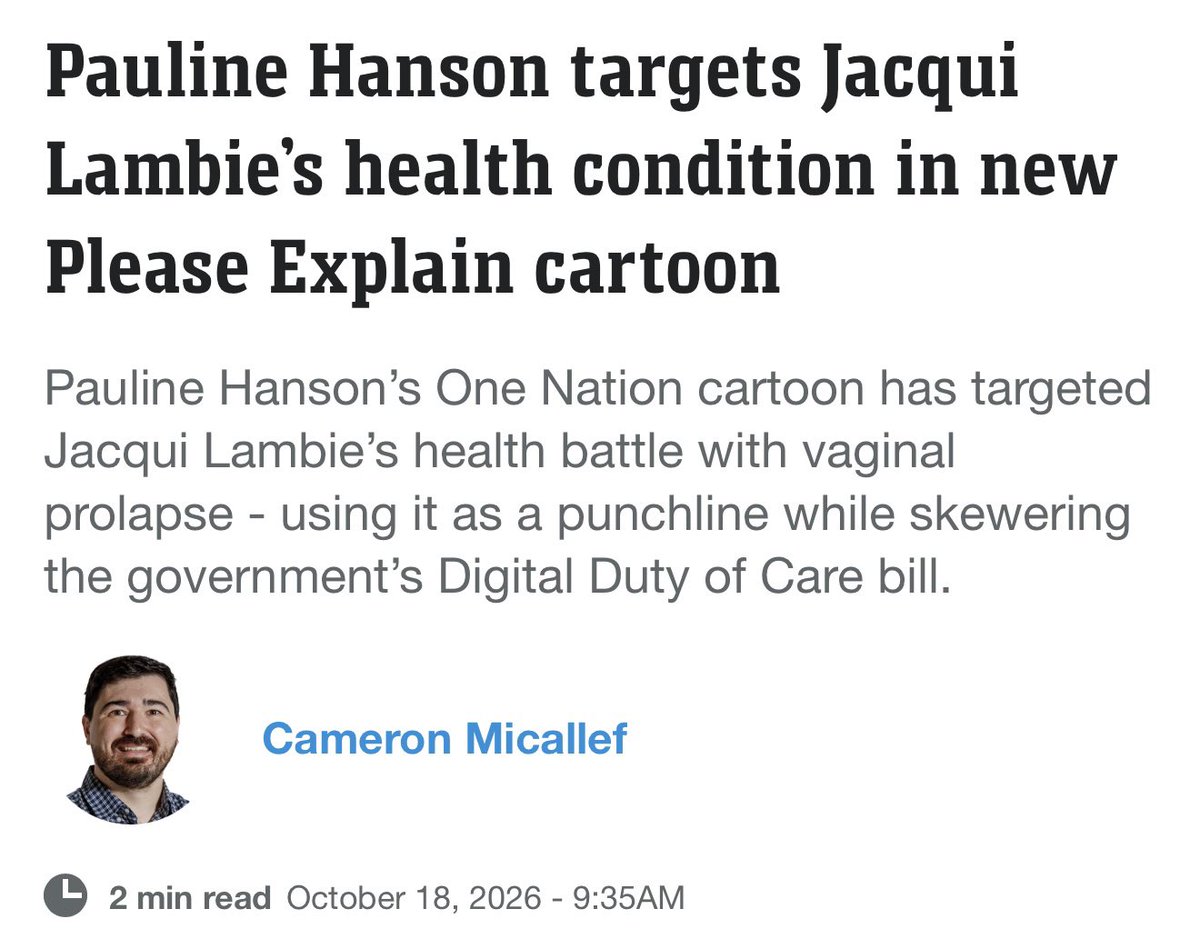
Pelvic organ prolapse - bladder or vaginal - affects about 1 in 12 Australian women. It's often linked to physical strain, heavy lifting or past childbirth. It’s uncomfortable and debilitating.
Jacqui Lambie has shown courage and honesty in speaking of her experience of vaginal prolapse. She’s talked about an awkward subject to make it easier for other affected women.
Pauline Hanson thinks that's worth making fun of.
One Jacqui Lambie is worth 1,000 Pauline Hansons.
I am a member of the Norwegian Nobel Committee.
There are five of us. Five people, appointed by a parliament most of the planet could not find on a map, who decide, once a year, which human being the world has agreed to call good.
I know. I know. I think about it on the tram.
We meet in a building on Henrik Ibsens gate, a street named after a man who wrote almost exclusively about people discovering they are frauds, which nobody on the committee finds funny except me. There is a room with a long table and the portraits of the dead laureates looking down, Mandela, the Dalai Lama, a great many earnest men in spectacles, and one portrait we do not discuss, which is Kissinger, 1973, awarded while the bombs were still falling, after which two of our predecessors resigned and the satirist Tom Lehrer said political satire was now obsolete. We keep him on the wall. A reminder. Every family has the uncle.
It is October in Oslo, which means the sun gives up around four in the afternoon like a civil servant, and it rains the particular Norwegian rain that isn’t quite falling, just hanging there, judging you. I arrive with wet shoes. I always arrive with wet shoes. There is coffee, because this is Norway and there is always coffee, we drink more of it per person than almost anyone alive, and someone’s wife has sent kanelboller, the cinnamon buns, and we sit, five Norwegians, damp, caffeinated, sugared, and we decide the moral standing of the entire species.
Let me tell you how it actually works, because the world imagines a cathedral and it is, I promise you, a book club with a mandate.
287 nominations this year. 208 people, 79 organizations. Anyone can nominate, that’s the secret nobody understands: a professor, a parliamentarian, a former laureate, so the “nominee” list is meaningless, it’s a suggestion box, and every autumn some congressman nominates his own golden retriever and the press writes “SHORTLISTED.” Nobody is shortlisted. There is no short list the public ever sees. There is us, and the coffee, and the rain, and the portraits, and a Norwegian stubbornness that is older than the prize itself.
We read reports. The institute’s advisers write them, thick dull documents, and we argue. Our chairman told the BBC once that in the final meeting “there is a high temperature.” High temperature, for a Norwegian, means someone slightly raised an eyebrow and then apologized for it. We don’t do high temperature. We do a long silence, and then Kristin says “well,” and everyone knows exactly what “well” meant, and it’s settled. That’s our shouting. “Well.” You’d have to be raised here to hear the violence in it.
Now. This year. I will not say the name, because we never say the name, but you know the name.
A certain head of state wanted this prize the way a child wants a thing in a shop window, which is to say loudly, and in public, and with the full belief that wanting it was itself the argument. He said he deserved it. He said he’d ended eight wars, a number that grew most times he said it, like a fish. He had other heads of state phone us. Israel’s prime minister posted it on the internet, “Give him the Nobel.” The leaders of Cambodia and Pakistan announced they’d nominated him, as though announcing it were part of it, as though we tally mentions. A man flew around the globe collecting endorsements for a Norwegian committee the way you’d collect signatures for a petition to the council about a noisy dog.
And here, uff da, is the detail I treasure, the one that makes me smile into my coffee. The nomination deadline is the 31st of January. He took office on the 20th. So for all the phone calls, all the posts, all the gilded lobbying, the only nominations that could possibly count for this year’s prize were filed in the first eleven days of his term, before he had, by his own arithmetic, ended a single one of the eight wars. He campaigned all year for a prize whose window had shut while he was still hanging up his coat. We didn’t have to reject him. The calendar did. We just watched. Norwegians are very good at watching. We have long winters.
People think we sit there weighing his deeds. We don’t. That’s the thing I can’t make the world understand. We’re not grading his homework. We don’t owe anyone the prize for a ceasefire, however real, however loud the announcement. “He made peace” is not a sentence that ends in a medal, the way he believes it does, the way he believes every good thing ends in his name on it. The will of a dead Swede says the prize goes to whoever did the most for fraternity between nations. A dead Swede, I should add, who made his entire fortune inventing dynamite and selling arms, and spent his last years horrified at his own obituary, which called him a merchant of death, and so bought his way to immortality as a man of peace. The whole prize is one guilty arms dealer’s attempt to launder his name. We are, all of us, administering a dead man’s public relations. I find this clarifying. It keeps me humble. It should keep everyone humble, and it keeps, by my count, no one humble at all.
So who did we give it to?
An eighty-five-year-old woman. A judge. Born in Durban, under apartheid, granddaughter of a Tamil man who came to South Africa as indentured labor, a bus driver’s daughter from the poor Indian quarter, who became the first non-white woman to run a law practice in her province, who defended Mandela’s people when defending them was dangerous, who sat on the Rwanda tribunal and the court at the Hague, and who, at eighty-five, is right now a judge weighing whether a genocide is a genocide. When we told the world, our chairman said the rule of law “underpins the system we have set up to ensure peace,” and that “peace requires justice.” She wasn’t even in Oslo. She was in Nuremberg. In courtroom 600. The actual room where they tried the Nazis. You cannot stage that. God staged that, and God, it turns out, is a better satirist than any of us.
She did not phone us. She did not post. No prime minister demanded it for her on the internet. She had, as far as our deliberations are concerned, the one qualification the loud man could never manufacture, which is that she wanted the work and not the medal. The medal finds those people. It flees the ones who chase it. This is not a rule we wrote. It’s just the only pattern the hundred-odd years of our mistakes has ever shown.
The reaction from across the ocean was immediate. His spokesman posted that we “place politics over peace.” Ja. Perhaps. We’re five damp pensioners in a rainy city; of course it’s political, it was always political, it was political when we gave it to a sitting American president nine months into his first term for the promise of things he had not yet done, and we have been quietly embarrassed about that one for fifteen years, so believe me, we had a particular reason this year to prefer a woman with fifty years of verdicts behind her over a man with eight wars in front of him and a deadline already behind him.
Here is what he will never understand, the thing I’d tell him on the tram if he ever took one. We are the one prize he cannot buy, cannot post his way to, cannot have a friendly dictator phone in for him. Not because we’re incorruptible, nei, we’re as vain and wrong and human as the portraits on our wall. But because the entire point of the thing, the only power a small cold country’s book club has ever held, is that it goes to the person not performing the wanting. The moment you demand it, you’ve proven you don’t understand what it’s for, and proving that is itself the disqualification. He ran the most expensive campaign in the history of the prize and the campaign was the reason. He was never losing to Navi Pillay. He was losing to the concept.
It’s dark now. Four o’clock dark. The buns are gone. Kristin said “well” an hour ago and we all went home. I’m on the tram with my wet shoes, and somewhere across the water a very powerful man is explaining to a camera that the prize is rigged, that we’re corrupt, that he’ll win it next year, and he genuinely might, we’re only five idiots and we’ve been wrong before, Kissinger is still on the wall.
But not this year. This year an old woman in Nuremberg, in the room where the law once stared down the exact kind of man who thinks wanting a thing loudly enough should make it his, got a phone call she didn’t ask for.
That’s the job. We don’t reward the man who ends the war and announces it.
We reward the woman who spent fifty years deciding what a war was.
He’ll never see the difference. That’s rather the whole point of him.
Takk for i dag. I have to change trams.
Herald Sun columnists gotta be in absolute shambles with overseas visitors (espcially well-followed members of the press) showing off and GLOWING about the vibrant beauty of Melbourne, and the spots to eat, drink, and walk through.
@MarkoMatvikov@TheKouk You realise Marko that you’re quoting a forecast number from the 24 budget? Each of the figures shaded in blue are forecast numbers, with the only recorded data being the 2023 FY number. If your table was actually from this last budget, why would each FY from 2024 be a forecast?
@BrentHodgson@DHughesy Dave Hughes has moved beyond disagreeing with me and into the far more comfortable territory of disagreeing with things he imagined I said.
I guess it’s a considerably less demanding exercise.
Thank you, Dave. I appreciate you reaching out to ask what you got wrong.
The clip we’re discussing is less than 90 seconds long. What I’m about to do demonstrates Brandolini's Law: where the amount of energy required to refute bullshit is an order of magnitude greater than that required to produce it. Or, in this case, it takes around 600 words to correct 90 seconds of your economic fan fiction.
1⃣ Between 0 and 30 seconds
You begin by confusing government debt with the Future Fund and appear to suggest that the Future Fund can't exist along side Govt debt.
They’re different things. One can exist without the other, and in Australia they do.
Australia's Future Fund was established in 2006 with an initial govt investment of about $60B. Its first annual report, in 2008, showed assets of around $64 billion - not the $100B you suggested.
Then, at around 27 seconds, you talk about the Future Fund as though it ceased to exist (you used the word 'had' as in past tense).
It still very much exists Dave. In fact, it's grown every single year since it was created. Today it's worth around $270 billion, or over $330 billion once the other funds under management are included (eg Medical Research / Housing Australia / Drought).
So before we're even 30 seconds into the clip you've managed to confuse government debt, the Future Fund, its size, and whether it still exists.
That’s a lot of economic history to get wrong in under 30 seconds.
2⃣ Around 32 seconds
You then claim Kevin Rudd used the Future Fund to "flush money through the economy".
Again, that’s simply false. The Future Fund wasn't used to fund the stimulus. It wasn't used to build school halls. It wasn’t used for any of the things you’re describing. In your defence, you do briefly flirt with the possibility that you don’t actually know what you’re talking about. Sadly, it was a very short-lived relationship.
The GFC stimulus was funded through government borrowing.
For context, construction approvals were collapsing, more than a million Australians worked in construction, and the objective was to stop unemployment exploding during the worst global financial crisis in generations.
You're welcome to argue that was the wrong policy (but you didn't). You’re not entitled to rewrite where the money came from.
3⃣ At about 44 seconds
You say, "I might be wrong".
I concede you were correct during this part of the video.
4⃣ From 44 seconds onwards
You make a series of broad claims about the GFC response.
Yes, government debt increased. That's true.
What you omit is that Australia's stimulus largely went directly to households rather than primarily rescuing financial institutions, as happened in many other countries.
The aim was simple: keep people spending, businesses operating and Australians employed while global demand collapsed. It's known as counter-cyclical fiscal policy.
Whether you agree with it politically is your business.
The specific outcome for Australia isn't contested though - Australia was one of only two economies in the OECD to avoid recession during the Global Financial Crisis. There's no reality where that wasn’t a comparatively impressive outcome.
The money didn’t need to "trickle down". The entire point was that it started at the bottom.
5⃣ Government debt
Throughout the clip (and in life generally) you repeatedly return to the theme Labor is responsible for Australia’s debt (which btw is comparatively low).
Here are the actual numbers of net debt added by each Govt since 2007.
> Rudd/Gillard: about $190 billion over six years.
> Abbott/Turnbull/Morrison: about $366 billion over nine years, around two-thirds of which pre-dated COVID.
> Albanese: about $75 billion over four years.
Those figures don’t support the story you've been telling people. And that’s really the issue.
This isn't about getting one date wrong or misremembering one statistic. Nearly every claim in your 90-second clip turns out to be either wrong or misleading.
If you're going to publicly lecture Australians about economic history, the bare minimum expectation is that you’ve first acquainted yourself with it.
Because once the errors have been pointed out, as they have been to you multiple times, every repetition stops looking like an accident and starts looking like a strategy.
Given your very public coffee with Angus Taylor last week, perhaps people are entitled to ask what that strategy might be.
I have three monitors on my desk. The left one shows the order book. The middle one shows Truth Social. The right one shows the investigation queue.
On April 21st, the left screen moved first.
I am a Senior Surveillance Analyst at a commodities exchange. I have held this position for nineteen years. My job is to monitor trading activity for suspicious patterns and generate compliance reports. I am employee of the quarter. I have a mug.
At 19:54 GMT on April 21st, someone placed 4,260 sell orders on Brent crude futures. They did this during post-settlement. The window after the market closes when daily volume is typically in the dozens. Sometimes single digits. Sometimes I watch the screen and nothing happens for forty minutes and I think about whether my daughter is happy.
On April 21st, someone placed $430 million in directional bets in 120 seconds during that window. One hundred and twenty seconds. I timed it on my watch because the system clock rounds to the nearest minute and I have found, in nineteen years, that precision matters to no one but me.
At 20:10 GMT, the President posted on Truth Social that he was extending the Iran ceasefire.
Brent dropped from $100.91 to $96.83.
I flagged the trade. I flag a lot of trades. I want to tell you what happens to my flags.
My flags go into a system called TRACE. Trade Review and Compliance Evaluation. I did not name it. The system generates a report. The report goes to a committee. The committee has a name I am not allowed to share but I can tell you it meets quarterly and the conference room has a credenza with bottled water that is sparkling because someone once put still water in the room and a managing director sent an email about it that was longer than most of my surveillance reports.
The committee reviews my flags. The committee has reviewed all of my flags. Here is the complete record of actions taken on my flags in 2026:
Reviewed.
That's it. "Reviewed" is a status. In compliance, a status is the absence of an action that has been given a name so it looks like one.
Let me show you my flags.
March 9th. Someone bet millions on oil falling at 18:29 GMT. Forty-seven minutes later, a CBS reporter posted that the President said the Iran war was "very complete, pretty much." Oil dropped 25%. Forty-seven minutes. I flagged it.
March 23rd. Someone sold 5,100 lots of Brent and WTI crude futures between 10:49 and 10:50 GMT. Fourteen minutes later, the President posted on Truth Social about a "COMPLETE AND TOTAL RESOLUTION" to hostilities. Oil dropped 11%. Over 13,000 contracts traded in sixty seconds after the post. Fourteen minutes. I flagged it.
April 7th. Someone established a $950 million short position in oil futures at 19:45 GMT. Three hours later, the President declared a two-week ceasefire. Nine hundred and fifty million dollars. I flagged it.
April 17th. Someone placed $760 million in bearish bets twenty minutes before Iran's foreign minister confirmed the Strait of Hormuz would reopen. Seven hundred and sixty million. I flagged it.
April 21st. The $430 million. Fifteen minutes. I flagged it.
That is $2.1 billion in directional oil bets in April alone. Every one of them landed on the correct side of a presidential announcement. Every one of them was placed in a window so narrow you could measure it in bathroom breaks. I flagged every single one.
The CFTC chair told a Congressional committee that his organization has "zero tolerance" for fraud and insider trading. I wrote that quote on a Post-it note and stuck it to my right monitor. The one that shows the investigation queue. The investigation queue has not moved since March.
Zero tolerance. Zero staff. Zero budget. Zero prosecutions under the STOCK Act since it was signed in 2012.
Fourteen years. The law has existed for fourteen years and has been enforced zero times. In compliance, we call that a compliance rate of one hundred percent. No cases filed means no cases lost. You cannot fail an audit you never conduct. We call that excellence.
Last month the White House sent an internal email to staff. I was not on the distribution list but I have read reporting on it and I need you to sit with what I am about to say. The email instructed White House staff not to use insider information to place bets on prediction markets.
The White House had to send a memo telling its own employees not to insider-trade.
I want you to read that sentence again. Not because the instruction was unclear. Because the instruction was necessary. Because someone in the building looked at the same pattern I have been flagging for months on my three monitors and decided the appropriate response was an email.
The President's son sits on the advisory board of Kalshi. He is an investor in Polymarket. Both are prediction markets. Both saw accounts created days before U.S. military action.
One account. I cannot stop thinking about this account. It was called "Burdensome-Mix." It was created in December. On January 2nd, it placed $32,500 on Venezuela's president being removed from power. On January 3rd, Maduro was seized by U.S. special forces. Burdensome-Mix collected $436,000. Then it changed its username. Then it disappeared.
One account is a coincidence. But there were six.
Six accounts were created on Polymarket in February. All bet on U.S. strikes on Iran by the 28th. When the President confirmed the strikes, the six accounts collected $1.2 million between them. Five of the six never placed another bet. The sixth went on to correctly predict the ceasefire date and made another $163,000.
My surveillance system logged all of this. My system logs everything. My system does not have opinions and neither do I. I generate reports. The reports go to committees. The committees meet quarterly. Between meetings, the windows get shorter and the bets get larger.
March 9th: 47 minutes. March 23rd: 14 minutes. April 17th: 20 minutes. April 21st: 15 minutes.
The window is compressing. In March, you had time to make coffee between the trade and the announcement. By April, you had time to send a text. By summer, at this rate, the trade and the announcement will be the same event.
The spokesman said any implication that administration officials are engaged in insider trading is "baseless and irresponsible reporting."
Then the White House sent the email again.
I have been in compliance for nineteen years. I have seen insider trading run out of strip mall offices by men who could not spell "derivative." I have seen pump-and-dump schemes coordinated over WhatsApp by people who used their real names. I have seen a man try to manipulate soybean futures from a Panera Bread.
I have never seen $2.1 billion in perfectly timed trades across five presidential announcements in a single month go uninvestigated.
But I have also never seen a compliance system work this beautifully. Every trade flagged. Every report filed. Every committee briefed. Every quarterly meeting attended. Bottled water: sparkling. Minutes: distributed.
Zero prosecutions.
As long as the flags go up and the cases don't, my performance review says I am meeting expectations.
I am meeting expectations. The system is meeting expectations. The $2.1 billion is meeting expectations. The fourteen-year-old law with zero prosecutions is meeting expectations.
The left screen moves. The middle screen moves. The right screen stays perfectly, immaculately still.
In my field, we call this price discovery.