1) Here I argue: At this critical time when nuclear-armed adversaries expand their arsenals with impunity, pressuring democratic U.S. allies for merely debating security options to support Washington reveals the logical weakness and irony of the nonproliferation orthodoxy.
@VictorDCha wrote: Future G7 hosts should seriously consider an expanded “G9” to increase the effectiveness of the group on global issues. Specifically, two countries—Australia and South Korea—are strong candidates for inclusion in a G9 configuration.
https://t.co/9ZOwKcn6YA
@VictorDCha wrote that Australia and South Korea are strong candidates to be included in the expanded G7 (called “G9” in the report) as South Korea and Australia showed good performance on global governance issues alongside G7 countries. I agree with him.
https://t.co/9ZOwKcn6YA
So Should should not build nuclear submarines like a sitting duck and wait for the God’s almighty to aid South Korea again when a crisis comes? This will only benefit North Korea and China, while the US increasingly needs key allies’ active support (mainly from Seoul and Tokyo).
The United States may be on the verge of an unprecedented step: procuring major naval vessels from allied shipbuilders in Japan and South Korea to help address growing capacity constraints in the U.S. naval industrial base 🇺🇸 🇯🇵 🇰🇷
By @TakahashiKosuke
https://t.co/ZewRy7jQEo
Why do nuclear dominoes not fall? The common wisdom holds that each new proliferator goads its rivals into following suit, but they rarely do. @the_nuclearyogi and I argue that this gap between expectation and reality cannot be explained by the cost of nuclear pursuit alone. 1/6
Stop the contradiction. What do you say about advancing PRC/NK nukes that pose threats to non-nuclear allies (such as South Korea & Japan) that are requested to support the US vis-à-vis China. Pointless nonproliferation. Stop failing key allies and the US.
https://t.co/olqpQ1wC25
In this paper, I and Dr. Kim argued domestic debates questioning the utility of K-SSNs continue to shape public opinion and constrain policy implementation. We analyzed the major critiques of SSN program and evaluated their limitations, then proposed strategic roles of K-SSN.
I’m pleased to publish a co-authored paper to the Korean think-tank Sejong Institute’s journal: “Debating South Korea’s SSNs: Strategic Utility and Roles in National Security”, which I worked with Dr. Jeeyong Kim at ROK Naval Academy.
Full text: https://t.co/1X8luWipLD
📌「대한민국 핵추진잠수함 개발 기본계획」 발표
국방부는 5월 26일(화)에 「대한민국 핵추진잠수함 개발 기본계획」을 발표했습니다.
「대한민국 핵추진잠수함 개발 기본계획」은 대한민국이 핵추진잠수함을 체계적으로 개발하기 위한 추진 방향을 국내·외에 최초로 제시하는 문서로서 주요 내용은 다음과 같습니다.
ⓛ 핵추진잠수함은 장기간 잠항 능력과 높은 기동성 등 기존 디젤잠수함에 비해 비약적으로 향상된 작전 능력을 보유하고 있어, 북한의 잠수함 기반 핵·미사일 위협 등에 대응하는 핵심적인 역할을 하게 될 것입니다.
② 핵추진잠수함 개발은 단순한 함정 건조사업을 넘어, 우리나라 원자력, 조선 분야의 기술을 토대로 국가적 역량을 결집해야 하는 국가전략 사업으로, 원칙을 준수하며 체계적이고 단계적으로 개발할 것입니다.
③ 대한민국은 국제 사회의 신뢰를 바탕으로 핵비확산 의무를 투명하고 확고하게 이행해 나갈 것입니다.
④ 대한민국은 핵추진잠수함 사업 추진 간 원자력 안전과 보안을 확고히 견지해 나갈 것이며, 핵추진잠수함에서 발생하는 모든 방사성 폐기물을 관련 법령과 규정에 따라 안전하고 체계적으로 관리해 나갈 것입니다.
⑤ 핵추진잠수함 개발은 조선, 원자력, 방산을 잇는 40여 년 (건조 10년+운용 30년 이상)에 걸친 국가 산업 발전 프로젝트로서 산업계 발전에 기여하도록 하겠습니다. (4만 개 이상의 안정적이고 질높은 일자리를 창출 예상)
⑥ 앞으로 정부는 핵추진잠수함 사업을 「장보고 N사업」으로 명명하고, 이를 국가 차원의 핵심 전력 획득 사업으로 추진할 예정입니다. 이는 대한민국 최초의 잠수함인 장보고함의 정신을 계승한 차세대 모델(Next generation)이며, 핵추진(Nuclear powered) 방식을 적용하고, 첨단 신기술(Neo technology)을 집약한 잠수함을 구축하겠다는 의미를 담고 있습니다.
향후 국방부는 핵추진잠수함 사업이 대한민국 해양 안보의 새로운 지평을 여는 역사적 이정표로 자리매김할 수 있도록 대한민국의 모든 국가 역량을 결집하여 추진해 나가겠습니다.
South Korea’s next nuclear powered submarine program is taking shape.
The next generation submarine program has been named Jang Bogo N. Unlike South Korea’s existing diesel powered submarines, it is planned as a nuclear powered submarine using low enriched uranium below 20% enrichment for propulsion.
Under the current government plan, the submarine will be developed and built in South Korea. The first vessel is targeted for launch in the mid 2030s, with operational deployment expected from the late 2030s onward.
That's funny. The basic design for the 8,000~9,000-ton South Korean KSS-N nuclear-powered submarine has already been nearly complete by Hanwha Ocean reportedly. Hanwha said they will begin incorporating detailed requirements and calculating costs starting this year. Construction will commence almost immediately after the next phase, the detailed design.
Please let Hyundai Heavy Industries participate as well later.
●It is said that the basic design has been carried out from 2022 until now.
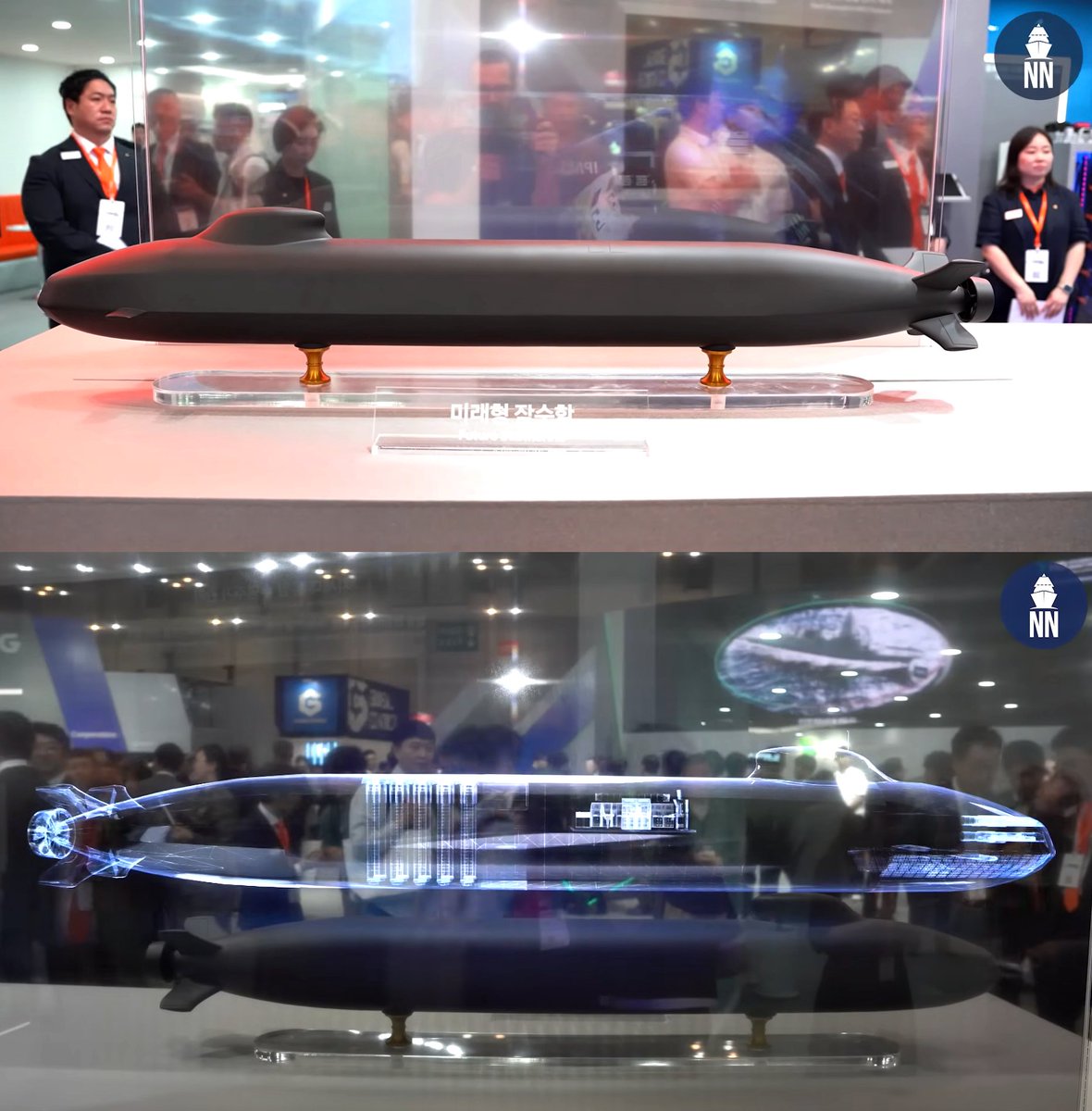
It's official. The KSS-N nuclear-powered submarine has been confirmed to be an 8,000-ton class. Its full load displacement (submerged) is estimated to be around 9,000 tons, which is similar to the U.S. Seawolf-class and Virginia-class. As such, the shape and proportions are expected to be similar to the model unveiled at MADEX.
The South Korean Navy uniquely uses light displacement standards, and since SSBNs carry heavy armament, the actual size of the KSS-N is expected to be considerable.
Nevertheless, the KSS-N is not for nuclear retaliation(second strike), so it is smaller than the Ohio-class, Borei-class, Vanguard-class, and Triomphant-class.
What is more interesting is the next-generation SLBM.
As they have always done, they have armed this large missile with an "extraordinary" warhead. (36 tons of Hyunmoo-V Ultra-High-Power variant ballistic missile is a good example) According to ADD's data, its size, the new SLBM appears to be smaller than the US Trident and Russian Bulava SLBMs for more capacity. While it depends on the range and warhead type, its range is likely to be around that of an MRBM-IRBM, and the warhead weight is estimated to be around 1-2 tons.
As for the torpedo room, more missiles, torpedoes, and mobile sea mines will be stocked, and it appears that the missiles to be operated are the HS-III long-range cruise missile, the HS-V supersonic cruise missile, and the HS-VI (?) hypersonic cruise missile.
The Korean Strategic Command and the Missile Strategic Command have more jobs to do.
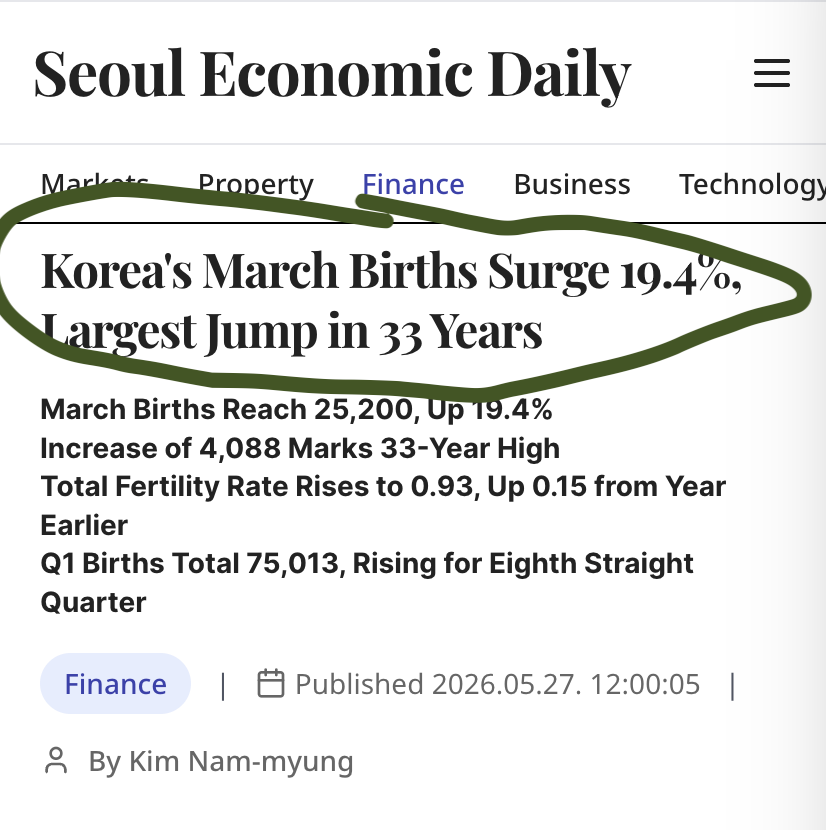
Bad news for the "Korea is a hypercapitalist dystopia that's not going to exist in 80 years" crowd.
A temporary dip as a newly-rich society decides to have babies later.
The KSS-N's nuclear reactor is based on Korea's SMR (Small Modular Reactor) models and was developed in parallel with private sector investment and R&D in SMR. Interestingly, the gov and companies plan to apply SMRs to various commercial and specialized ships, targeting the 2030s when the private market for sea-based SMRs is expected to expand significantly.
As plans to install SMRs in massive AI data centers are being pursued globally, we can count on the government, and relevant ministries will further strengthen cooperation regarding Korea's nuclear engineering capabilities.
Thanks to the KSS-N program, this positive industrial "cycle" is expected to be further activated.
According to the Minister of National Defense, the ground and underwater testing procedures for the SMR reactor for the KSS-N have been roughly completed. (According to the statement that it is being developed to enable long-cycle operation by using low-enriched uranium and minimizing fuel replacement, the reactor dedicated to the KSS-N seems to be quite advanced)
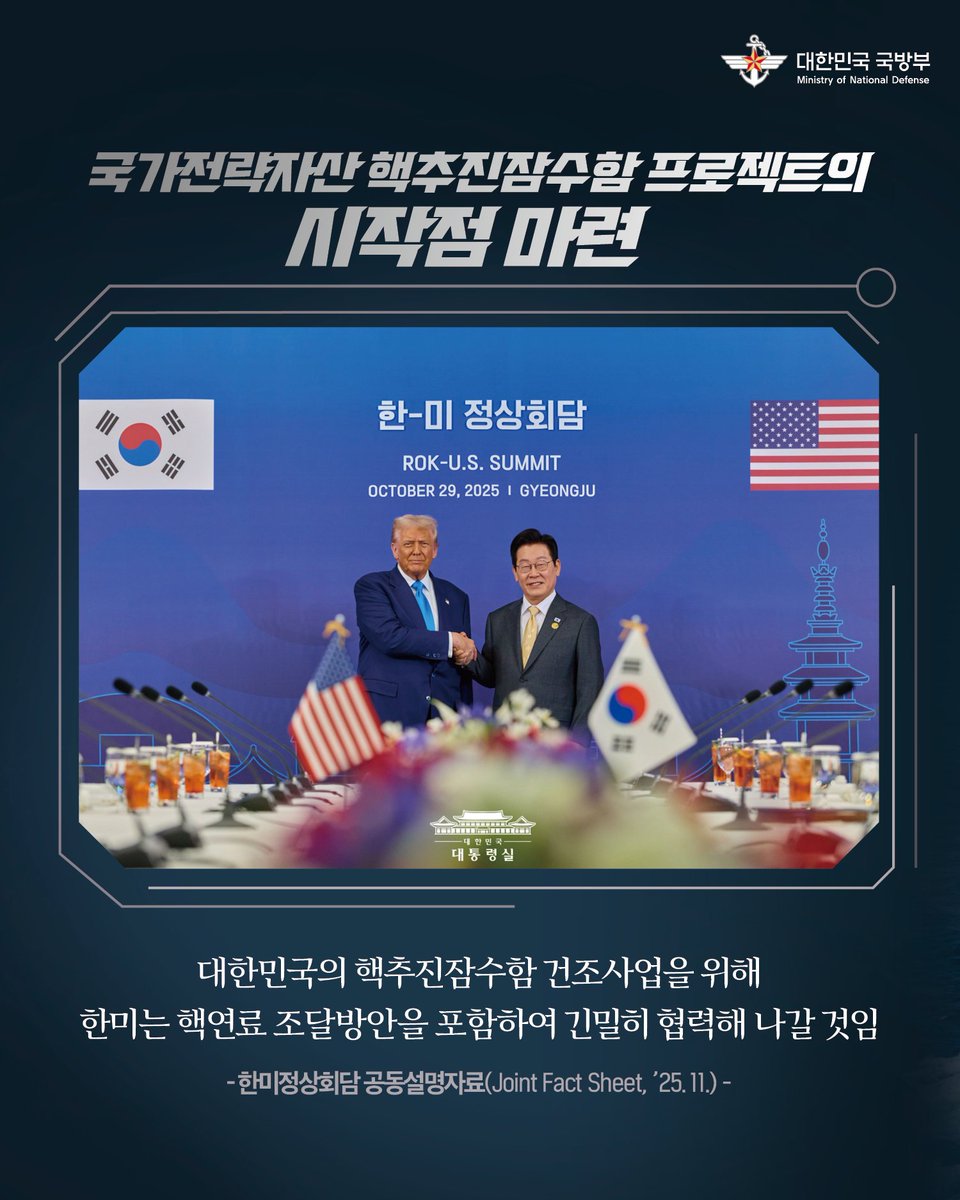
Meanwhile, the South Korean Ministry of National Defense confirmed on this day that all technology, laws, construction, and industrial cooperation will be conducted entirely in Korea, as they had previously reaffirmed this last year due to Trump’s nonsense on "Truth Social."
On October 30, 2025, Trump posted on social media that the KSS-N would be constructed in Philadelphia, USA, which led to the spread of false information that it would be manufactured using American technology.
Of course, this was a misunderstanding on Trump's part, and on November 14, the Korean National Security Office and the US side reconfirmed through a bilateral fact sheet that the original plan was to construct it rapidly in Korea using Korean technology.
It seems he was confused because, at that time, South Korea was unveiling a large-scale of the "MASGA" direct investment project for the United States and USN.
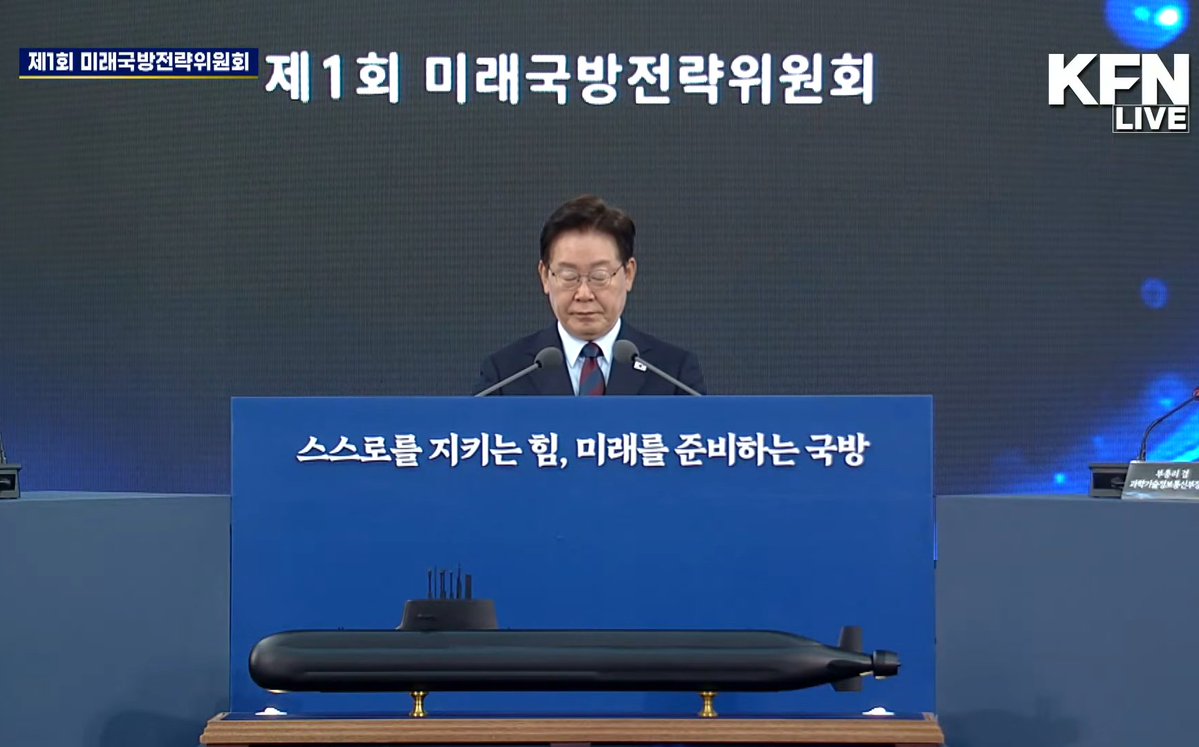
Breaking News! South Korea has announced the KSS-N, a nuclear-powered submarine program. The first KSS-N will be launched by the mid-2030s. The enactment of a special act for rapid acquisition is currently underway. Hardware details such as size, weight, armament, and number of units have been communicated by the Navy to higher commands. These details will be announced gradually.
The plastic model visible to the public is intended to aid understanding and may differ somewhat from the final result.
Currently, the estimated full load displacement of 7,000~9,000? tons, a next-generation large submarine-launched ballistic missile following the HM-4-4 SLBM, other special missiles/torpedoes, a high-efficiency reactor, next-gen sensors, and further enhanced stealth features have been almost confirmed through government projects, seminars, exhibitions, and official announcements.
For such national programs, the commitment of the military and government and a systematic schedule are of the utmost importance, followed by technology, budget allocation, and corporate production capability.
Most of these requirements appear to be met, so let's look forward to it.
Well, since they have been preparing for this for a long time, this isn't "Breaking News," like i said.
While Hanwha Ocean is leading the submarine construction, Hyundai Heavy Industries may also take on a portion of the orders.
Since this is a large-scale/strategic platform project on a different level from major programs, it is likely that certain technical and production aspects will proceed quietly with the details remaining undisclosed. Just like the case of the development and production status of various kinds of their hypersonic missiles and Hyunmoo-series strategic missiles.
Anyway, that would be faster than Australia acquiring a nuclear submarine, right...?
I am looking forward to the super-large UUV(MRXUUV, XLUUV), KSS-III Batch-II, and the medium-sized KSS-IV that will replace KSS-I, II more than the KSS-N.