“On this Labor Day in 2023, we have achieved a remarkable feat — transforming the lowest paid ferry jobs in the nation into the highest paid.” https://t.co/0F5Rc39y9M
The erosion of the Jones Act didn't begin with the current waiver.
It began decades ago through administrative letter rulings that has quietly reshaped America's offshore maritime industry.
In this op-ed for the Washington Examiner (@dcexaminer), OMSA President & CEO Aaron Smith explains how these decisions deter domestic investment and weaken U.S. maritime capabilities. While U.S. citizens see no economic relief and U.S. mariners lose work, the only ones left to benefit are foreign competitors sourcing underpaid foreign operated vessels.
It's time to protect American jobs, strengthen our maritime industry and restore confidence in the Jones Act.
Read the full piece: https://t.co/OrZftaJ9cN
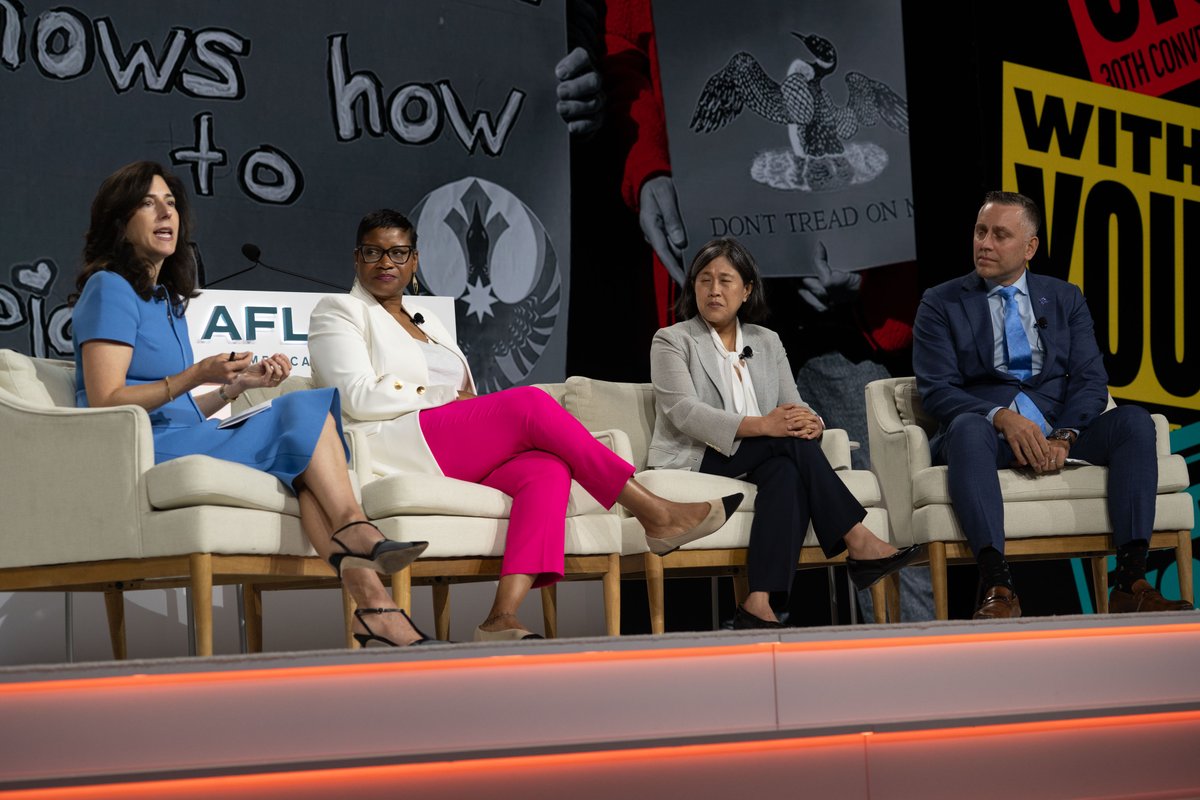
M.E.B.A. Secretary-Treasurer Roland Rexha joined USW International President Roxanne Brown & former U.S. Trade Representative Ambassador Katherine Tai at the AFL-CIO Convention last week for a panel on fair trade & good jobs in shipbuilding & maritime.
https://t.co/RMlpMgiZxo
ICYMI: At the 30th @AFLCIO Convention, @Steelworkers President Roxanne Brown & @MEBAUNION Secretary-Treasurer Roland Rexha spoke on strengthening the U.S. supply chain and bolstering our economic self-reliance through shipbuilding.
Watch here: https://t.co/nVjYM1UrWI
The 2026 @AFLCIO Convention was a powerful display of the strength of working people & solidarity powering our labor movement.
Several @TTDAFLCIO affiliated unions represented transportation labor with creative, educational, & interactive Exhibit Hall booths. 💪
. @NYSComptroller Tom DiNapoli kicking off the Transport Workers Union International Executive Council Meeting in Manhattan, thanking TWU officers for fighting for working families, noting his father was a phone company lineman and union Shop Steward. “Any time I can stand with labor at any time, it really is my way of saying thank you” to the labor movement for delivering economic security to families like his. @TwuSamuelsen@CentralLaborNYC
Promises made. Promises broken.
On the campaign trail, @GovernorVA committed to fighting for public workers and ensuring they had a voice on the job. This week, she vetoed legislation that would have done exactly that.
https://t.co/lLokDjvcqo
When the Democratic Governor of NYS hires an anti-worker hitman lawyer to represent her in contract bargaining , one cannot expect progress . @GovKathyHochul dramatically increased the potential of of this @LIRR strike by hiring Gary Dellaverson, and it’s no coincidence that he is man who triggered the @TWULocal100 2005 NYC Transit Strike . Anti-Worker Governors Hire Anti-Worker Lawyers. @LIFEDofLABOR@transportworker@NYSAFLCIO@CentralLaborNYC
Absolutely hysterical that @LIRR is posting ALERTS about work related service disruptions when the whole railroad is going to be totally shutdown by workers’ strike action. A STRIKE is almost definitely forthcoming and the blame lies solely with @GovKathyHochul and Multi-Million Dollar hatchet-man lawyer, Gary Dellaverson, who is recklessly sending @LIRR & @MTA off a cliff. @LIFEDofLABOR@NYSAFLCIO@CentralLaborNYC@transportworker
.@GovKathyHochul is solely responsible for this impending strike by @LIRR workers. She has rejected the findings of TWO different panels of esteemed arbitrators , established by the Railway Labor Act, and she’s hired the same cut throat , duplicitous anti-worker outside lawyer who triggered the 2005 NYC Transit strike ( Gary Dellaverson) . She herself is triggering this STRIKE. @NYSAFLCIO@NYCCLines@transportworker
Heavy lifts. Tight tolerances. High pressure. M.E.B.A. members do the work most people never see — and do it right. #MEBA#MarineEngineering#UnionStrong
M.E.B.A. Gulf Coast VP Adam Smith in The Dallas Express on the Jones Act waiver: "If Jones Act waivers become normalized, the greatest risk is the damaging signal they send to the U.S. maritime industry." #JonesAct#MEBA https://t.co/FTGWtVu0Na
“The air traffic control tower, the entire time, was saying, ‘We have a real safety problem here,’ and nobody was listening. It was like somebody was asleep at the switch or didn't want to act. It is a bureaucratic nightmare,” says NTSB Chairwoman Jennifer Homendy. https://t.co/Oq5VJhO0tm
@DoyleWilliamP@mercoglianos@cpgrabow@grok In modern shipping, most companies treat their crews about three times better than how they are treated in their home countries.
In modern shipping, US shipping and the Jones Act is laughed at combined with a face palming; big smiles if a wildly overpriced USDA cargo is done.
The problem with this @DominicJPino is you are focusing the blame on the wrong thing. It is not the Jones Act that caused the decline in US shipbuilding since World War Two. Instead, it is the Jones Act that has kept that little vestige that is left.
If you want to be accurate, here are the top 10 reasons that US shipping and shipbuilding have declined:
1️⃣Ships Sales Act of 1946 provides Allied merchant fleets with 1113 surplus ships from the US when we could have used the opportunity to jam our shipyards with orders.
2⃣The US assists Liberia in the creation of a ship registry akin to Panama. The latter was used to avoid Neutrality Laws and ship aid - particularly 100 octane gas - to the UK. Liberia, as one of the few independent states in Africa needed economic support.
3️⃣Marshall Plan of 1949 provides loans to counties to rebuild critical infrastructure, including shipyards. Many of which adopt the pre-fabrication method of the US
4⃣US set up the Military Sea Transportation Service in 1949 (now Military Sealift Command) to handle sealift for the Dept of Defense, thereby reducing its level of dependency on the US merchant marine.
5⃣New cargo handling technologies are introduced, but a few - LASH, SeaBee, Roll-on/Roll-off - are not commercially viable and lead to the demise of some key shipping companies.
6️⃣ Federal-Aid Highway Act of 1956 leads to the creation of the Interstate Highway System. This reduces the need for coastal (cabotage) shipping as cargo shifts to trucks.
7⃣The introduction of DC8 and 707 in 1958 shifted the movement of people from rail and ship to plane. This opened up cargo capacity on the nation's rail system. 8⃣Colonial Pipeline 1962 saw a massive reduction in the number of product tankers needed from the Gulf of Mexico to the US East Coast
9⃣Vietnam War demonstrated the utility of the containership (see The Box) but the failure to invest a new program to sponsor ship construction until the MMA 1970, allowed Europe and Japan - using some of those protectionist methods you oppose - to surpass the US.
🔟The 1980s saw the end of construction differentials under the Merchant Marine Act of 1936. This witnessed the end of ship construction for ships in the international trade as the US Navy wanted to ship construction of their 600-ship Navy exclusively into private yards, but the end of the Cold War saw US yards lose not just commercial, but also military business.
You will note that the Jones Act does not make the list, because it actually preserves the vestiges of US shipbuilding.
I would also note that when the US decided in the 1980s to divest itself of commercial shipbuilding, at the time Europe, Japan and Korea built the overwhelming majority of the world's ships.
In 2024, China builds 51% with expectations that 2025, that number rose to 63%.
Congratulations to PASS members Donald Davis, Brian Dickey & Al Minton for their work running new data cables, fiber optics & installing servers, software for new Georgia Enterprise Center in the interest of air traffic control safety & efficency! #ATCAConnect#PublicService
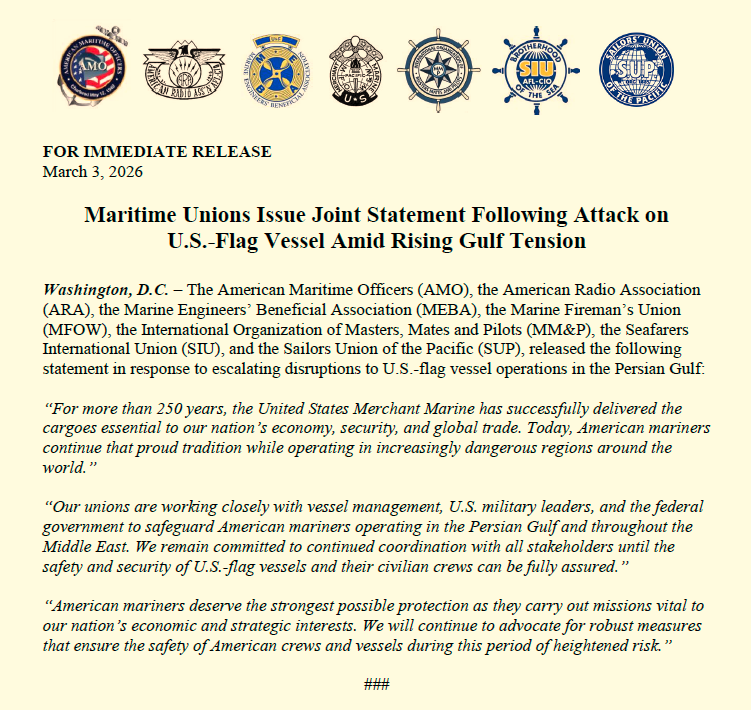
American mariners operating in the Persian Gulf & throughout the Middle East deserve the strongest possible protection as they carry out missions vital to our nation’s economic & strategic interests.
Read the joint statement from U.S. maritime unions:
To all the workers who keep our city safe and moving during extreme weather—we thank you. And to everyone whose job doesn’t allow for a snow day, please stay safe out there.