I think the weakest point here is 1. The first premise I very much agree with — that we are really talking about replacing those “excellent few” — but I don’t think the substance of the author’s point amounts to stroking their ego. I’ll never be as good a basketball player as LeBron, but I can participate in appreciating his greatness at the sport, and likewise I can participate in appreciating by the talent of an artist or what have you. It’s like the social service provided by a cathedral, where the poorest to the richest access something amazing above and beyond them even though it belongs to none of them. 2 is the terrible kicker; we don’t have a fantastic track record of mutual restraint (i.e. our nuclear arsenals have shrunk but no one will ever give them up). 3 is a good example, it reminds me of effective altruist arguments against emotional / spiritually fulfilling projects (like a cathedral) when the same effort could have “merely” eliminated more straightforward material suffering.
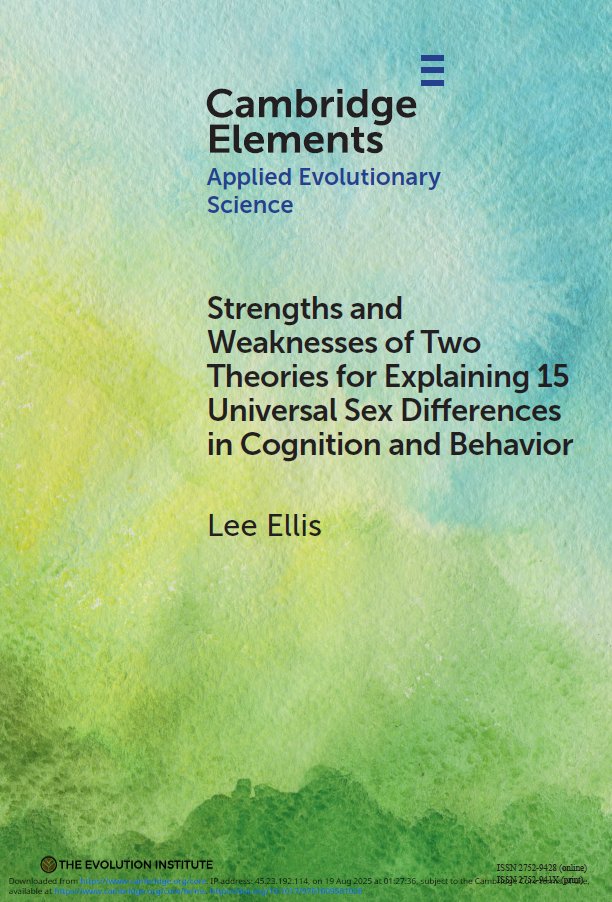
Every comedian knows that men and women are different, and there's a new book reviewing the scientific literature of sex differences that supports that. Sociologist Lee Ellis and his colleagues reviewed 40,000 studies on sex differences in behavior and cognition. They found 15 differences that are almost certainly universal, and showed up as having a consistent sex difference in >95% of 100 or more studies. These sex differences include:
➡Criminal behavior (⬆️ in ♂️)
➡Performing household chores (more frequent for ♀️)
➡Income and occupational prestige ⬆️ for ♂️)
➡Risk-taking (more frequent in ♂️)
The full list of 15 sex differences is in the 2nd through 4th images.
There are two theories that attempt to explain these sex differences: the social role theory and the evolutionary neuroandrogenic theory (ENA). Social role theory posits that most sex differences are due to cultural influences and gender roles, though it does acknowledge that fundamental differences in biology (e.g., men being taller and stronger on average, women being able to give birth) could also create some sex differences. The ENA theory argues that these sex differences are due to evolution selecting for different traits in males and females and hormonal exposure (especially through testosterone).
So, which theory stacks up better? The ENA theory has a plausible explanation for all 15 universal sex differences and at least some empirical evidence for all of them. Social role theory only has evidence regarding four sex differences, and it is completely unable to explain some (e.g., higher male prevalence of ADHD, greater female time investment into household chores).
It's a cool study that is pretty easy to read.
Read it here: https://t.co/VkUrDWJSYz
@PsychRabble The amount of time it will take actual psychology courses to catch up on any of this is indefinite. It isn’t discussed enough (particularly w/ replication crisis) how students taking psychology are made to “learn” material most of which is known to be false / not replicated
@KathleenHanley@RichardHanania The point they are making is the actions are not actually positive because of negative second order effects. Policy shouldn’t just be evaluated on having “nice vibes”.
@ChristianHeiens I think Evola sticks out like a sore thumb. Read him side-by-side with Schmitt and it’s hard to believe these two people could plausible belong to remotely similar tribes.
Cheaper childcare is not associated with higher fertility.
In fact, it is the opposite. Countries like the US and New Zealand, where childcare is very expensive, have much higher fertility than countries like Italy, Korea, and Germany, where childcare is essentially free. 1/2
@bryan_caplan There are an indefinite number of implausible albeit logically consistent explanations for any given phenomenon but I feel like we might have to exhaust them all before it’ll be permissible to just say that black culture is a straightforward cause of negative outcomes
A government-funded tournament put thousands of ordinary people against CIA intelligence analysts in a 4-year contest to predict world events, and the amateurs won so decisively that the CIA had to fundamentally rethink how it forecasts the future.
The professor who ran the tournament is Philip Tetlock.
He teaches at Wharton. Daniel Kahneman called the book he wrote about the result the most important decision-making book since Thinking, Fast and Slow.
The story actually starts 20 years earlier.
Tetlock spent two decades collecting 28,000 predictions from 284 of the world's most famous experts. Professors. Government officials. Journalists. Policy advisors. People with PhDs and TV shows. People who got paid huge sums to predict elections, wars, and economic crises.
When he scored their predictions against what actually happened, the average expert performed at roughly the level of random guessing. The most famous experts, the ones who appeared most often on TV, turned out to be the worst predictors of all. The more confident they sounded, the more wrong they tended to be.
That study became one of the most cited findings in modern psychology. The famous summary line was that experts were no better than monkeys throwing darts.
In 2011, the US intelligence community decided to test this finding directly.
They funded a tournament called the Good Judgment Project. Tens of thousands of ordinary volunteers were recruited to predict global events. Will North Korea launch a missile in the next 6 months. Will the Eurozone admit a new member by year-end. Will a specific dictator still be in power 12 months from now.
The volunteers were put up against the CIA's own intelligence analysts, who had access to classified information the volunteers did not have.
The amateurs won by 30 percent.
The CIA had to absorb the fact that a group of people sitting at home on their laptops, with nothing but a Google search bar and good thinking habits, were outpredicting their own paid professionals on the questions the professionals had spent their entire careers training for.
A small group of these volunteers were dramatically better than even the other amateurs. Tetlock called them superforecasters.
They had nothing in common on paper. One was a Brooklyn filmmaker. One was a retired pipe installer. One was a former ballroom dancer. They were not domain experts. They had no insider access. They were ordinary people with ordinary jobs.
Tetlock spent years figuring out what they did differently. The answer is almost insulting in its simplicity.
They did not think in yes or no. They thought in percentages. They did not say "Russia will invade." They said "there is a 65 percent chance Russia will invade in the next 12 months, and here are the three things I would update on."
They were not loyal to their first answer. The moment new evidence came in, they updated. Most experts treat changing their mind as a sign of weakness. Superforecasters treat refusing to change their mind as the actual weakness.
They knew many small things instead of one big thing. The famous experts almost all believed in one big theory and forced every problem to fit it. The superforecasters used many small theories and switched between them depending on the situation in front of them.
They kept score on themselves. Most experts never go back and check whether their past predictions came true. Superforecasters track everything, especially their mistakes. They study their own failures the way most people refuse to.
They were comfortable saying "I don't know."
The deeper lesson of the book is the one most readers miss the first time through.
The reason experts are bad at predictions is not that they lack intelligence. It is that their identity is tied to being right. Once you have built a career, a brand, or a public following on being the person who knows, you lose the freedom to think clearly. You start defending positions instead of updating them. You start protecting your reputation instead of testing your beliefs.
The ordinary people who became superforecasters had no reputation to protect. Their thinking was free.
The book is 352 pages. It can be summarized in one line.
The people who see the future most clearly are the ones with the least to lose by being wrong.
Which means the question worth asking yourself is this. Where in your own life are you defending an old belief simply because changing your mind would cost you something it would not actually cost you anything to lose?
Working hours tend to fall as incomes rise.
Between 1950 and 2024, the average hours worked per worker in wealthy countries declined from over 2,100 per year to under 1,800.
Another example of the "...His name is..." formula. But this is an important finding, and long a cornerstone of behavioral genetics (while flying over the head of its critics): Many aspects of the environment are heritable. (Yes, you read that right.) Our genes steer us into different environments - people practice and enrich themselves in ways that multiply their innate talents and interests. It's sometimes called "gene-environment interaction," but most of the time that's technically inaccurate: it's "gene-environment correlation."
There's a type of study we should banish from public discussion:
Attribution Studies
These studies purportedly attribute deaths to something without actual death count. For example, one famously said lack of insurance coverage caused 68.5k deaths/yr
It was based on bad methods
How do the personalities of rich people compare to the personalities of everyone else?
They tend to be less risk averse, less neurotic, more open to new experiences, more extraverted, a bit more conscientious, and no more or less agreeable.
Amazing real world demonstration of populist envy and self-destruction. “Our deliberate policy is to transfer the economic control of Uganda into the hands of Ugandans, for the first time in our country's history” — Idi Amin. Lo and behold, plundering the most productive members of society makes everyone’s lives worse.
10 August 1972 : Front page of the Uganda Argus. Ugandan President Idi Amin ordered the expulsion of the country's Asian minority, giving them 90 days to leave. Approximately 80,000 people of Indian, Pakistani, and Bangladeshi descent were forced into exile, abandoning their businesses and properties. The mass exodus created a severe refugee crisis, leading to international condemnation and long-term economic collapse in Uganda. The “Asian” population was source to 90% of Uganda’s tax revenue.
1% of people account for 63% of all violent crimes.
0.2% of people ever commit murder, and **67% of all murders**are committed by people with prior arrests
You can literally just fix crime by not tolerating people who show a history of being destructive to society.
@jayvanbavel “When women earn more money, this preference goes away [therefore it’s cultural]” is a dishonest way to frame the data when “earn more” amounts to the extreme circumstance of 2x income.
This is more a thought than prediction, but the Haidts, Pinkers, and other critics of the current state of academia seem to presume that the reputation of higher education is indeed reparable. Do you think it is a real possibility that we are past a point of no return? Perhaps the political filtering that stuffed positions with ideological zealots means there is no realistic way back. Perhaps people just won’t forget the reputational damage that universities inflicted on themselves.
I must be in some way confused. If the agreement — that they will open the straight of Hormuz — is predicated on Israel withdrawing forces from Lebanon and the U.S. from the Persian Gulf, and these conditions are not being met, how are they “seeing what they can get away with” by closing it? I would love the strait to be open, but why would we expect Iran to be the only actor that has to uphold the memorandum?
The current invasion of southern Lebanon is allegedly an offensive specifically against Hezbollah. Israel’s minister of national security has apparently forgot the script, and is now outwardly calling for massively disproportionate violence against the people of Lebanon.
על כל דמעה של אמא ישראלית, אלף אמהות לבנוניות צריכות לבכות. לבנון כולה צריכה לבעור!
עם כל הכבוד לאמריקאים, ישראל חייבת להבהיר לעולם כולו שדם בנינו וביטחון אזרחנו איננו הפקר. לבנון כולה צריכה לבעור. חובתנו העליונה היא להגן על אזרחי ישראל ועל חיילי צה״ל, והמחויבות הזו קודמת לכל שיקול אחר.
אמרתי לראש הממשלה, גם בישיבות בינינו: על כל דמעה של אמא ישראלית, אלף אימהות לבנוניות צריכות לבכות.
מספיק עם הפינג־פונג. במזרח התיכון לא מנצחים בתגובות מדודות ובהכלה - צריך להשתגע. למחוק. להכריע את הטרור.